The mystery of imposed pain: where was God in Auschwitz?
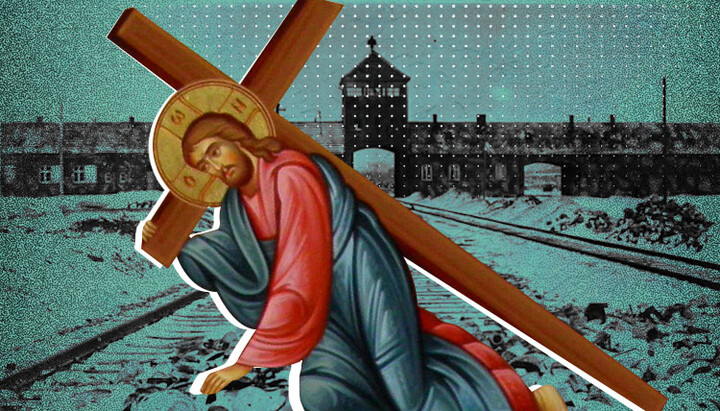
A suffering person carries their cross together with Christ. Photo: UOJ
In the previous reflection on the Cross of the Lord, we spoke of the divine pedagogy of love – of how the Cross of Christ and the cross of our own lives become the place of encounter. But such a vision presupposes conscious faith and freely given consent. What, then, of those who never consented or possessed such faith? Of children born into incurable suffering, of voiceless creatures enduring the same blind pain? What meaning can the Cross have for them?
We are one body
The tragedy of the human condition is that we are bound to one another. If each person lived sealed within a private sphere, the sin or folly of one would never wound another. But neither would love exist – for love is nothing less than radical interdependence. My freedom to do evil inevitably infringes upon another’s freedom not to suffer. Were God to intervene at every moment, neutralizing every act of violence, He would reduce the world to a theater of puppets, where no will is truly free.
Humanity is one living organism. When a single cell turns malignant, the entire body suffers. At the level of the cell, this seems unjust. At the level of the organism, it is simply the truth of our condition.
God has granted the world not only freedom of will – to human beings – but freedom of being – to creation itself.
The laws of nature unfold according to their own integrity. Cells divide, viruses mutate, continents drift. If God were to correct every collision, soften every fall, intercept every consequence, the world would cease to exist as something distinct from Him. It would dissolve into a projection, a mere extension of the divine will. Pain belongs to a world that has slipped out of harmony – a world fragile, wounded, and mortal at its core.
God beside the victim
And here lies the heart of the mystery. In the Christian vision, God does not stand behind the executioner, sanctioning the lesson. He is not the architect of suffering. He is found on the ground beside the victim.
The Book of Job lays this bare. Job rejects the tidy explanations of his friends – their moral arithmetic, their insistence that suffering must be deserved. He protests, he cries out, he refuses to accept a system that justifies pain. And in the end, God vindicates Job – not the defenders of abstract justice.
More radically still: the Father does not spare His own Son from imposed suffering. In Gethsemane, Christ trembles: “Let this cup pass from Me.” He does not desire death. His sacrifice is freely embraced, yet it is not devoid of anguish. God does not explain suffering. He enters it. He becomes the One to whom it is done.
God crosses into the category of the victim – and from within, shatters the very notion of meaningless suffering.
Suffering is not a gift. It is an enemy.
And yet, the one upon whom pain is imposed stands at the very place where Christ stood on the Cross. This does not make suffering easier – but it renders it sacred. In that abyss, God and man become, as it were, companions in affliction. Theology dares to say that the depth of future consolation will correspond to the depth of present pain. But such a claim belongs to faith – to a horizon not yet visible.
Freedom in hell
The question is not whether we choose suffering, but what we do when suffering chooses us. It can reduce a person to bitterness and ash – or it can become a threshold through which God enters.
In the reality of “imposed hell,” philosophical arguments collapse. What remains are the witnesses – those who did not theorize suffering, but endured it.
Archpriest Alexander Men, who lived under persecution and was ultimately murdered, insisted that God does not send suffering as punishment. Suffering arises where divine light encounters the resistance of a fallen world. The Son of Man dwells in the suffering – standing in interrogation lines, sitting in prison cells, walking toward execution. To know this is the last defense of human dignity: you are not alone. God is with you – the God who was betrayed, bound, and killed. And in that knowledge, despair is no longer solitary; it becomes shared.
Etty Hillesum, a young Jewish woman who perished in Auschwitz, left behind diaries of astonishing spiritual clarity. Her response overturns expectation. She did not ask God to save her. Instead, she wrote:
“I shall try to help You, God, not to abandon me… One thing becomes ever clearer: You cannot help us, we must help You – and in doing so, we help ourselves. This is all we can do in these times, and it is the only thing that matters: to safeguard within ourselves a fragment of You, O God.”
She grasped something paradoxical: in the camp, God did not act outwardly – but He lived within her.
If she preserved love amid barbed wire, then God endured there. Freedom, in such a place, becomes the freedom to guard the presence of God where everything seeks to extinguish it.
Mother Maria (Skobtsova), a Russian nun in Paris and a member of the Resistance, died in the gas chamber of Ravensbrück, having taken another woman’s place. She taught that after the Liturgy in church begins the “liturgy after the Liturgy” in the world – where the altar is the heart of another, and the sacrifice is one’s own life. In the camp, she refused to become a number. She continued to serve, to give, to pray. Even in absolute captivity, she exercised a final freedom – the freedom of self-offering. In that moment, imposed suffering was transfigured into sacrificial love.
Keys to understanding
What unites these witnesses? These people found their own keys to understanding imposed suffering.
First, they cease to wait for intervention from above and instead discover God within suffering itself. The question “Why?” yields to another: “With whom am I now?”
Second, suffering becomes a field of resistance. Not resistance through force, but through life. A shared piece of bread in a death camp is a victory over hell. It is freedom revealed where freedom is denied.
Third – most mysteriously – they testify that suffering, when endured without hatred, becomes a source of spiritual ascent. Not because suffering is good, but because love proves stronger than it.
And what does this mean for us?
It means that God has irrevocably entered human suffering and, in doing so, has transformed its meaning. From the moment He Himself endured torture and death, suffering ceased to be a sign of abandonment or error. It became the place where God draws nearest to the human being.
As Kierkegaard wrote: “God creates everything out of nothing. And everything that is to become great begins by being reduced to nothing.”
Read also
Honest atheism vs. spiritual hypocrisy
The 70th anniversary of Albert Camus’s Nobel Prize recalls an uncompromising challenge to Christianity. An honest unbeliever brings theology back to the mystery of the Cross.
The valley of trouble and the gateway of hope
One soldier buried an expensive cloak and some gold beneath his tent. Because of this, all Israel lost a battle. Why did one man’s sin bring disaster upon an entire nation?
From love spells to bishop's throne
Antioch’s most powerful sorcerer sent demons against a devout young Christian woman three times – and failed every time. In the end, a demon himself revealed the truth that led to his conversion.
The Weeping Queen of Blachernae
On the night of the Feast of the Protection, only two people witnessed the miracle in the Church of Blachernae. Everyone else prayed and saw nothing. Yet they, too, received grace.
Deadly spiral of human hatred
The tragedy of Lebanon's civil war lays bare how dehumanization and fear can turn human beings into monsters.
Woe to expectant mothers – or to those of little faith?
God commanded one prophet not to have children, yet told his people in exile to bear sons and daughters. What does this apparent contradiction tell us today?