
Babylonian сonstruction on the Dnieper bank and the collapse of power unity
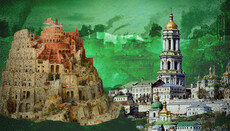
The state is trying to legitimize the seized churches. But the attempt to replace the living Church with an administrative standard exactly repeats the mistake of the builders in the land of Shinar.
In Iraq’s Babil Province, about a hundred kilometers south of Baghdad, the earth cracks from the unbearable heat, and the hills conceal the remains of ancient Babylon beneath them. When you stand at the excavation site near the foundation of the Etemenanki ziggurat, reddish dust crumbles beneath your boots. You pick up a fragment of ancient masonry, run your finger across its rough surface, and see traces of black tar, hardened forever into place.
Today this Mesopotamian dust suddenly comes alive in memory here, in Kyiv. A damp wind lashes your face, somewhere in the distance an air raid siren wails, reminding of the ongoing war and mobilization. And at the iron barrier near the Kyiv-Pechersk Lavra, tired people shift from foot to foot.
Since 2023, state commissions have been sealing monastic buildings one after another. First they closed the Dormition Cathedral and the Refectory Church, then the inventory reached the Near and Far Caves, the academic auditoriums. Angle grinders clatter, cutting off old door hinges, officials check numbers in property registers. Watching this systematic eviction of monastic communities, it's hard not to recall an ancient story.
Chapter 11 of the Book of Genesis describes a similar construction: people in the valley of Shinar decided to build a city and a tower reaching to heaven, in order to "make a name for themselves" (Gen. 11:4). The erection of the gigantic structure was required not for serving God, but for national pride to consolidate political prestige.
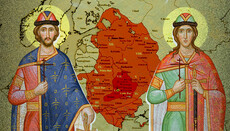
Stamping versus living stone
In the Euphrates valley there is practically no natural stone. The builders of the Tower of Babel had to improvise. The Scripture text records this technological substitution thus: "They used brick instead of stone, and tar for mortar" (Gen. 11:3).
A brick is a stamped product. It is molded in wooden frames and fired in kilns according to a rigid standard so that every block is absolutely identical to the next. Natural stone, by contrast, is unique. It has its own unrepeatable pattern, cracks, and density. It is no coincidence that the Apostle Peter, in his epistle, calls Christians "living stones" (1 Peter 2:5), from which a spiritual house is built.
In the narrow Lavra caves you feel this living and uneven stone. Their vaults are polished by the shoulders of millions of pilgrims who descended to the reliquaries of the Venerable Anthony and Theodosius. But the modern bureaucratic machine finds it inconvenient to work with such a complex, rough-edged material as the human conscience. It needs a clear and manageable standard.
The process of transferring monastic buildings demonstrates precisely such a "brick" approach. The ancient temple is perceived by officials exclusively as an architectural shell, and useful floor space.
The logic is simple: it is enough to terminate one contract, drive some people out, bring in others according to the lists, hang a new seal on the massive door – and the holy place will automatically change custodians. A living tradition is being forcibly walled into the rigid vertical of political expediency. Every element within it is expected to be equally predictable.
Earthen tar instead of binding lime
The tar that held the Babylonian ziggurats is natural bitumen. The heavy, black substance permanently welded the blocks together, but deprived the grandiose structure of the slightest flexibility. The attempt to glue together the tired Ukrainian society through the forcible seizure of shrines uses frighteningly similar building material. It's enough to approach the cordon and listen to the hum of activists celebrating the transfer of another church to schismatics. Their shouts speak much about independence, but what glues this crowd together is viscous, aggressive rejection of those who remained on the other side of the barricades.
Now comes a heavy and exhausting spring. On city streets, men are forcibly taken to the front, families lose loved ones, homes are destroyed. The shared tragedy should have brought the people closer together. Yet by the concrete half-spheres at the entrance to the Reserve stand parishioners, reading an akathist in the drizzling rain, while just a meter away police officers from the cordon check entry lists. In their pockets are identical passports bearing the trident, and they attended the same schools. But the reality is that a ministry representative monotonously reads through the clauses of the decree annulling the lease into a megaphone, while the monk standing opposite him quietly fingers his prayer beads.
They speak in absolutely different, untranslatable languages. The words may sound within the same space, but their meanings do not intersect by even a millimeter. What emerges is that very Babylonian confusion through which the empires of the past collapsed.
The mercy of collapse and empty cathedrals
Studying the hills concealing ancient cities in Iraq, you notice an interesting thing. The tower in Shinar was not destroyed by a blow. In the biblical text, there is not a word about punishing lightning or earthquake. The Creator simply confused the languages of the builders. Saint John Chrysostom in his homilies on the Book of Genesis draws attention to an amazing moment: the division became an act of Divine care for people. If the builders had continued their project, welded together by unified pride, they would have erected a perfect monument to their own vanity.
Stopping the large-scale construction saved them from final fall. The project collapsed from within, leaving people alone with their own misunderstanding.
People signing orders for community eviction today hardly realize that they are literally playing out an ancient scenario. Confiscating keys to churches, they receive at their disposal only empty square meters. In the huge Dormition Cathedral, thousands of oil lamps no longer flicker at evening service. Spacious halls are filled only with the echoing sound of steps from rare tour groups or inspection commissions. Without the prayer of a living community, the church rapidly transforms into a cold, lifeless museum.
For a person coming to the Lavra gates, the loss of their native monastery is felt as sharp and aching pain. Standing for hours in the wind at iron barriers, watching the indifferent inventory of the shrine, is physically difficult.
But precisely here, at the concrete blocks under spring rain, where the exiled community gathers for prayer services, the archaeology of faith manifests itself. God did not remain walled up in official brick. He stands on the street, next to those who lost ancient walls but preserved the ability to speak with Him without distortions. And on the other side of the barrier rises only an architectural form, perfectly documented but completely mute without the living voices of worshippers.