Why do the people love Patriarch Ilia so deeply?
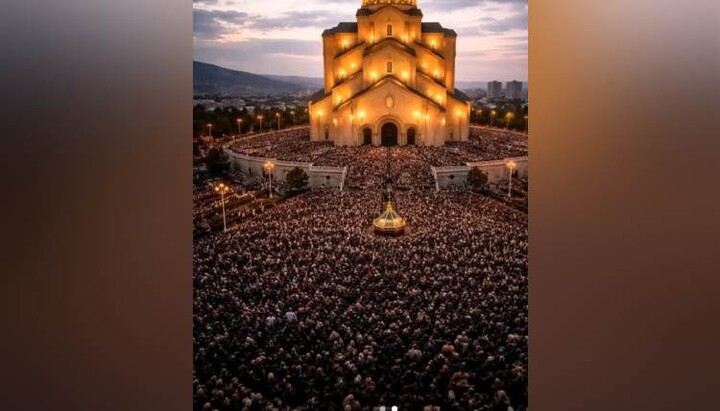
Georgians who came to bid farewell to their Patriarch. Photo: open sources
This is the one thing people await from a first hierarch above all else.
In the days of farewell to Patriarch Ilia, images spread across the world – an unending river of people, flowing toward his coffin. Georgia did not merely impress the Orthodox world; it moved it, unsettled it, compelled it to ask questions. Many hastened to explain it by pointing to the people themselves – to their centuries-long formation in the Orthodox faith. They say: this is a pious nation, and such love would be shown to any primate. Some even, perhaps not without a hidden sigh, think: the Patriarch was fortunate in his flock – if only we were loved in the same way.
But is this really so?
Look elsewhere. In other Churches, bishops and primates labor tirelessly. They build churches, cultivate relationships with governments, speak eloquently, act wisely, administer effectively. Some surpass Patriarch Ilia in these very qualities. And yet – where is that same boundless love? Where is that trembling reverence, that quiet, almost childlike trust? It is not there. And so the question returns with greater force: what, then, was the secret?
Why did even those far from faith – even those who did not believe – look upon Patriarch Ilia with such unmistakable reverence?
We recall Moses, who led the people out of bondage. But we often forget that he recoiled from this calling. He pleaded with God, spoke of his weakness, his inability, his lack of eloquence. He did not see himself as worthy of the task:
“And Moses answered and said, But, behold, they will not believe me, nor hearken unto my voice: for they will say, The Lord hath not appeared unto thee.”
And yet God Himself confirmed him – not by argument, but by His presence, by the signs through which it became clear: the Lord is with this man.
So it is even now.
We no longer see the wonders of Sinai. And yet God still chooses those through whom His will becomes perceptible in the world. No external proof compels belief – and yet people know. They sense it with a certainty deeper than reasoning: here is someone through whom God acts.
We cannot fully explain this mystery. But perhaps the words of St. Seraphim of Sarov draw us closer to it: “Acquire the Spirit of peace, and thousands around you will be saved.”
There are many who are successful, articulate, influential – men who shine in public, who govern well, who speak convincingly. But the human heart is not drawn by skill alone. It is drawn by presence. By truth. By holiness.
What people seek is not simply a capable administrator, nor a gifted speaker, nor a skilled diplomat. They seek someone who truly stands before God for them – someone in whom the divine image is not obscured, but revealed. All other talents may adorn a man; but without this, they do not kindle love.
Patriarch Ilia of Georgia, like Patriarch Pavle of Serbia, may not have been perfect in worldly terms. But they possessed something greater – something that cannot be imitated, manufactured, or taught. They were men through whom the will of God quietly shone. And people recognized it without error.
They came not out of duty, nor out of habit. They came because they felt that, in coming near to him, they were coming near to something holy.
And so the answer becomes clear.
What we witnessed in Georgia in those days was not merely the love of a people. It was a response to a life wholly given – to a man who had stood before God for them, day after day, year after year, bearing them in prayer.
They came not simply to say farewell.
They came, one last time, to stand near the one who had stood for them before God.
Read also
Shoulder straps or a cassock: who writes the script for UOC "fighters"?
Everything indicates that both Veliar and Pshenychny are ordinary performers of someone else's script. There is only one question – does the scriptwriter wear shoulder straps or a cassock?
Why is it legal to kill a person before birth but not after?
Children are the most privileged members of society. Yet that same society officially permits children to be killed – and on a massive scale.
Honoring the Bolsheviks’ successors at Kyiv Lavra
It was under the Reserve that the relics of the saints were desecrated, Lavra churches were turned into an atheism museum, and toilets were installed in sanctuaries.
"Degenerates" and "stupid animals": anti-UOC activists turn on children
Future historians will wonder how a vast country’s information agenda could have been shaped for so long by people so petty, vicious, and utterly contemptible.
Zelensky sees murder of Polish priest but not of Sviatohirsk monk
Why does Zelensky react so emotionally and swiftly to the murder of a Catholic cleric while remaining completely silent about the murder of an Orthodox monk?
UOC vs. OCU numbers: pollsters count, social media recount
Official polling suggests Dumenko’s structure has an overwhelming lead in the number of parishioners, while social media polls paint a very different picture. Which should we believe?