The murder of Metropolitan Volodymyr: the record of a robbery
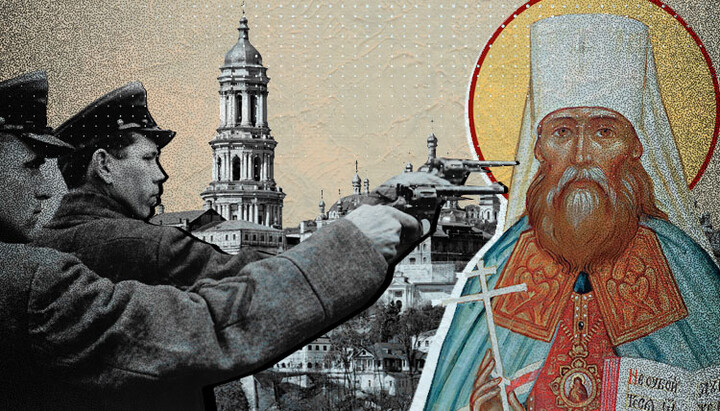
The murder of the Hieromartyr Volodymyr. Photo: UOJ
Footsteps can be heard already in the corridor – heavy, unfamiliar for monastic brethren. Then a knock. Not the cautious knock with which one enters a bishop’s chambers bearing a report or a request, but a different one – short, insistent, like at a government office.
Five armed men stand at the door. Several in soldiers’ greatcoats, one in a sailor’s uniform. The seventy-year-old Metropolitan Volodymyr of Kyiv and Galicia opens the door himself.
“What do you want?”
“Money. We were told it’s here.”
This is how begins what the Church would later call a martyr’s death, and investigative commissions – an unsolved murder.
An inside tip: who led them to the metropolitan
Kyiv in those days was a city without power. Muravyov’s troops had entered the day before yesterday, after a week of artillery bombardment. Officers are being shot in the streets, homes are subjected to searches, random gunfire cracks at intersections. In this chaos, rumors of the “metropolitan’s millions” spread through the city like news of a fire.
These rumors began inside the monastery. This is not conjecture – it is based on witness testimony recorded in a report by Bishop Pimen of Balta to Patriarch Tikhon.
At the end of 1917, part of the Lavra brotherhood rebelled against Metropolitan Volodymyr’s strict administrative discipline. Monks and novices formed their own “committee,” demanding control over the printing house and the treasury. But the metropolitan refused to yield. Then a rumor spread across Kyiv: that a multimillion treasury of the Lavra was locked in his personal safe.
Who exactly pointed the five armed men to the metropolitan’s chambers that evening was never established. The names do not appear in the case materials, although multiple witnesses confirmed that there had been an informant. This remains one of two unresolved knots in the case. The other is who the killers were: ideological commissars from Muravyov’s forces or ordinary Kyiv criminals wearing military coats as cover. Neither the investigation under Hetman Skoropadskyi nor Denikin’s counterintelligence provided an answer.
What is certain: by half past seven in the evening, they are already in the metropolitan’s bedroom.
100 rubles and a few crosses
They break open the safe. Then the caskets. They overturn everything within reach. They tear from the metropolitan a white panagia – a gesture that, even in this company, seems to have been not ideological but purely predatory: to seize something valuable, nothing more.
But the promised millions are not there. In the safe they find several pectoral crosses and about one hundred rubles in cash. That is all.
Here comes the turn that makes what follows especially terrifying. If these had been ideological executioners acting from a list, the metropolitan would have been arrested or killed immediately, without a search. If they had been ordinary robbers, they would have left empty-handed. But these men spent time searching for money that did not exist, realized it was not there – and did not leave.
Their anger at the fruitless raid proved stronger than any calculation.
Around 8:30 p.m., the metropolitan is led out of the room. Before leaving, the seventy-year-old man removes the gold cross on a chain from his neck and silently hands it to his cell attendant, Philip. It is a farewell without words – a single gesture.
Philip tries to follow. A revolver is pointed at him and he is ordered to stay. He remains in the bishop’s quarters.
The escort leads the metropolitan through the Economic Gate of the Lavra and out onto the street. He is wearing only a cassock and a black winter coat. Outside – January, snow, and frost.
A path beyond the ramparts
The Kyiv-Pechersk Lavra is a thousand monks and novices, residential buildings, guards, stone walls… All of this is left behind as five men lead one old man along a snow-covered path beyond the earthen ramparts of the old Pechersk fortress.
On a vacant lot, the metropolitan asks for time to pray. He is allowed it – whether seconds or minutes, sources differ, but agree on one thing: he was permitted to pray. He raises both hands, blesses the armed men standing before him, and speaks four words:
“May the Lord forgive you.”
This moment was recorded in the investigation from the testimony of witnesses who observed the execution from a distance. Shortly before that, there had been another exchange, also preserved in the record – from the account of Philip:
“So, you want to shoot me?”
“Why should we stand on ceremony with you?”
Then the shots rang out. Behind the walls of the Lavra they were clearly heard in the residential quarters. But until dawn, none of the monks dared to go beyond the gates.
On the morning of January 26, Metropolitan Volodymyr’s body was discovered by passersby.
The forensic examination recorded multiple gunshot wounds – to the head, shoulder, and chest – as well as numerous stab wounds inflicted with bayonets and blades. Death resulted from the combined injuries.
The first martyr of the 20th century
Metropolitan Volodymyr (Bohoyavlensky) became the first bishop of the Russian Orthodox Church to be killed in the twentieth century. But he was not killed after a public trial for confessing the faith – not as Christians of the early centuries were executed, not as the heroes of hagiography die. He was led beyond the gates of his own Lavra by five men who were looking for money, did not find it, and turned to brutality.
In this difference between past and present lay the full horror of the age that had begun. Before 1917, repressions against the Church at least had a legal form: arrest, trial, charges, sentence. The system was hostile, but it had procedures.
What happened in January 1918 beyond the Lavra walls fit into no system at all – it was simply the rage of bandits at an empty safe, and four words of forgiveness spoken into the darkness.
After that night would come thousands more: bishops arrested, churches destroyed, priests executed. The Soviet regime would build an entire machinery of persecution against the Church. But the first link in that chain was not a court sentence – it was an ordinary robbery.
In 1992, Metropolitan Volodymyr (Bohoyavlensky) was glorified among the saints. Yet the case of his murder remains officially unsolved to this day.
Read also
Why holy monasteries turned into state prisons
The history of Christian Europe has preserved the memory of times when monasteries became places of state exile. The fates of monarchs and righteous men were decided there.
A shepherd boy with a letter from Christ to French king
In the summer of 1212, thousands of pilgrims carrying staffs waited for the sea to part before them. Later chroniclers added ships, slave traders, and a pope's lament to their story.
Facade of bones and facade of light
Antoni Gaudí spent forty-three years building a church in Barcelona, knowing that this construction was for the ages.
Trial of a dead pope
Once in Rome, the body of a deceased pope was seated on the throne and put on trial. The accusation relied on a church canon that had once saved his see.
Monastery built in defiance of king
When Orthodox believers in Minsk were left with just one church, townspeople decided to build another – and even a royal decree did not stop them.
Young Mother and Sleeping Christ
Michelangelo carved a Virgin Mary who looks younger than her Son – and signed his name in marble for the only time in his life. Neither of these peculiarities was accidental.