Narthex: A book of repentance we have forgotten how to read
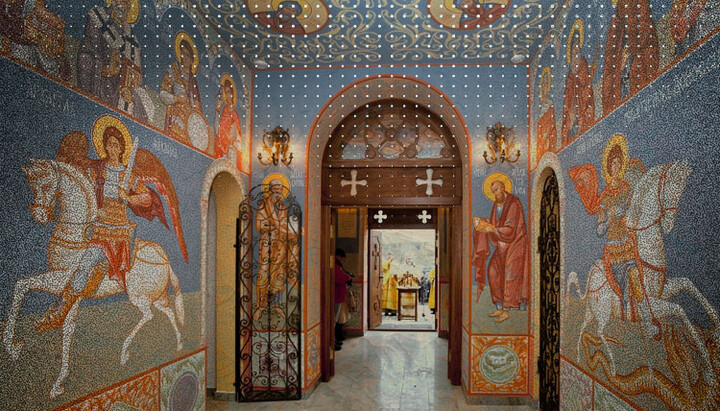
View of the narthex. Photo: UOJ
Count how many seconds we spend in the narthex. We do not linger there for long. We push open the heavy door – a draft of cold air brushes past, the dimness flashes by, candle stands, someone’s coat on a rack – and already the hand reaches for the next door, beyond which light spills out, incense rises, and sweet chanting resounds. The narthex is left behind, and we do not even remember it. And yet its role in church architecture is immensely important.
In the early Christian tradition, this space was called the narthex – from a Greek word denoting a box for storing incense. In shape, the narthex resembled it closely. Those who designed the first Christian basilicas in the fourth century understood that the transition from the world into the church should not be instantaneous. The soul, no less than the body, needs a kind of шлюз on its way into the dwelling place of prayer.
A waiting room where people waited for years
Those doing penance for grave sins were divided into stages. The farthest from forgiveness – the “weepers” – stood outside on the porch, under the open sky. The next group – the “hearers” – were allowed to enter the church building, but only into the narthex, only until the reading of the Gospel, after which the deacon proclaimed: “Catechumens, depart. Let all catechumens depart.”
And they left. They returned for the next service. Then left again. This went on for a year, two, sometimes three – until the Church determined that the person had fully repented, was ready for Baptism, and for participation in the Eucharist.
St. Gregory Thaumaturgus, Bishop of Neocaesarea, in his canonical rules, specifies the exact place for those who still did not have the right to enter the assembly of the faithful: “Let those who prostrate themselves stand within the church doors.” Within – yet by the doors. No longer outside, but not yet in the church. This intermediate state was not a punishment – it was a reflection, in domes and stone, of a person’s spiritual condition.
How darkness affects a person
Step into the narthex and lift your head. The vault here is deliberately lowered: the ceiling presses down, the space contracts. The windows are narrow, set high, or absent altogether. Eyes coming in from the street do not have time to adjust to the half-darkness, and for the first few moments we feel almost blind. This too is no accident.
Light in a church is directed with the same care with which voices are arranged in a choir. The domed space of the central nave is flooded with light from above – the gold of mosaics and frescoes there breathes, shimmers, lives. But here, in the narthex, that bright light is absent: only the distant echo of chanting beyond the portal and the flicker of candles barely reaching the threshold.
It is precisely this contrast that is the narthex’s chief architectural instrument. Not darkness in itself, but the expectation of light – already visible, yet not yet open for you to enter.
Symeon of Thessalonica, the fifteenth-century theologian and liturgist, explained the structure of the church as an image of the cosmos: the altar symbolizes heaven, the central nave the renewed earth, paradise. The narthex too is earth – but earth not yet redeemed, a space in which people are still awaiting an encounter with God as Lord of the visible and invisible world.
On the wall behind you as you stand in the narthex and look toward the closed doors of the nave, there was traditionally placed an image of the Last Judgment. Behind your back – fire and scales. Ahead – doors. And the direction of our movement becomes a matter of the greatest consequence. It is no accident that it was precisely in the narthex of the Church of the Holy Sepulchre that St. Mary of Egypt made the fateful decision to radically change her life of harlotry and set out on the path of spiritual struggle.
In the monasteries of Mount Athos and in the ancient monastic houses of Rus’, stasidia – wooden stalls with armrests that allowed one to lean without fully sitting – stood along the walls of the narthex. Those who stood there for years stood in the most literal sense – as a person stands on the threshold of an important decision.
Walls that have ceased to preach
In most parish churches built or rebuilt in recent times, there are no doors between the narthex and the nave. The two spaces have merged into one – acoustically, visually, and in meaning. The boundary has vanished. The precise historical moment when the inner doors ceased to be shut was never recorded in any document or typikon. It happened of itself – gradually, imperceptibly, the way any habit fades once it is no longer felt to be necessary.
Candle stands in the narthex, racks for outerwear, notices, service schedules – none of this is malicious in itself. It is simply the domestication of an unnecessary space, one that has lost its true function. The logic is simple: if no one stands here anymore, then at least let something be stored here.
But try once to enter the narthex and not go further. Stop right here, in the semi-darkness, at the closed or wide-open doors to the inner space of the church. Let your eyes adjust to the darkness while your ears gradually begin to distinguish the sounds of the service that proceeds without your participation.
Silence extinguishes the squall of our endless emotions. The cold air of the narthex still smells of the street, and ahead – warmth, light, the smell of wax. Between us and them – only a few steps and a threshold that rises one step.
The architects of the first basilicas knew: precisely here, in this interval between the street and the altar, a person has a chance to understand exactly what he came to God with and why.
Read also
Why were holy monasteries turned into state prisons?
The history of Christian Europe preserves the memory of times when monasteries served as places of exile imposed by the state. Within their walls, the fates of monarchs and righteous men were decided.
A shepherd boy with a letter from Christ to French king
In the summer of 1212, thousands of pilgrims carrying staffs waited for the sea to part before them. Later chroniclers added ships, slave traders, and a pope's lament to their story.
Facade of bones and facade of light
Antoni Gaudí spent forty-three years building a church in Barcelona, knowing that this construction was for the ages.
Trial of a dead pope
Once in Rome, the body of a deceased pope was seated on the throne and put on trial. The accusation relied on a church canon that had once saved his see.
Monastery built in defiance of king
When Orthodox believers in Minsk were left with just one church, townspeople decided to build another – and even a royal decree did not stop them.
Young Mother and Sleeping Christ
Michelangelo carved a Virgin Mary who looks younger than her Son – and signed his name in marble for the only time in his life. Neither of these peculiarities was accidental.