St. Florus Monastery in Kyiv: how the shrine survived the challenges of centuries
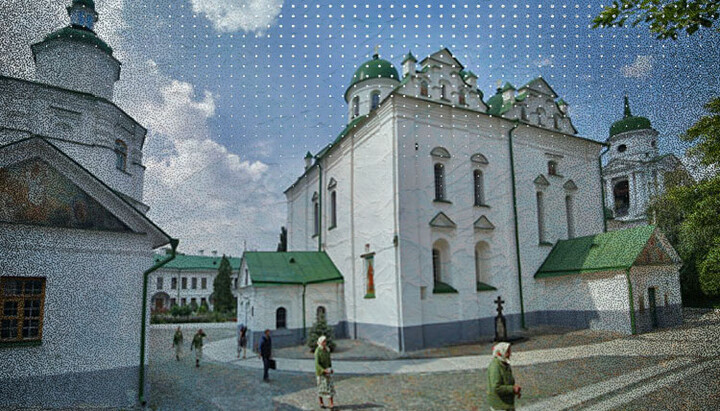
The Holy Ascension St. Florus Monastery. Photo: UOJ
The cobblestones beneath the pilgrim's feet are old and uneven. It's impossible to walk quickly on them. The thickness of the brick walls in the cell buildings is one and a half meters. This is the Holy Ascension St. Florus Monastery in Podil, and it has stood here since 1566.
Natural protection of St. Florus Monastery
To understand how this monastery survived through so many centuries, one must look up. Directly above the cells and garden rises Castle Hill, about seventy meters high. It looms from the east with a sheer rock face overgrown with shrubs, making the monastery's position simultaneously a trap and a shelter: to the west lies the flat, open Podil, to the east - a slope where neither artillery carriage nor truck could ascend.
Natural springs flow from beneath this hill directly onto the monastery grounds. During the most difficult years – sieges and revolutions – the monastery fed and watered itself.
The nuns carried their deceased sisters up to the top of the hill. The cemetery church of the Holy Trinity stood there, at the summit. A narrow path led to it, then a wooden staircase. The coffin of the departed sister was carried by hand, seventy meters up the steep slope. Soviet authorities demolished the church, and the cemetery subsequently became overgrown.
The fire of 1811: how the monastery survived and got rebuilt
On July 9, 1811, a northeastern wind drove fire through wooden Podil directly toward Contract Square. An eyewitness to that catastrophe, then six-year-old historian Nikolai Zakrevsky, later recalled: "Flaming waves passing from one part of the city to another, strong wind carrying burning boards, thick black smoke, houses collapsing over an area of three square versts."
All of wooden Podil burned out in three days. The smoke was visible from Nizhyn, and the wind carried ash as far as Kozelets.
The St. Florus Monastery was almost entirely wooden. Only one stone Ascension Church survived; everything else burned down. Some nuns suffocated from smoke while trying to carry icons and property inside.
Sources differ on the number of inhabitants – thirty-some or forty – but agree on the main point: they remained inside while everything around them burned.
After the fire, the monastery began to rebuild. Architect Andrei Melensky built a new bell tower, a rotunda, and the abbess's house. By 1917, the monastery had five churches.
How the nuns outwitted the Cheka
In the 1920s, Soviet authorities gradually began squeezing out the monastery: they nationalized property, forbade accepting novices, and pressed with taxes. The nuns registered a labor sewing artel on the monastery grounds. Officially, this was a workshop fulfilling state contracts. They sewed uniforms for workers and Red Army soldiers, even overfulfilling the plan. The nuns who were gold embroiderers, masters of ancient techniques for embroidering church vestments, applied the same techniques to Soviet orders.
This "knight's move" allowed the sisters to continue Divine services. The monastic rule was read in closed rooms. The statute was observed.
For almost ten years – from 1920 to 1929 – a full-fledged monastery operated under the guise of an artel.
There are no reports from Kyiv Chekists in the archives explaining the monastery's existence. The exceeded sewing target plan apparently satisfied inspectors more than new cases against the monastery.
In 1929, the monastery was officially closed. In 1941, it reopened – this time forever. Even when in the 1960s churches were again taken away for workshops and a prosthetic factory, the sisters remained in place.
A noblewoman who became a nun
In 1758, a woman whom no one expected to see moved to the convent. Natalia Borisovna Dolgorukova – daughter of Peter's field marshal Boris Sheremetev, widow of Prince Ivan Dolgorukov who was executed by quartering. She grew up in one of the empire's wealthiest houses. Her husband was arrested, then executed in Novgorod. She survived years of exile in Berezov with small children. One child died there, in Siberia.
Into the cramped Kyiv cell she brought scraps of his clothing and personal belongings – all that remained of her husband. Here she took monastic vows with the name Nektaria and lived as a nun until death. In 1767, Dolgorukova wrote the following in her cell memoirs: "I did not intend to describe here what my life was like from my earliest childhood; I lived in all prosperity and wealth... and now I wander in the wilderness, and I left all that voluntarily," the nun affirmed.
In the story of the noblewoman who took monastic vows lies the key to everything that happened within the walls of the holy monastery over four and a half centuries.
The monastery was not preserved legally – it was held by prayer.
It was preserved for us by forty nuns who remained in the burning building for the sake of saving icons. Sisters who sewed Soviet banners and read the monastic rule at night. A woman who exchanged Petersburg balls for a Podil cell.
Each time – a voluntary renunciation of the world. And all because precisely here, behind this arch, was that for which it was worth staying.
Beyond the gates, tram wheels clatter and the eternally hurrying Podil makes noise. The boundary between them runs along one stone arch that separates the earthly from the heavenly, the dwelling of prayer from the world of temptations.
Read also
Shepherd boy carries letter from Christ to French king
In the summer of 1212, thousands of pilgrims with staffs waited for the sea to part before them. Later chroniclers added ships, slave traders and a papal sigh to their story.
Facade of bones and facade of light
Antoni Gaudí spent forty-three years building a church in Barcelona, knowing that this construction was for the ages.
Trial of a dead pope
Once in Rome, the body of a deceased pope was seated on the throne and put on trial. The accusation relied on a church canon that had once saved his see.
Monastery built in defiance of king
When Orthodox believers in Minsk were left with just one church, townspeople decided to build another – and even a royal decree did not stop them.
Young Mother and Sleeping Christ
Michelangelo carved a Virgin Mary who looks younger than her Son – and signed his name in marble for the only time in his life. Neither of these peculiarities was accidental.
Orthodox books from a Uniate printing press
In the 18th century, Uniate monks at Pochaiv printed books used in prayer by Orthodox Christians and Old Believers alike.