Why did Dumenko sit in Metropolitan Onufriy’s chair?
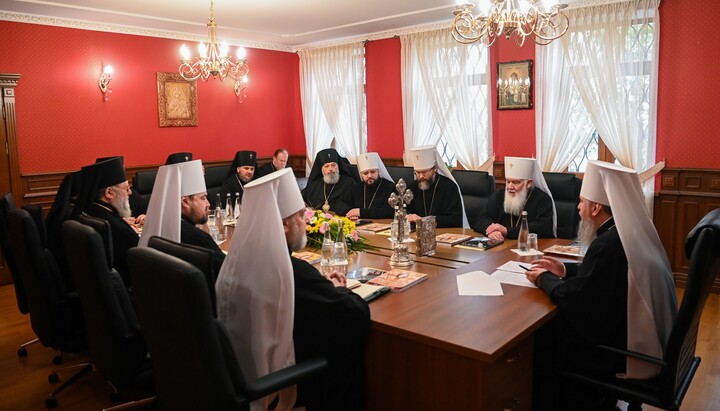
OCU “synod” in Metropolitan Onufriy’s Lavra residence. Photo: OCU
On April 3, the OCU leadership gathered in the Kyiv-Pechersk Lavra, in a residence long associated with the Primate of the UOC, a residence taken from the Church with state backing. It gathered in a building the UOC restored with its own hands after decades of Soviet neglect, in a place where its Holy Synod had met for years under the chairmanship of His Beatitude Onufriy. And at the center of it all sat Dumenko, occupying Onufriy’s seat.
At first glance, the question seems simple: why?
Epifaniy Dumenko does not lack space. He had options – his own residence, Filaret’s former headquarters on Pushkinska Street. Yet for his latest “synod,” he chose something else entirely: the Lavra, the office of Metropolitan Onufriy, the chair that was not his.
Because this was never about logistics.
It was about symbolism.
History offers a familiar script. Revolutions do not merely replace seats of power – they appropriate its symbols. The Bolsheviks took the Kremlin. The French revolutionaries repurposed royal palaces, turning them into “people’s” institutions. Not out of necessity, but to send a message: authority has changed hands.
In practical terms, Dumenko has no real need for the Lavra residence – just as he has no real need for the hundreds of churches that have been seized, while his own remain half-empty. What is at work here is the psychology of the predator: to show the world that the rival has been defeated, that his territory is now occupied.
The Lavra is not just a location – it is a sign. To sit there is to claim continuity, legitimacy, victory. It is a gesture meant to be seen, understood, absorbed.
And yet the gesture raises uncomfortable questions.
If this is strength, why does it need to be staged?
If this is unity, why does it look like conquest?
If this is dialogue, why does it begin with appropriation?
And in all of this symbolism and spectacle, one question lingers:
Where is love for one’s neighbor – even if that neighbor is branded an “FSB agent” or simply an “enemy”?
Where is Christ?
Read also
Why is it legal to kill a person before birth but not after?
Children are the most privileged members of society. Yet that same society officially permits children to be killed – and on a massive scale.
Honoring the Bolsheviks’ successors at Kyiv Lavra
It was under the Reserve that the relics of the saints were desecrated, Lavra churches were turned into an atheism museum, and toilets were installed in sanctuaries.
"Degenerates" and "stupid animals": anti-UOC activists turn on children
Future historians will wonder how a vast country’s information agenda could have been shaped for so long by people so petty, vicious, and utterly contemptible.
Zelensky sees murder of Polish priest but not of Sviatohirsk monk
Why does Zelensky react so emotionally and swiftly to the murder of a Catholic cleric while remaining completely silent about the murder of an Orthodox monk?
UOC vs. OCU numbers: pollsters count, social media recount
Official polling suggests Dumenko’s structure has an overwhelming lead in the number of parishioners, while social media polls paint a very different picture. Which should we believe?
Who is working for the Kremlin in Poland? OCU, Uniates and Catholics versions
Who in the conflict between Poland and Ukraine is "an agent of the Russian Federation"? Zelensky, who gave the UPA name to an AFU special operations center? Nawrocki, who stripped him of an order for it? Polish MEPs?