Pharaoh's pathology: how the heart loses sensitivity
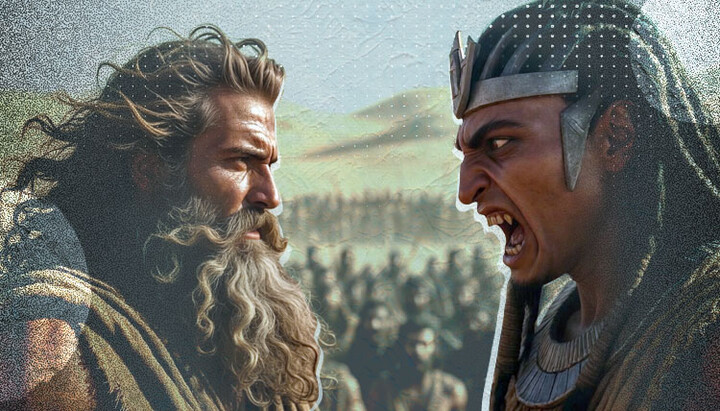
The agony of Pharaoh and the calmness of Moses. Photo: UOJ
We know this state very well. Probably everyone has experienced it at least once. A person has done something vile, made a deal with their conscience, and understands this very clearly within themselves. They feel frightened and uncomfortable. But to admit the mistake out loud means destroying the entire comfortable world they lived in. They would have to give up self-justifications, stop blaming others, and destroy convenient excuses.
And so they press the gas pedal. They cannot brake – they would have to see the dead-end wall they are flying into at tremendous speed.
The person begins to pile one lie upon another. And then the most terrible thing happens: they begin to sincerely believe in their own lie.
And this is no longer banal cowardice. This is gradual, almost imperceptible deadening of conscience.
This is precisely the mechanism that the story of the Egyptian pharaoh tells us about in the biblical Book of Exodus. We commonly read it as an ancient legend about the liberation of slaves, filled with miracles and plagues. But in reality, this is a very precise personification of our human misfortune. A story that continues to happen right before our eyes.
How the soul becomes stone
In the biblical original, the state of Egypt's ruler is described by two very precise words.
The first means "to become hard, to lose elasticity." Living tissue reacts to pain: it flinches, and contracts. Dead tissue does not do this. It simply becomes wooden, covered with a thick shell. The second word means "to become heavy." Like a huge lead weight that inexorably pulls to the bottom and makes a person absolutely deaf to any words and cries around them.
First you simply lose sensitivity. You stop feeling pain for others. And then you physically cannot move toward the truth because you have become too heavy.
Let us see how this works in Egypt. The Nile turns to blood. The land is covered with frogs, then gnats, mass death of cattle begins, people develop ulcers. After each new blow, pharaoh falls into panic. He calls Moses, gives in and promises to let the Israelites go. "Just pray to your God to make this stop," he asks.
But as soon as the pain recedes, as soon as the water becomes clean again, the ruler returns to his former state. He looks out the window of his palace and thinks: the crisis has passed, I control everything again, nothing needs to change. He tightens the screws again.
Advisors understand first
This repeats again and again. And at some point the courtiers begin to understand that catastrophe is happening.
By the eighth plague – when unprecedented locusts attack the country and devour the last remnants of greenery – the elite cannot endure it. The advisors openly demand that their sovereign surrender. They tell him to his face: "How long shall this man be a snare to us? Let the people go... Do you not yet know that Egypt is destroyed?" (Ex. 10:7).
These people probably did not believe in the God of Israel. They are simply pragmatists. They see that the economy is destroyed, the country is flying into the abyss, and the ruler's stubbornness costs too much. They understood everything before he did.
But pharaoh does not hear. Not because he is stupid or insane. His heart has lost elasticity. It has become stone and no longer reacts to obvious facts. Preserving his own power and pride becomes more important to him than the survival of an entire country.
When God steps aside
And here the biblical text changes sharply. During the first plagues, the same thought is repeated: "Pharaoh hardened his heart." He does this himself. Voluntarily. He convinces himself that all these catastrophes are just coincidence, natural anomalies or clever tricks by Moses. This is his personal, conscious choice – not to believe his own eyes.
But then the formula sounds different: "And the Lord hardened pharaoh's heart."
Does this mean that God specifically made a person evil in order to then spectacularly punish him? No. Saint Gregory of Nyssa gave a very simple and understandable example. The sun shines equally on wax and clay. But wax melts under its rays, while clay hardens. The difference is not in the sun's temperature, but in the material itself.
A person becomes callous not because God pours malice into them, but because they stubbornly go into darkness themselves.
What happens to the Egyptian king next is a very terrible moment. God does not add evil to him. He simply leaves the person alone with what he has chosen. The Lord stops restraining him.
Pharaoh repeatedly chose his own will. And at some point the Creator simply stopped forcibly offering him another option. The highest punishment is when God steps aside and says: "Fine. Let it be as you want. Do it." And the person flies into the abyss at tremendous speed, thinking they are winning.
Point of no return
There is another striking detail in this story. Before the most terrible, tenth plague, Moses comes to the palace for the last time. And the ruler, in a fit of rage, drives him away. He forbids the prophet to appear, threatening immediate death.
Moses stands before him and calmly agrees: "You have spoken well. I will never see your face again" (Ex. 10:29).
The break becomes final. Notice: it is not God who refuses to speak. It is not the prophet who slams the door. The power itself cuts the last connection with reality.
Here the disease reaches its very end. When a person stops hearing the truth, they stop hearing people too. They drive away everyone who tells them unpleasant things and remain alone with the reality they themselves invented. And invented reality always kills its creator.
What should we expect?
Today, when our churches, priests and communities are being pressured from all sides, we are not assigned the role of Moses. We do not have his prophetic staff, we cannot turn water into blood or part the sea.
But we can understand how this works. The Israelites in Egypt did not raise armed rebellions. They did not build barricades or write angry manifestos. Their true strength was in a frightening, completely incomprehensible calm for the authorities.
They simply waited. They waited until the deadened, desensitized state machine broke itself trying to run over God's design.
Will we have enough patience to simply stop and not rush about? Will we have enough strength not to be infected with reciprocal hatred? Will we be able, like Moses, to stand without anger and shouting, with sober understanding that the Creator has not let history out of His hands for a second?
The Egyptian government and army perished in the dark, cold waters of the Red Sea. And they perished not at the hands of the Israelites, but by special Divine Providence, confirming the final collapse of the persecutors' power.
Read also
Honest atheism vs. spiritual hypocrisy
The 70th anniversary of Albert Camus’s Nobel Prize recalls an uncompromising challenge to Christianity. An honest unbeliever brings theology back to the mystery of the Cross.
The valley of trouble and the gateway of hope
One soldier buried an expensive cloak and some gold beneath his tent. Because of this, all Israel lost a battle. Why did one man’s sin bring disaster upon an entire nation?
From love spells to bishop's throne
Antioch’s most powerful sorcerer sent demons against a devout young Christian woman three times – and failed every time. In the end, a demon himself revealed the truth that led to his conversion.
The Weeping Queen of Blachernae
On the night of the Feast of the Protection, only two people witnessed the miracle in the Church of Blachernae. Everyone else prayed and saw nothing. Yet they, too, received grace.
Deadly spiral of human hatred
The tragedy of Lebanon's civil war lays bare how dehumanization and fear can turn human beings into monsters.
Woe to expectant mothers – or to those of little faith?
God commanded one prophet not to have children, yet told his people in exile to bear sons and daughters. What does this apparent contradiction tell us today?