The Living Church: The history of a managed schism
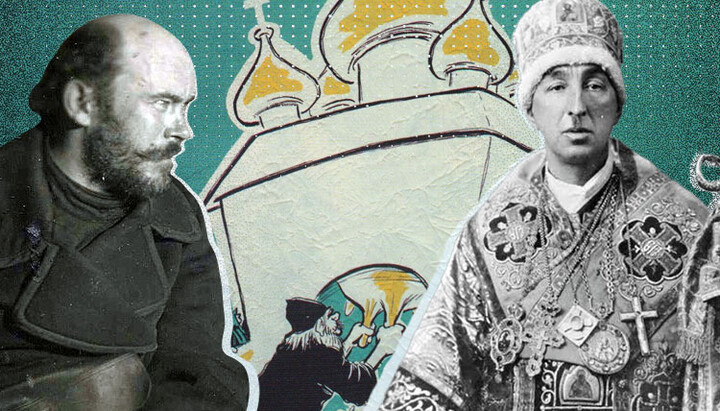
Priests Alexander Vvedensky and Vladimir Krasnitsky – the ideologues of Renovationism. Photo: UOJ
Spring 1922. The country is exhausted by war and choking from famine. Entire villages in the Volga region are dying out. Under the pretext of aiding the starving, the state launches a brutal campaign to seize church valuables. Patriarch Tikhon is placed under house arrest, and clergy are put on trial across the country. But direct repression produces the opposite effect – the faithful rally around those being persecuted.
Then the authorities decide to blow the Church apart from within.
May 1922. Moscow. Lubyanka. The office of Yevgeny Tuchkov, head of the Sixth Division of the GPU’s Secret Department. Behind him are a couple of years of parish-school education and a confident career as a Chekist. One can easily picture drafts of resolutions for the coming council of the “Living Church” lying on his desk while he leisurely marks them up in pencil.
An atheist in uniform takes it upon himself to edit dogma. An investigator formulates church reforms. In August 1922, the Renovationist congress unfolded exactly according to the Lubyanka script. Tuchkov reported to his superiors that the required resolutions had been passed without delay. He jokingly called himself the “Soviet Ober-Procurator,” while the Renovationists, behind his back, referred to him as “the abbot.”
Resentments and ambition
The state did not even have to invent anything fundamentally new. Inside the Church there had always been different currents, old resentments among the white clergy toward the bishops, and simply people with outsized personal ambitions. The authorities found them, brought them together, and gave them the green light.
Archpriest Alexander Vvedensky, a brilliant orator with enormous vanity, preached from the ambo that Marxism was the Gospel, merely printed in a modern typeface. He drove around the city in a car provided by the authorities and drew packed halls. Archpriest Vladimir Krasnitsky, once an activist in the far-right Union of the Russian People, now furiously demanded that Patriarch Tikhon be put on trial. They spoke of Christian socialism, the salvation of the country, and the struggle against reaction.
In secret GPU memoranda, these men were listed as “agents.”
Tuchkov moved them like pawns, constantly pitting them against one another. His task was simple: turn priests against bishops and tear the Church to pieces.
The leaders of the schism could not have failed to understand this. But their thirst for power outweighed everything else. To engineer a split, the Chekists did not need sophisticated theology. Old grudges and vanity were enough – and the authorities were lavish in trading both for other people’s churches.
The police and empty walls
The scheme for seizing holy places worked unfailingly and with brutal simplicity. A canonical parish would be branded “reactionary” and stripped of registration. The next day, police would pull up at the church doors together with Renovationist representatives. The locks would be smashed, and the keys ceremoniously handed over to the new masters.
Bishops and priests who refused to recognize the power of the schismatics were immediately sent by the GPU to prison or exile in the north. Under that kind of coercive pressure, the Renovationists quickly took control of a vast share of parishes across the country. Outwardly, it seemed as though they had won a total victory.
But then something unexpected happened. People simply stopped going to the churches they had seized.
A “red” bishop might serve in a huge cathedral, a magnificent choir might sing, thunderous sermons about the radiant future might ring out – and yet there would be ten people standing in the church. The faithful instinctively sensed the falsehood. Elderly women in white headscarves would leave for the outskirts, to small, unheated wooden churches where a canonical priest, having miraculously escaped arrest, still served. There, in the crush and the stifling air, real church life was breathing. Meanwhile, the Renovationist churches stood empty.
The authorities understood perfectly well the worth of their allies. In a secret memorandum to the Politburo in the spring of 1922, Leon Trotsky wrote quite plainly that the reformers should be supported only in order to destroy the Church. Even so, he added a reservation: in time, a “living” religion loyal to the state could itself become dangerous. The regime’s handlers regarded the schismatics as nothing more than a temporary, expendable instrument.
A change of course
September 1943. Another hard, grinding war is underway. For the sake of survival, the state is forced to reconsider its harsh policy. People at the front and in the rear needed real consolation, not political slogans wrapped in church vestments. Stalin summons the canonical metropolitans, brings them back from exile, and allows the election of a Patriarch.
The authorities remove their supporting hand from the Renovationists. And what happens next is astonishing in its speed.
The movement that for two decades had leaned on official offices and police bayonets begins to collapse before everyone’s eyes. Without the Chekists behind them, the Renovationist parishes finally empty out completely. Yesterday’s leaders of the “Living Church” begin writing letters of repentance, asking to be received back into the canonical Church, or simply disappearing quietly into history. The people return en masse to their native churches – the very churches from which they had been driven by force twenty years earlier.
A church group assembled by the authorities around a table and raised on the seizure of other people’s property cannot exist on its own. Remove the police cordon and the backing of official offices, and nothing will remain of it except empty walls and forgotten resolutions.
And the canonical Church – the very Church that had passed through endless interrogations, Solovki, firing ranges, and confiscations – survived and remained. It endured not because it proved cleverer in the political game or found better arguments for dialogue with the authorities. It endured because people came to it not for careers and not for security.
It possessed what never was and never could be found in an interrogation office at Lubyanka. Christ lived in it – and He cannot be shot, abolished by decree, or appointed by order from above.
Read also
Orthodox Books from a Uniate Printing Press
In the 18th century, Uniate monks of Pochaiv printed books that Orthodox believers and Old Believers used for prayer.
The story of the honey brotherhood
The Mogilev Brotherhood began with members pooling money to brew honey drinks for feast days – and eventually grew to have its own printing press.
Golgotha in the midst of a pogrom
In the autumn of 1938, the Jewish artist Marc Chagall painted the crucified Christ. Synagogues burn and refugees flee around the cross, while the Crucified One Himself is wrapped in a prayer shawl.
Stories of the Early Church. Level of governance: patriarch
How did several episcopal sees rise above the rest, why did the Church’s administrative map come to mirror that of the empire, and is the patriarchate a sacred form of Church governance?
A Chronicle without an author
We are accustomed to calling The Tale of Bygone Years the work of St. Nestor. Yet another monk left his signature on it, while the chronicle itself passed from one generation of scribes to the next.
How a wedding stopped a war
The young princess of Slutsk was married off to keep two powerful noble families from drowning the city in blood. Soon afterward, a Uniate metropolitan complained that Orthodoxy had been reborn in Slutsk.