Docetism: The theory of a God Who does not suffer
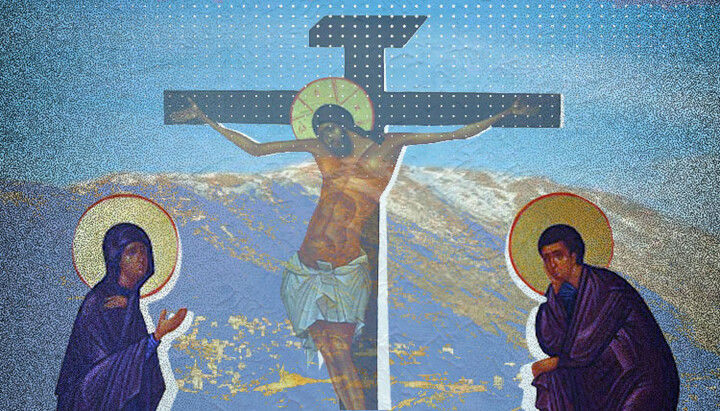
The central idea of the Docetists was the phantom suffering of God. Photo: UOJ
The Roman cross – in Latin, crux – was not an elegant piece of jewelry. In antiquity, it was an engineered instrument of death, designed to ensure a long and suffocating agony. A crucified man hung there in excruciating tension. To draw even a single breath, he had to push himself up on pierced feet, tearing his back against the rough wood of the upright beam.
An archaeological find in Jerusalem – the fragment of a heel bone belonging to a first-century man named Yehohanan – silently confirms the reality of this practice. A metal nail had been driven straight through living bone. That was the reality of that terrible execution.
Now imagine an ancient thinker standing before such a cross. Blood falls from the beam into the dust at his feet. He recoils in disgust. To him, the true God is too lofty to bleed, to gasp for air, to sweat. Too pure for such filth.
The illusion of salvation
The word “Docetism” comes from the Greek verb dokein (δοκεῖν) – to seem. Just one verb, and yet it brings the entire meaning of the New Testament crashing down.
If God’s Incarnation only “seemed” real to men, then the iron nails pierced emptiness. What hung on the Cross was a bodiless projection. This was the conclusion reached by thinkers formed by ancient philosophy.
For the ancient world, the idea of a suffering God was not merely strange – it was scandalous.
The whole Platonic tradition had for centuries taught that the Absolute is unchanging, impassible, infinitely removed from earthly turmoil. Matter was regarded as a mistake, a burden, a source of evil.
And then the Christians came and declared that the Logos, the Creator of the universe, had willingly placed Himself in a vulnerable body. That He felt hunger and exhaustion, and in the end allowed Roman soldiers to nail Him to a piece of wood. To an educated Greek or Roman, this sounded like an intellectual outrage. What they wanted was a sterile Savior, one who could walk the earth without so much as dirtying His feet.
The Gnostic Basilides carried this logic to its very end. He taught that on the way to Golgotha Christ exchanged appearances with Simon of Cyrene. The Romans crucified Simon by mistake, while the bodiless God stood invisibly in the crowd. It is only one Gnostic variation, but it lays bare the very essence of the heresy: God cannot suffer.
At first glance, one might ask what difference it makes whether the body was real, so long as the teaching itself remains intact. But Christianity is not a code of moral maxims. It is a religion of salvation.
In Orthodox theology there stands a hard law, struck like iron by St. Gregory the Theologian: “What is not assumed is not healed.” The meaning of the Incarnation is to enter into damaged human nature from within and heal it by uniting it to the divine.
If Christ only pretended to become man, then He did not truly take on our flesh, our nervous system, our will. Death was not conquered from within – it was merely brushed aside with dramatic effect. An illusory Cross inevitably leads to an illusory salvation.
The argument of the arena
Between 107 and 110, the Hieromartyr Ignatius, Bishop of Antioch, was being taken under heavy guard to Rome. There he was to be thrown into the arena before wild beasts. The road was long, and along the way Ignatius wrote farewell letters to the Christian communities.
In his Epistle to the Trallians, he formulates the most powerful counterargument to Docetism. Ignatius writes these lines in chains. In his letters he calls the escorting soldiers “leopards,” who only grow worse when shown kindness. It is in that extreme tension that his argument is born.
“But if, as some say... He suffered only in appearance,” the condemned bishop writes, “why then am I in chains? Why do I burn with the desire to fight the beasts? Then I die in vain.”
Here theology is tested by blood. The martyrs of the early centuries did not walk into the arena for the sake of a beautiful metaphor. If the Savior’s pain was only theatrical staging, then the martyrdom of the early Church becomes nothing more than meaningless suicide for the sake of a mirage.
Anyone who had sat in a Roman prison understood this instinctively: either the execution on Golgotha was real, or Christianity is emptiness.
The Apostle John warned of this as well: every spirit that does not confess Jesus Christ come in the flesh is not of God (1 John 4:3). For the first Christians, the reality of Christ’s flesh was precisely the line that separated faith from philosophical fiction.
A modern mutation
Docetism has not disappeared. It has simply changed its scenery. Today it appears as the mass craving for “spirituality without religion.” It is the desire to have God in the form of positive energy, a philosophical absolute, or a convenient heavenly therapist who is always on your side.
People want beautiful rituals, candles, emotional comfort – but in that scheme there is absolutely no room for co-crucifixion. Many gladly await a radiant Easter, yet do their best not to notice Holy Week. They want the light of the Resurrection, but flee from the darkness of Gethsemane, where God asks His disciples simply to remain with Him – and they fall asleep.
Modern man is strikingly like the ancient Gnostics. He is driven by the same instinct – to turn his face away from the brutal reality of the Cross.
But if God never felt pain, suffocation, or betrayal, then He is utterly deaf to human grief. An impassible god cannot console, because he himself has never wept.
Real, physical death became the only door into the Resurrection. A phantom cannot rise from the dead. A bodiless projection cannot conquer corruption. Jesus Christ became man with all our frailty upon Him. Without that radical, painful honesty of the Incarnation, there is no salvation at all. For only what has truly become one’s own can be healed.
Read also
Trial of a dead pope
Once in Rome, the body of a deceased pope was seated on the throne and put on trial. The accusation relied on a church canon that had once saved his see.
Monastery built in defiance of king
When Orthodox believers in Minsk were left with just one church, townspeople decided to build another – and even a royal decree did not stop them.
Young Mother and Sleeping Christ
Michelangelo carved a Virgin Mary who looks younger than her Son – and signed his name in marble for the only time in his life. Neither of these peculiarities was accidental.
Orthodox books from a Uniate printing press
In the 18th century, Uniate monks at Pochaiv printed books used in prayer by Orthodox Christians and Old Believers alike.
The story of the honey brotherhood
The Mogilev Brotherhood began with members pooling money to brew honey drinks for feast days – and eventually grew to have its own printing press.
Golgotha in the midst of a pogrom
In the autumn of 1938, the Jewish artist Marc Chagall painted the crucified Christ. Synagogues burn and refugees flee around the cross, while the Crucified One Himself is wrapped in a prayer shawl.