Two betrayals: Why Peter was saved and Judas perished
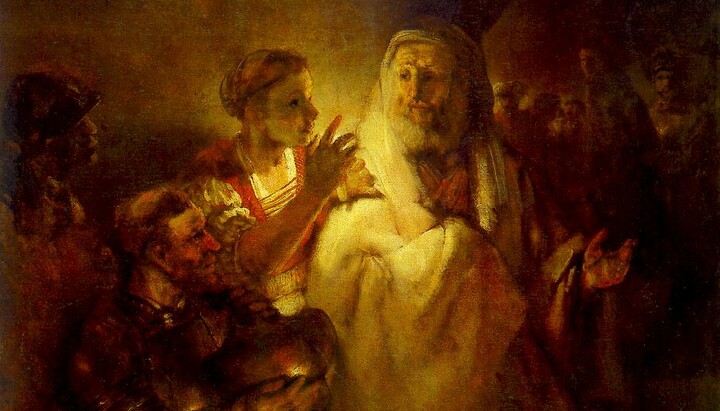
Rembrandt. Painting "The Denial of Peter". Photo: Wikipedia
The story of Christ’s Passion is not only the chronicle of a divine sacrifice – it is also a mirror held up to the human soul. At the center of this drama stand two figures whose names have become bywords. Both were called. Both drank from the same cup. Both committed betrayal. Yet one became the foremost of the apostles, while the other became a symbol of eternal ruin.
Peter’s ardor and his everyday weakness
Simon Peter always stood out for his fiery intensity. His faith was not cold calculation, but a living blaze. His declaration – “Even if all are made to stumble because of You, I will never be made to stumble” (Matt. 26:33) – was not empty bravado. It was the sincere conviction of a man ready for heroic self-sacrifice. And he proved it in Gethsemane, when without hesitation he drew a sword against an entire cohort of armed men.
Peter’s paradox is that he was ready for a “great feat,” yet found himself defenseless before something small.
He was not afraid of death in battle, but he faltered before an ordinary suspicion. His denial was not sheer cowardice in the purest sense. It was, rather, an attempt to “preserve himself for the cause.” He wanted to remain in the shadows, to watch the end unfold, to play the part of a random passerby.
We often imagine that faith will be tested in great and dramatic trials, yet forget that betrayal most often happens in a whisper, not in a shout. Peter’s tragedy teaches us that spiritual vigilance is needed most not on the barricades, but in everyday life. It is easy to confess Christ in church, but much harder in a company where faith is mocked with a smirk. Denial often comes disguised as a “reasonable compromise.” We are afraid not of torture, but of awkwardness, of a sidelong glance, of damage to our reputation.
The erosion of the soul and the theology of despair
Christ warned of just such a danger: “Whoever is ashamed of Me and My words in this adulterous and sinful generation, of him the Son of Man also will be ashamed when He comes in the glory of His Father with the holy angels” (Luke 9:26). Peter understood the depth of his fall only under Christ’s gaze. That gaze was not accusatory – it was full of love, and it was precisely that love that shattered the apostle’s heart. What saved him was his ability to weep over what he had done, and his faith that Mercy stands higher than justice.
If Peter’s fall was a sudden flash of weakness, Judas’s fall was a long, hidden process of erosion of the soul.
Judas was not merely an extra in the apostolic community. He was entrusted with responsibility – he kept the common funds. Holy Scripture is sparing in its details about his inner life, yet it gives us crucial clues. The Apostle John speaks directly of theft from the money box. Money became the thread by which the devil pulled out the whole soul. The Lord knew of Judas’s inward estrangement long before the final act: “But there are some of you who do not believe. For Jesus knew from the beginning who they were who did not believe, and who would betray Him” (John 6:64). Of Judas were spoken some of the most terrible words in human history: “Woe to that man by whom the Son of Man is betrayed! It would have been good for that man if he had never been born” (Matt. 26:24).
There is a hypothesis that Judas was trying to provoke Christ into seizing earthly power, hoping that arrest would force the Messiah to reveal His might. That explains why he returned the money: when the plan to “accelerate the kingdom” collapsed, and Christ went to His death as the Lamb, Judas realized the monstrousness of what he had done. The most terrible moment in Judas’s story is not the kiss in the garden, but the noose on the tree. His sin was not only the betrayal of Innocent Blood, but absolute despair. He repented in the sense that he acknowledged his guilt, but he did not believe in the possibility of forgiveness. Despair is the highest form of pride, when a person deems his own sin so enormous that even God cannot cover it.
Two ways out of sin
Metropolitan Anthony of Sourozh offers a bold and hope-filled private reflection. Since Judas took his own life before the Crucifixion, his soul descended into hell before Christ. The bishop supposed that when the Savior descended into hell to bring out the righteous, their last meeting took place there. We do not know the outcome of that encounter, but the very thought itself underscores something profound: God struggles for man until the final breath – and even beyond it.
Comparing these two stories, we see two paths out of sin. Peter’s path is repentance through hope. He acknowledged his own nothingness, but entrusted himself to God’s love. Judas’s path is remorse through self-laceration. He acknowledged his guilt, but drowned in his own darkness.
The chief lesson for us is this – there is no fall from which a man cannot rise, if hope still lives in his heart.
The only sin that is not forgiven is the one for which a person refuses to ask forgiveness. Analyzing the stories of Peter and Judas allows us to move beyond a simple retelling of history and peer into the very architecture of the human spirit. This is not merely a story about two mistakes. It is an inquiry into how man relates to God.
Guilt that leads toward light, and shame that leads into darkness
The psychology of these betrayals is the study of how a person copes with the collapse of his own image of himself as “righteous.” Peter suffered from a “hero complex.” His betrayal is a classic case of cognitive dissonance. He believed in his own exceptional loyalty, yet collided with the instinct of self-preservation. Peter’s psychological triumph lies in the fact that he was able to accept his own imperfection. He allowed his “ideal self” to die so that the real self – the one in need of God – could be born.
Judas, by contrast, was likely the most “intellectual” of the apostles. His betrayal was an attempt to control God, to force the Messiah into the framework of his own schemes, whether political or economic. When reality failed to conform to his calculations, his psyche broke under the strain.
Peter felt guilt, and guilt can lead to restoration. Judas felt shame, and shame drove him toward self-destruction. Judas’s shame became total – it left no room for his personhood at all, turning his whole life into one unbroken mistake that he resolved to “erase” through suicide.
The gaze of Christ and the human response to their own darkness
Repentance is a change of mind, a reorientation of the soul itself: Peter turned the whole direction of his gaze away from himself and toward Christ. Judas remained locked within himself. His remorse was horizontal – before men, before the law, before his own conscience – but never vertical, never before God.
Christ knew beforehand of the betrayal of both men. And this reveals something profound about metaphysical freedom: God’s foreknowledge does not abolish human choice. The betrayal had to occur within the history of salvation, but Judas’s personal ruin was never an iron necessity. Even for the betrayer, God leaves the door unbarred until the final instant. In this light, blasphemy against the Spirit is revealed as ultimate despair – the fatal conviction that the darkness within me is stronger than the light that stands outside me. Judas enacted a theology of despair: he judged the mercy of the Creator to be finite.
The moment Peter meets the eyes of Jesus is the point at which the Divine and the human intersect. In that gaze, Peter saw not condemnation, but his true self as seen in God. Metaphysically, hell is the place where a man can no longer meet God’s gaze. Peter endured that gaze. Judas recoiled from it. He tried to destroy not only his body, but his very bond with being.
The difference between Peter and Judas lies not in the weight of their sin – both, in their own way, turned from the Source of Life – but in how each responded to the darkness within himself.
Peter used his darkness as the backdrop against which the light of Christ shone all the more clearly. Judas stared so long into his darkness that it became, for him, the only reality left. To grasp this is to understand something essential about our own road to salvation: we must never surrender to despair, no matter what form it takes, no matter under what pretext it comes.
Read also
The help God never asked for
Uzzah wanted only to keep the Ark of the Covenant from falling into the dust. Why did this well-intentioned act cost him his life, and who was really responsible for his death?
Freedom begins when there's nothing left to take
Fear of persecutors takes root in our attachment to possessions. We turn to St. Basil the Great to understand why the prefect's threats held no power over him.
The bride in the window frame
The author of the earliest account of St. Thecla’s life was defrocked. Yet it was his book that preserved the only ancient description of the Apostle Paul’s appearance.
Drinking priest, or the flip side of parish life
In his epistle, the Apostle Jude describes a scene familiar to anyone who has seen a church meal turn into a drinking party.
A lesson from a speechless donkey
The famous seer struck his donkey three times for refusing to go forward. All the while, she was saving his life – and seeing what he could not.
The time when the soul ripens
Modern society has turned youth into a cult and old age into a period of merely “living out one’s days.” The Christian perspective reveals the profound spiritual meaning of our later years.