Christian brotherhood in Chernihiv region: an attempt to live by the Gospel
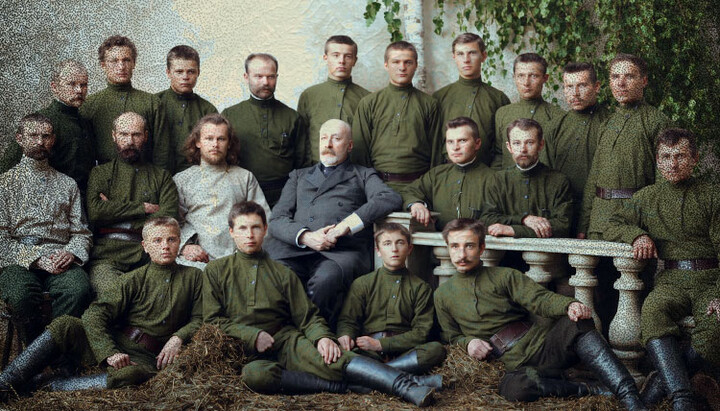
Nikolai Nepliuyev with members of the brotherhood. Photo: UOJ
Christianity is often reduced either to private piety or to cultural tradition. And yet there are always people who try to place the whole order of their lives under the Gospel. That is precisely what the world – and at times even the church milieu – fears most. Why does this happen? Many are still searching for an answer to that question today. That is why the experience of the Exaltation of the Cross Brotherhood remains so precious for us now.
How the brotherhood came into being
The history of the brotherhood began when, in 1880, a 29-year-old nobleman and landowner, Nikolai Nepliuyev, arrived at his estate of Vozdvizhenskoye in Hlukhiv district of Chernihiv province and devoted himself to agriculture. Before that, he had graduated from the law faculty of St. Petersburg University in 1875, served for a time at the Russian embassy in Munich, and then entered the Petrovskaya Agricultural Academy in 1877. Such a turn was already highly unusual for a nobleman of his era. But more striking still was the fact that he gave up the prospect of a brilliant worldly career in order to live a truly Christian life.
He began in 1881 by taking in ten peasant orphans and building a shelter and school for them. In 1885, a boys’ school was officially registered, and in 1891, a girls’ school followed.
As a zealous Christian, Nepliuyev soon realized that while his pupils lived and studied together, they were able to preserve a Christian way of life. But once they graduated, they returned to the ordinary world, where everything was arranged according to the laws of this age. From this came the idea of creating a community in which the grown former pupils could continue to live as Christians. In 1889, after the first graduation, three of the six students decided not to leave, but to found such a community. They became the first members of what would later become the brotherhood.
The solemn opening of the Exaltation of the Cross Brotherhood, which had received the blessing of the Holy Synod, took place in July 1895. Nepliuyev was personally blessed for this work with an icon of St. Alexei, the Man of God, by Metropolitan Pallady (Raev) of St. Petersburg, the senior member of the Holy Synod. In other words, from the very beginning this was not a secret circle or a self-styled sect, but an open Orthodox community with its own rule, its own church, and ecclesiastical patronage.
The brotherhood’s inner order
The central idea of the brotherhood was to make Christianity not one part of life, but life itself – to let every sphere be permeated by the spirit of the Gospel. To govern the brotherhood, a Brotherhood Council was established. From among its full members, a lifelong overseer of the brotherhood was elected, while economic matters were handled by a special administrative board.
According to their occupation, the members were organized into what were called brotherly family-communities: teachers, farmers, livestock breeders, craftsmen, and others. Each such community lived in its own house, prayed together, ate together, and discussed its affairs together.
Within these communities there were sisters on duty, responsible for meals, cleaning, and the care of small children.
But it is important to stress that this was not a celibate commune and not an attempt to replace the family with the collective. Marriages were contracted within the brotherhood, members lived with their wives and children, and the brotherly vows explicitly spoke of family duties, love for one’s wife and children, and the family as a “little church.” Family life was thus woven into a shared order of churchly labor and discipline. Nepliuyev himself, however, consciously chose to remain unmarried and devote himself entirely to the cause.
The brotherhood was also emphatically ecclesial. It had its own church, its own priest, a common life of prayer, a brotherhood choir, and general assemblies after the Divine Liturgy. One feature unique for church life in the brotherhood was that the rector of the church was chosen by the community itself, while the bishop retained only the right to approve or reject the proposed candidate.
A utopia – or a successful project?
Very often, dreams of arranging life as in the apostolic community of Jerusalem prove unworkable when they collide with reality. But the Exaltation of the Cross Brotherhood was not one of these. From the very beginning, it was built as a carefully organized household – a functioning economic organism.
In December 1901, Nepliuyev transferred to the brotherhood 16,435 desyatinas of land (a traditional Russian land measure, ≈ 1.09 hectares / 2.7 acres – Ed.), together with forest, buildings, and factories. The value of this property was estimated at more than 1.7 million rubles – an enormous sum for the time. Along with these assets, the brotherhood assumed major responsibilities: maintaining schools, the church, the hospital, and so forth. The members were not dreamers or enthusiasts detached from life. They succeeded in creating a remarkably effective social and economic body.
The results bore this out. By 1905, the brotherhood possessed 1,787 desyatinas of arable land, 200 oxen, 140 horses, 100 Simmental cows, 120 young cattle, and around 600 pigs. Its income was growing, and so was its population: from 79 people in 1901 to 291 in 1907, and to roughly 500 if one includes the pupils of its schools. The brotherhood had schools, a library, a hospital, workshops, processing facilities, orchards, and livestock operations of a very high standard for that era. As early as 1898, a local Siemens telephone network had been installed on the estate; later, it acquired its own power station. In 1911, the brotherhood’s agricultural enterprise received a large gold medal at the All-Russian Agricultural Exhibition. Its farming used the most advanced methods of the time, and its yields were two and a half times higher than the average for Chernihiv province.
Why the brotherhood proved so inconvenient to almost everyone
This is where the most painful part of the story begins. The experience of Nepliuyev and the Exaltation of the Cross Brotherhood aroused not only interest, but intense irritation. Contemporary reactions were deeply divided. Among those hostile to the brotherhood were Konstantin Pobedonostsev, Ober-Procurator of the Holy Synod; Metropolitan Antony (Vadkovsky) of St. Petersburg; Bishop Antony (Sokolov) of Chernihiv; and a number of prominent archpriests and public figures. Among those who supported it were Bishop Sergius (Sokolov), Metropolitan Pallady (Raev), St. John of Kronstadt, and Elder Barnabas of Gethsemane.
This very polarization of opinion already shows how sharply the brotherhood stood out from the customary patterns of church life.
The opposition was not merely verbal. According to contemporaries and later researchers, Pobedonostsev obstructed the approval of the brotherhood’s rule and, more broadly, viewed such an initiative as something alien to the habitual Synodal system.
Some sources recount the following exchange between Pobedonostsev and Nepliuyev: “Why are you so eager to occupy yourself with what is not your business? If you want to serve God, build a monastery, take monastic vows, and we shall soon make you a bishop.” When Nepliuyev replied that his aim was the enlightenment of the people, Pobedonostsev is said to have answered: “Leave the people alone. They have no need of enlightenment, and for the state popular enlightenment is even harmful, for it may shake its foundations.”
There were also the words of Metropolitan Antony (Vadkovsky), who wrote to Count Lamsdorff about the brotherhood: “A society whose aims are ambiguous, and for many, doubtful.” Under Antony’s influence, Empress Alexandra Feodorovna refused to take the brotherhood under her patronage. As for Bishop Antony (Sokolov) of Chernihiv, though he was formally its patron, he visited it only once in fifteen years and took almost no part in its life.
Why did this experiment provoke such irritation? First, because by its very existence the Exaltation of the Cross Brotherhood was already a reproach to the inert church administration. And second, because Nepliuyev himself spoke with great sharpness against the ecclesiastical realities of his day. In an article he wrote in 1906, in preparation for the Local Council – which, incidentally, had not been convened in Rus’ since 1667 – Nepliuyev wrote that church parishes had become “scattered and turned into fictions,” and that many representatives of the clergy were guided “not by the truth of God, but by orders and instructions from their superiors,” passing off “anti-ecclesial routine” as “true Orthodoxy.” Yet Nepliuyev did not leave the Church, and by remaining within it he exposed all the more starkly the deadness of its official structure.
The inner conflict
The brotherhood’s difficulties were not only external. In 1900, it went through a grave internal crisis. A group of teachers and more “intellectual” members rose up against the established order. They complained of excessive religious demands, too many meetings, a “gloomy religiosity,” and the suppression of independence. Nepliuyev himself was effectively accused of authoritarianism; they called him the “absolute master,” and the Brotherhood Council a closed judicial body. One of the dissatisfied members bluntly declared that the brotherhood ought to be not an ascetic labor, but a comfortable arrangement for life.
It cannot be said that these reproaches were entirely groundless. For example, about half of the Brotherhood Council consisted of Nepliuyev’s relatives.
This episode reveals that not every member of the brotherhood was capable of bearing a genuinely evangelical Christian life. To live by such a high ideal meant subordinating one’s personal ambitions, habits, domestic desires, and even family interests to it.
As a result of the conflict, several people left. Later, Nepliuyev wrote of it: “We lost many brothers and sisters after this. Some left us of their own accord at different times; a few were removed by us. The remnant of the faithful… began more than before to live with God, more than before consciously to love God and serve His holy work, and far more than before to place their hope not in themselves, not in their own reason and talents, but in the living God and the gracious powers that proceed from Him.”
It was at this difficult moment that Nepliuyev was supported by St. John of Kronstadt. In a personal meeting, he told him: “If you have gone after Christ, it cannot be otherwise than that you will be persecuted, slandered, and hated for His name’s sake. Rejoice in that. It is proof that you are serving the work of God and not the work of man.”
How the story ended
Nikolai Nepliuyev died in 1908. With his death, the brotherhood did not collapse, but continued to live and develop. Even after the Revolution of 1917, it preserved its internal Christian and economic order. In 1919, it was renamed the “First Ukrainian Soviet Commune,” and in 1923, the “October Revolution Agricultural Artel.” In the early 1920s, Soviet newspapers even wrote approvingly of its high agricultural culture and economic achievements.
But the brotherhood did not fit into the Soviet vision of life either. In 1925, its principal leaders were sentenced to terms ranging from one to ten years, with confiscation of property, on charges of counterrevolution, economic crimes, and criminal offenses. Not long afterward, many ordinary members of the brotherhood were also repressed. And in 1929, when collectivization began in Soviet Ukraine, the brotherhood was completely destroyed, and all its members were expelled from Vozdvizhensk.
Afterword
The history of the Exaltation of the Cross Brotherhood matters today not because it offers some ready-made model to be copied. What it offers, first of all, is a series of difficult questions.
If laypeople really were able – not without hardship and conflict, of course – to build a community in which the Christian faith shaped everything: labor, education, daily life, property, marriage, the raising of children, and the ordinary bonds between human beings, then why did the official church structures not do the same? Why did the experience of the Exaltation of the Cross Brotherhood prove unwelcome alike to state power – both imperial and Soviet – and to the official Church? And what, exactly, was so intolerable in this experiment? Its strictness? Its strangeness? Its accusatory power?
Or perhaps what frightens us is the very fact that the Gospel is capable of being not merely an object of reverence, but an actual rule of life.
Read also
Man before the forces of nature
A solitary figure on the shore seems insignificant before the immense power of the sea, yet it is he who stands before the Creator.
The mysteries of Golgotha in the light of archaeology
The veil of centuries obscures what really happened in the fourth century. Archaeology and ancient texts shed light on the true history of one of Christianity’s greatest sacred sites.
Zaporozhian Cossacks defend the persecuted faith
The story of how Cossacks drew their sabers to defend abused priests – while sometimes causing violent disturbances inside churches themselves.
A forgery at the foundation of Mohyla Academy
For centuries, historians have repeated an appealing story about a wealthy benefactor’s generous gift. Archival documents, however, paint a very different picture of what happened.
Theology of worn-out shoes
A painting of a pair of old shoes in a Dutch museum preserves the memory of an ordinary working person and a life of hard labor.
Everyday life and labors of the Lavra brotherhood
We are accustomed to seeing the Pechersk Monastery as it appears on picture-perfect postcards. Archival records from the 19th century take us back to the down-to-earth realities of monastic life.