On the seizure of a UGCC сhurch in Tokmak
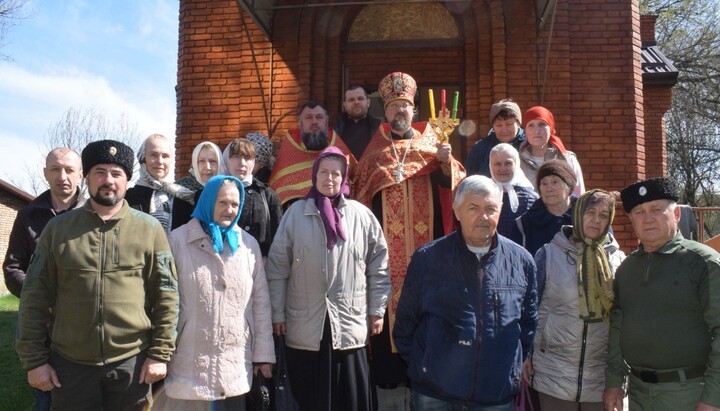
Orthodox believers outside the UGCC church in Tokmak. Photo: Tokmak Today
In Tokmak, priests identifying themselves as “clergy of the Berdyansk eparchy of the Russian Orthodox Church” held a Paschal service in the Saints Peter and Paul church of the UGCC. According to them, the building had been abandoned, no services were being held, and so they decided to take it under their control and “in the near future transfer it to the Berdyansk eparchy of the ROC.”
The UGCC called it a seizure and theft. They insist the parish does have a genuine parishioner, while “outsiders demonstratively present themselves as ‘parishioners.’” The sharpest reaction came from the head of the Greek Catholics, Sviatoslav Shevchuk. In his words, an Orthodox service in a Greek Catholic church is “blasphemy against the Risen Lord – the Prince of Peace.”
How should this situation be assessed?
First, one can hardly disagree with the Greek Catholics that entering a church without the consent – and even without the knowledge – of its owners is theft. All the more so since there appears to be no pressing need for it: judging by the photos, Orthodox churches in the city are not overcrowded.
On the other hand, the UGCC’s response – especially the language of “blasphemy against the Lord” – inevitably raises questions.
- Few remember it now, but the UGCC’s emergence from the underground in the late 1980s was accompanied by mass and often forceful seizures of Orthodox churches. Yes, in many cases Greek Catholics were reclaiming what had once been theirs. Yet in the process, hundreds of historically Orthodox churches were also taken. Many still recall the 2017 incident in Kolomyia, when UGCC clergy broke down doors and expelled the UOC community from the ancient Annunciation church. The case drew wide attention, and Shevchuk could hardly have been unaware of it – yet no assessment of that seizure followed. And unlike Tokmak, the church in Kolomyia was not abandoned: services were held there daily.
- In his Paschal homily, Shevchuk called for unity between Greek Catholics and Orthodox – even unity “in the sacraments of Christ’s Church.” As far back as 2013, speaking on Luhansk television, he asserted that the UGCC adheres to Orthodox dogma. Which raises a question: if he calls for unity between Catholics and Orthodox, why is an Orthodox service in a Greek Catholic church in Tokmak suddenly “blasphemy”? Was there any insult or irreverence toward God, toward the sacred, toward religious symbols or objects of faith? No. So what, then, is the issue – politics? The fact that the Orthodox in Tokmak are deemed “pro-Russian”?
- The UGCC statement claims that “local parishioners are forbidden from coming to their native church, while outsiders demonstratively act as ‘parishioners.’” The words are familiar. This is exactly how UOC believers spoke in Kolomyia when they were driven out of their own church. It is how UOC parishioners speak when they are expelled by supporters of the OCU. Yet the UGCC leadership has never once come to the defense of those affected.
And here lies the central problem. The UGCC’s declarations of “blasphemy” are not the cry of a persecuted Church. They are a textbook example of double standards. When you take from others, it is “the restoration of justice.” When something is taken from you, it becomes “blasphemy against the Lord.”
The only difference is which side of the line you happen to be on.
Read also
Ternopil post on Feast of Intercession: Has calendar reformn failed?
A significant number of believers have rejected the new church calendar introduced by the OCU and UGCC with government support.
Shoulder straps or a cassock: who writes the script for UOC "fighters"?
Everything indicates that both Veliar and Pshenychny are ordinary performers of someone else's script. There is only one question – does the scriptwriter wear shoulder straps or a cassock?
Why is it legal to kill a person before birth but not after?
Children are the most privileged members of society. Yet that same society officially permits children to be killed – and on a massive scale.
Honoring the Bolsheviks’ successors at Kyiv Lavra
It was under the Reserve that the relics of the saints were desecrated, Lavra churches were turned into an atheism museum, and toilets were installed in sanctuaries.
"Degenerates" and "stupid animals": anti-UOC activists turn on children
Future historians will wonder how a vast country’s information agenda could have been shaped for so long by people so petty, vicious, and utterly contemptible.
Zelensky sees murder of Polish priest but not of Sviatohirsk monk
Why does Zelensky react so emotionally and swiftly to the murder of a Catholic cleric while remaining completely silent about the murder of an Orthodox monk?