Paper fortress: The Gregorian schism of 1925
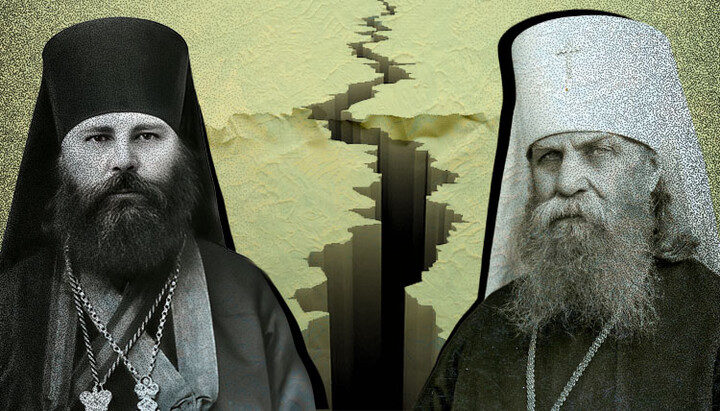
Metropolitan Peter (Poliansky) and Archbishop Grigory (Yatskovsky). Photo: UOJ
In the center of Yekaterinburg as it appeared in 1926 stood the Epiphany Cathedral. The episcopal throne there was held by Archbishop Grigory (Yatskovsky). He possessed everything required – official registration of the Provisional Higher Church Council (VHCC) and complete recognition by the local authorities. Yet the deacon’s voice resounded into emptiness. The vaults of the cathedral echoed the sounds of the service without resistance – there were almost no worshippers in the building.
At the same time, on the outskirts of the city, in the small Church of St. John the Baptist at the Ivanovo cemetery, the picture was entirely different. In the cramped narthex, hundreds of people stood shoulder to shoulder, creating an atmosphere in which it was difficult even to raise one’s hand for the sign of the cross. There served clergy deprived of rights to the central churches and receiving no support from the state.
The situation in Yekaterinburg vividly illustrated the mechanism of the Gregorian schism. Administrative legality and transferred buildings were severed from the real life of the community. People made their choice, ignoring official seals on paper. They sought canonical continuity – something that, in their eyes, outweighed any lease agreement.
Operational situation
By the autumn of 1925, the anti-religious policy of the Secret Department of the OGPU required adjustment. Yevgeny Tuchkov, head of the Sixth Section, analyzed the results of the Renovationist project. The Renovationists, who had attempted to reform the Church by abolishing fasts and introducing a married episcopate, had lost influence. The people perceived them as something alien. Tuchkov needed a new instrument to destabilize the church environment.
The OGPU’s new strategy was to create a structure that outwardly would fully replicate the traditional Church.
Tuchkov needed the same beards, the same liturgical texts, and the old calendar style. The essential requirement was hidden yet complete loyalty of the hierarchy to the administrative apparatus.
On December 10, 1925, Metropolitan Peter (Polyansky), acting as Locum Tenens of the Patriarchal Throne, was arrested. This created a vacuum in the highest level of church governance – one the OGPU moved to fill with a controllable group of bishops. The choice fell on Grigory (Yatskovsky), whose ambitions and dissatisfaction with church leadership became the lever for launching the schism.
Recognition in eleven days
On December 22, 1925, ten bishops gathered in Moscow, in the former quarters of Patriarch Tikhon at the Donskoy Monastery. The group announced the creation of the Provisional Higher Church Council. Archbishop Grigory and his supporters justified this step as necessary to legalize church administration under conditions where the lawful head had been arrested.
The response of the state organs was immediate. Documents show that the NKVD registered the Provisional Higher Church Council in just eleven days – by January 2, 1926. For comparison, ordinary parish communities spent months obtaining permits even for minor economic needs. The Gregorians received the right to use official seals, publish a journal, and occupy the finest cathedrals in major cities.
Archbishop Grigory hoped that legal status would attract bishops seeking stability. In OGPU materials, the project was viewed as a way to definitively divide the supporters of the Patriarchal Church. The Gregorians built an administrative structure based on external attributes of authority and the backing of the security apparatus.
The canonical knot
The project encountered resistance in the person of Metropolitan Sergius (Stragorodsky). Based in Nizhny Novgorod, he was serving as Deputy Locum Tenens. On January 29, 1926, he issued a message that became a key document in the history of the schism.
In his letter, he invoked the 34th Apostolic Canon. This rule requires bishops to recognize their head and undertake nothing without his will. The hierarch pointed out that the Provisional Higher Church Council had arisen bypassing the lawful Locum Tenens and therefore constituted a self-appointed assembly. Grigory and his supporters were suspended from ministry.
The message spread across the country in handwritten copies.
For clergy and laity alike, Metropolitan Sergius’ canonical argument became a point of firm support.
Within church circles, a broader discussion arose about the nature of authority. The 1848 Encyclical of the Eastern Patriarchs was recalled – it articulated the principle that the people are the guardians of the faith. This thesis was confirmed in practice. Parishioners en masse refused to attend churches where bishops loyal to the VHCC served. Grigory’s project fell into isolation.
OGPU reports: leaders without followers
Secret OGPU reports from 1926 have been preserved in the archives. These documents record the failure to win over the faithful. In the Urals, the center of Grigory’s influence, reports noted the transfer of buildings to the Provisional Higher Church Council – but added remarks about empty halls. Cathedrals stood as administrative monuments, while church life continued in small churches or in private homes.
Tuchkov reported to his superiors that Gregorianism remained a schism within the episcopal corps. It succeeded in attracting some bishops but failed to attract the flock. By 1928, the authorities’ interest in the project began to wane. The OGPU no longer saw the VHCC as an effective instrument. The state turned to direct terror, where subtle games of legality lost their meaning.
Gregorian parishes began to be closed on general grounds. Yesterday’s allies in the Provisional Higher Church Council were now being arrested. Grigory’s loyalty did not ensure the safety of his supporters. By the early 1930s, both funding and administrative support for the schism had ceased.
The collapse of a paper structure
By the mid-1930s, the Gregorian schism had effectively ceased to exist. The Provisional Higher Church Council lost the ability to govern even the few parishes that remained under it. In 1937, most of the structure’s active figures were repressed. Archbishop Grigory died in 1932, leaving behind an organization that existed only on paper.
Unlike the Old Believers, who preserved their communities for centuries through inner conviction, Gregorianism disappeared together with the administrative resource that sustained it. The last parishes of the schism were incorporated into the Russian Orthodox Church in 1943, when Patriarch Sergius was elected.
The history of the Gregorian schism demonstrated that a church structure loses its meaning if it rests solely on registration papers.
The security services succeeded in seizing buildings and printing documents, but they could not compel people to accept a fabricated authority. Gregorianism remains in history as a striking example of how the pursuit of legality at any cost leads to a total loss of the faithful’s trust. The state’s project collapsed when it collided with the lived reality of parish life, where canonical truth proved stronger than official registration.
Read also
Why holy monasteries turned into state prisons
The history of Christian Europe has preserved the memory of times when monasteries became places of state exile. The fates of monarchs and righteous men were decided there.
A shepherd boy with a letter from Christ to French king
In the summer of 1212, thousands of pilgrims carrying staffs waited for the sea to part before them. Later chroniclers added ships, slave traders, and a pope's lament to their story.
Facade of bones and facade of light
Antoni Gaudí spent forty-three years building a church in Barcelona, knowing that this construction was for the ages.
Trial of a dead pope
Once in Rome, the body of a deceased pope was seated on the throne and put on trial. The accusation relied on a church canon that had once saved his see.
Monastery built in defiance of king
When Orthodox believers in Minsk were left with just one church, townspeople decided to build another – and even a royal decree did not stop them.
Young Mother and Sleeping Christ
Michelangelo carved a Virgin Mary who looks younger than her Son – and signed his name in marble for the only time in his life. Neither of these peculiarities was accidental.