Nestorianism: the heresy of professors
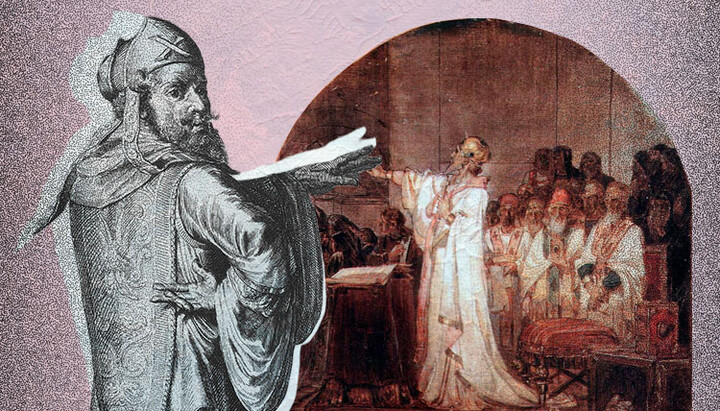
Patriarch Nestorius and the Third Ecumenical Council. Photo: UOJ
December in Constantinople in 428 began with personnel changes that would soon shake the entire empire. Nestorius ascended to the patriarchal throne, a monk from Antioch, a man of impeccable asceticism and rare oratorical gift. He was awaited as a reformer capable of cleansing the capital from the remnants of Arianism and licentiousness.
However, during one of his first sermons, when the church was packed to the last narthex, something was said that made the congregation fall silent. Nestorius supported his presbyter Anastasius, who declared: "No one should call Mary the Theotokos. For Mary was human, and it is impossible for God to be born from a human being."
A murmur rolled through the church, which quickly escalated into street protests. For the ordinary resident of Constantinople, this was not a subtle dispute among learned men. People's faith, which had absorbed belief in Christ for centuries, reacted instantly. If Mary gave birth not to God, but simply to a man, then God did not truly become one of us. An investigation began, which would lead three years later to the convening of an Ecumenical Council and a large-scale Christological schism.
The mechanics of division: the School of Antioch
To understand Nestorius’ reasoning, it is necessary to examine his intellectual tools. He was a representative of the Antiochian theological school, which emphasized the historical reality of Christ and a strict distinction between His natures. Nestorius was not a madman or a deliberate destroyer. He was an intellectual educated in Greek philosophy, where one of the main axioms was the “impassibility” of the Divine.
God, in the understanding of the Antiochian thinkers, is unchangeable, infinite, and cannot be subjected to physical processes – birth, hunger, pain, or death. In an effort to protect the divine dignity from the “humiliation” of earthly existence, Nestorius applied a method that his opponents considered destructive. He began to distinguish in Christ between “the one who suffers” and “the one who remains divine.”
The critical perspective of the Alexandrian school, led by Saint Cyril, described Nestorius’ system as an attempt to place God and man in the same body, but in different “apartments.”
According to his opponents, the patriarch created a scheme in which there existed two separate Persons: the Man Jesus, who was born and died, and God the Word, who only temporarily dwelt in this man, as in a temple or garment. For Nestorius, this was a matter of terminological purity; for his opponents, it was the actual destruction of the meaning of the Incarnation.
Documentary dispute: Theotokos or Christotokos
The conflict focused on one word – Theotokos (God-bearer). Nestorius proposed replacing it with Christotokos (Christ-bearer). He considered this term more "scientific" and precise. His reasoning was straightforward: Mary could not give birth to the Creator of time; she gave birth only to flesh that became an instrument of divinity.
However, behind this change of root lay a fundamental problem of redemption. Saint Cyril of Alexandria in his twelve anathemas established: if it was not the Divine Person who suffered on the Cross, then human nature was not healed. From the perspective of Alexandrian theology, if even a millimeter of distance is preserved between God and man, salvation is impossible.
The sacrifice had to be offered by God Himself in His humanity, not simply by a righteous man with whom God "made a partnership agreement."
The dispute quickly went beyond the synods. Emperor Theodosius II, his sister Pulcheria, and Pope Celestine of Rome became involved. The issue was no longer about terms, but about the political influence of sees and the unity of the empire.
Ephesus 431: the failure of diplomacy
The Third Ecumenical Council, which opened in Ephesus in 431, least resembled a peaceful gathering. Participants arrived with bodyguard detachments, and sessions began before Nestorius's supporters from Antioch had managed to reach the city.
The Council deposed the patriarch, recognizing the term "Theotokos" as mandatory. But Cyril of Alexandria's triumph did not bring immediate peace. The Church officially established a paradox: God the Word united with flesh in such a way that He became "one Word incarnate." From the perspective of Greek logic, this appeared to be an irrational assertion.
However, it was precisely in this rejection of Nestorius’ “convenient” and “comprehensible” system that the Church found a new formulation of its confession of faith.
After condemnation, Nestorius was exiled – first to his old monastery, then to the remote Egyptian oasis of Ibis. There he lived for about another twenty years, watching as his name became synonymous with heresy, while his followers moved further and further east, beyond the reach of the Roman legions.
The Eastern trail: the Assyrian Church
The fate of those called Nestorians is one of the most extensive and tragic pages of history. After expulsion from the empire, they found refuge in Persia, in the Sasanian state. There arose a structure known today as the Assyrian Church of the East.
It is important to clarify: the representatives of this tradition never considered themselves followers of a heretic. They claimed to preserve the original apostolic teaching of Antioch, and considered the decisions of the Council of Ephesus the result of intrigues and misunderstanding. By the 8th century, their influence was colossal. Nestorian missionaries traveled the Silk Road, building monasteries in India and China (as evidenced by the famous “Nestorian Stele” in Xi’an). They were the main translators of Aristotle and Galen into Syriac, effectively becoming intermediaries between ancient wisdom and the future Islamic world.
Contrary to popular opinion, this tradition did not disappear under Tamerlane's blows. The Assyrian Church of the East exists today, preserving an ancient liturgy and unique Christological language that still provokes disputes among historians.
Memoirs from the sands: "The Book of Heraclides"
IIn 1895, an event occurred that forced scholars to take a new look at this case. In the mountains of Kurdistan, a manuscript titled “The Book of Heraclides of Damascus” was discovered. These were the memoirs of Nestorius himself, written by him during his Egyptian exile shortly before his death.
In this book, the old exile defends himself. He claims that he never divided Christ into two persons, but only tried to find words so as not to mix the divine and human into some "third nature." He acknowledges Cyril's terminology and bitterly laments that he became a victim of political struggle.
This document makes Nestorius's story even more human and complex. Before us is not a fanatic but a man who became entangled in his own precision. Trying to create a perfectly calibrated theological blueprint, he forgot that living faith does not fit within the framework of syllogisms.
The tragedy of a brilliant mind
The history of Nestorianism is not only a chronicle of old disputes about Greek words but also a warning about how dangerous it is to make faith "decent" and "logical" for the mind at the cost of losing its essence.
Nestorius sought to save God from humiliation but ultimately deprived Him of the possibility to descend to man, into the depth of his suffering.
The main essence of the error here lies in the substitution of tasks. Philosophy strives for transparency and absence of contradictions. Christianity, however, is built on the paradox of the Incarnation, which cannot be "explained" but must be believed. Nestorius offered a remedy for ignorance where it was necessary to acknowledge the healing of humanity from death. This is where the tragedy of his brilliant mind lies.
Read also
Trial of a dead pope
Once in Rome, the body of a deceased pope was seated on the throne and put on trial. The accusation relied on a church canon that had once saved his see.
Monastery built in defiance of king
When Orthodox believers in Minsk were left with just one church, townspeople decided to build another – and even a royal decree did not stop them.
Young Mother and Sleeping Christ
Michelangelo carved a Virgin Mary who looks younger than her Son – and signed his name in marble for the only time in his life. Neither of these peculiarities was accidental.
Orthodox books from a Uniate printing press
In the 18th century, Uniate monks at Pochaiv printed books used in prayer by Orthodox Christians and Old Believers alike.
The story of the honey brotherhood
The Mogilev Brotherhood began with members pooling money to brew honey drinks for feast days – and eventually grew to have its own printing press.
Golgotha in the midst of a pogrom
In the autumn of 1938, the Jewish artist Marc Chagall painted the crucified Christ. Synagogues burn and refugees flee around the cross, while the Crucified One Himself is wrapped in a prayer shawl.