Bykivnia: Where the state buried the truth for fifty years
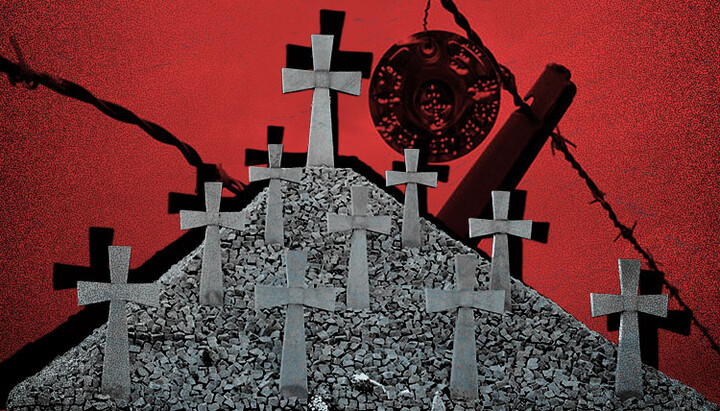
Memorial at the Bykivnia Graves. Photo: UOJ
On the northeastern edge of Kyiv, near Bykivnia, stands a pine forest that today may seem like an ordinary suburban woodland. But for decades, its true status was defined not by maps or public memory, but by secret protocols. Beneath layers of needles and sand lies the largest burial site in Ukraine for victims of the mass political repressions of 1937–1941.
The documented history of this place began on March 20, 1937. That day, the Kyiv City Council, meeting behind closed doors, allocated land for the “special needs of the NKVD of the USSR.” The decision concerned the 19th and 20th quarters of the Bykivnia forestry. The archival papers offered no explanation – only a cold bureaucratic formula, behind which lay hectares of future execution pits.
Soon the site was sealed off by a high, solid fence painted dark green. Barbed wire ran along the top; watchtowers with armed guards rose at the corners. Local residents were told an artillery depot was being built there. But the “depot” behaved strangely: by day, silence reigned behind the fence; at dusk, tarpaulin-covered trucks began moving toward the gates.
Logistics and the technology of concealment
The routes by which bodies were taken to Bykivnia have since been reconstructed by historians from eyewitness accounts and prison archives. The main points of departure were Lukianivska Prison, the NKVD internal prison on Korolenko Street – today the SBU building – and the basements of the mansion at 16 Lypska Street. In the 1930s, death sentences were carried out in these places day after day.
The burial process was put on an assembly line. Bodies were thrown into pre-dug pits up to five meters deep.
To force as many victims as possible into a single grave, the remains were laid in layers and covered with quicklime. It was a deliberate technique: the lime hastened the destruction of tissue and was meant to make future identification almost impossible.
When the trenches were filled, they were covered with soil, and young pines were planted above them. The calculation was simple and chilling: in ten or fifteen years, the forest would hide every scar in the earth. The peak of the special site’s activity came in the spring and summer of 1938. According to documents, on the night of May 19 alone, 563 people were shot in Kyiv and taken to the 19th quarter. Historians estimate that between 20,000 and 100,000 people are buried here, though the absence of complete records makes an exact figure impossible.
Repressions against the Kyiv clergy
Clergy were among the regime’s principal targets. In 1937–1938, arrests of Orthodox priests, monastics, and active laypeople in Kyiv and the surrounding region became massive in scale.
Investigations moved quickly. Priests were charged under standard political accusations: most often, participation in a “counterrevolutionary church-monarchist organization,” espionage, or “anti-Soviet agitation.” Sentences were issued not by courts, but by extrajudicial bodies – the so-called troikas.
Among those driven to Bykivnia at night were clergy of closed Kyiv parishes, monastics of the Kyiv-Pechersk Lavra, and residents of destroyed monasteries in the city and its outskirts.
In practice, religious identity itself was enough to make a person suspect, while loyalty to the priesthood or a hidden church life could become the reason for a death sentence.
During arrests, pectoral crosses, service books, and icons were seized as “evidence.” Today, numerous rehabilitation files preserved in the archives allow researchers to restore, name by name, the memory of executed clergy.
Official versions and the fabrication of falsehood
The secrecy surrounding the site was broken in 1941 during the German occupation, when the first excavations were carried out with the participation of representatives of the International Red Cross and local residents. Information about the mass graves of NKVD victims reached the press, and photographs were taken. But after Soviet rule returned in 1944, the official interpretation of the tragedy was abruptly rewritten.
For the next several decades, the Soviet state insisted that those buried in Bykivnia were victims of the Nazi regime.
To preserve this legend, state commissions were formed. The first worked in 1944, the second in 1971 – headed by KGB chairman Fedorchuk – and the third in 1987. All of them, despite the discovery of personal belongings dated before 1941, officially declared that the burials belonged to the period of German occupation.
A monument was even erected in the forest with an inscription to “Soviet citizens tortured by the German-fascist invaders.” For decades, relatives of the murdered were issued false certificates claiming their loved ones had died of illness in camps, or were given the standard formula: “ten years without the right of correspondence.” It was a period of systematic falsification, when even gravestone inscriptions were made to serve the machinery of disinformation.
Material evidence against the system
The official version began to collapse thanks to Kyiv dissidents and activists. In the 1960s, members of the Club of Creative Youth – Alla Horska, Vasyl Symonenko, and Les Taniuk – discovered sunken patches of ground and fragments of human remains. Despite pressure from the security services, they began collecting eyewitness accounts.
The decisive evidence came from the personal belongings pulled from the earth. The pits yielded not only bones, but objects that quicklime had failed to destroy: metal mugs, aluminum bowls, hair combs, fragments of shoes. On many of these items, prisoners had managed to scratch their surnames, initials, or even addresses. The dead themselves had left testimony.
Receipts for confiscated belongings, dated 1937, also emerged from the soil. It was obvious that Nazi occupiers could not have shot people using NKVD documents four years old. These material proofs, together with the political changes of the late 1980s, forced the authorities to admit the truth. In 1989, the fourth commission officially confirmed that those buried in Bykivnia were victims of Stalinist repression.
The memorial today
Today, Bykivnia is the National Historical and Memorial Reserve “Bykivnia Graves.” Researchers have so far restored, from archival lists, the names of more than 18,000 people taken to this special site. The list includes people of different nationalities, professions, and social backgrounds: academics, priests, workers, peasants.
The Polish Military Cemetery is located here as well. Thousands of Polish officers and civilians, executed in April–May 1940 as part of the so-called Ukrainian Katyn List, are buried in Bykivnia.
Every tree in this forest is now a reminder of those years. Pine trunks are wrapped in embroidered cloths; photographs of the murdered are fastened to the bark. Relatives continue to restore family memory that for decades was treated as if it had never existed.
Bykivnia has become a severe lesson in how long a state lie can survive – and how painfully historical justice is restored.
A place designed as a zone of absolute silence and oblivion has become documentary evidence of the scale of terror. The history of this forest shows that even destroyed records and quicklime cannot guarantee the concealment of crimes, so long as material evidence remains – and so long as there are people determined to seek the truth.
Read also
Orthodox Books from a Uniate Printing Press
In the 18th century, Uniate monks of Pochaiv printed books that Orthodox believers and Old Believers used for prayer.
The story of the honey brotherhood
The Mogilev Brotherhood began with members pooling money to brew honey drinks for feast days – and eventually grew to have its own printing press.
Golgotha in the midst of a pogrom
In the autumn of 1938, the Jewish artist Marc Chagall painted the crucified Christ. Synagogues burn and refugees flee around the cross, while the Crucified One Himself is wrapped in a prayer shawl.
Stories of the Early Church. Level of governance: patriarch
How did several episcopal sees rise above the rest, why did the Church’s administrative map come to mirror that of the empire, and is the patriarchate a sacred form of Church governance?
A Chronicle without an author
We are accustomed to calling The Tale of Bygone Years the work of St. Nestor. Yet another monk left his signature on it, while the chronicle itself passed from one generation of scribes to the next.
How a wedding stopped a war
The young princess of Slutsk was married off to keep two powerful noble families from drowning the city in blood. Soon afterward, a Uniate metropolitan complained that Orthodoxy had been reborn in Slutsk.