How a great logician became a "secular hesychast"
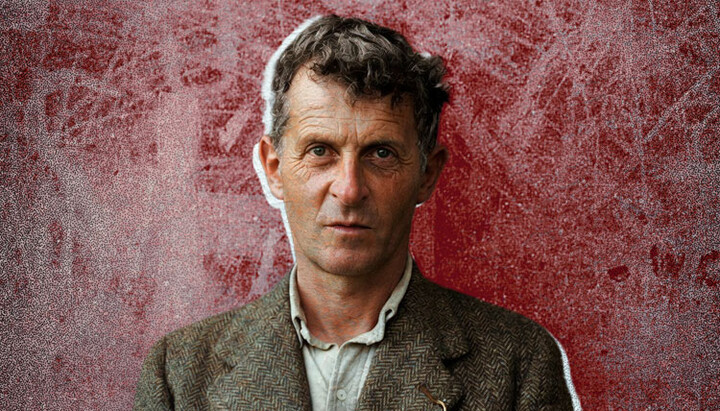
Philosopher Ludwig Wittgenstein. Photo: UOJ
On April 29, 1951, Ludwig Wittgenstein died – a man who entered philosophy as an engineer of logic and left it as something like a secular hesychast. His life and thought form a rare existential bridge between the dry rationalism of the West and the profound mystical intuition so close to Orthodox spiritual practice.
Ludwig Wittgenstein was born into one of the wealthiest families in Europe. His home in Vienna was a center of culture, visited by Brahms and Mahler, Klimt and Freud. But beneath the glitter of gold lay tragedy: three of his brothers took their own lives. Each had his own reasons, still debated by historians. Modern scholars also point to a possible hereditary tendency toward clinical depression. Ludwig himself admitted that thoughts of suicide haunted him almost every day for decades. Philosophy became for him a kind of therapy – a way of disciplining the mind so that it would not destroy its owner.
The Gospel in the trenches and the renunciation of millions
Ludwig’s path toward God and philosophy began not in the quiet of libraries, but amid the thunder of the First World War. As a volunteer in the Austrian army, he carried the Gospel in his knapsack – though in Leo Tolstoy’s version. His fellow soldiers called him “the man with the Gospel.”
It was there, under shellfire, that he understood: philosophy was not a career, but a way to survive without losing one’s humanity in the face of death.
After the war, Ludwig did something that shocked Viennese society: he renounced an immense inheritance, transferring it to his brothers and sisters on the condition that they never return it, and left to work as a village schoolteacher. He cleaned toilets in hospitals, lived in ascetic huts, and to the end of his days owned little more than a bed, a table, and a few books.
The limits of logic and the Ineffable
The central work of his life, Tractatus Logico-Philosophicus, is built like an iron chain of logical propositions. Wittgenstein tries to construct an ideal language in which every word corresponds precisely to a fact. But why? Not in order to glorify science, but to reveal its impotence before the things that matter most. He builds a “wall” around the world. Everything we can describe – science, facts, everyday life – remains inside that wall. But everything for which life is worth living – ethics, the meaning of life, God – lies beyond it.
“The meaning of the world lies outside the world,” Wittgenstein writes.
For an Orthodox reader, this resonates with the doctrine of the createdness of the world. The world does not contain within itself the reason for its own existence. Wittgenstein’s logic is an honest admission: “As a human being, I can describe the mechanism of a clock, but I cannot explain in the language of physics why the clock was made by the Master.”
Orthodoxy draws a firm distinction between the essence of God, which is unknowable, and His energies, through which He acts in the world. Wittgenstein, without realizing it, translated this principle into the language of analytic philosophy. For him, God is not an “object” among other objects. We cannot speak of God as we speak of the weather or the economy. The moment we try to “define” God, we fashion an idol. We try to force the Ineffable into the narrow frame of human syntax. Wittgenstein’s “silence” is not disregard for God. On the contrary, it is a form of deepest reverence. It is the recognition that God is not a “topic of conversation,” but the One by whom we breathe.
Religion as practice
In his later period, Wittgenstein came to see language not simply as a mirror of the world, but as a “form of life.” He introduced the idea of “language games.” The meaning of a word depends on the context in which it is used. For an Orthodox Christian, this is a key to understanding Tradition. Faith is not a collection of quotations to be memorized. It is a “language game” into which one must enter with one’s whole being.
For instance, we may read hundreds of books about “humility,” but we will not understand the meaning of the word until we bow down before someone who has offended us. Wittgenstein stressed that to understand religious language, one must participate in religious practice. Liturgy, fasting, prayer – these are not merely “symbols”; they are actions that generate meaning. Without the experience of prayer, the words of Scripture remain, for the outside observer, empty sounds.
Ludwig Wittgenstein often said: “I cannot help seeing every problem from a religious point of view.” And yet he was tormented by his own unbelief – or rather, by the “insufficiency” of his faith.
He was radically honest: he saw the height of Christ’s commandments and his own inability to live up to them. Wittgenstein’s life is a sobering lesson for “comfortable” Orthodoxy. We often grow accustomed to holy things, and the words of our prayers become automatic. Wittgenstein restores to us the truth that faith is a shock. If God exists, then everything in your life must change. If you do not change, then you are simply lying when you utter the word “God.”
The happiness of ultimate clarity
Wittgenstein died of cancer in 1951. In his final days, friends read philosophy to him, but he sought only silence. Ludwig’s last words were: “Tell them I’ve had a wonderful life.” They sound strange coming from a man who spent his life wrestling with melancholy and loneliness. But this was the happiness of having attained ultimate clarity.
Ludwig fulfilled his task: he cleared a place for God by removing the debris of empty words and false cleverness.
For an Orthodox thinker, Wittgenstein is an ally. He helps us understand that our faith begins where proofs end. He teaches us that the most important text is written not on paper, but with our lives. And when words come to an end, all that remains is to stand before the One who is higher than every word. The anniversary of this great thinker’s death may become for us a reason to fall silent, if only for an hour – and in that silence to hear the Voice that has no need of logical definitions.
Read also
The help God never asked for
Uzzah wanted only to keep the Ark of the Covenant from falling into the dust. Why did this well-intentioned act cost him his life, and who was really responsible for his death?
Freedom begins when there's nothing left to take
Fear of persecutors takes root in our attachment to possessions. We turn to St. Basil the Great to understand why the prefect's threats held no power over him.
The bride in the window frame
The author of the earliest account of St. Thecla’s life was defrocked. Yet it was his book that preserved the only ancient description of the Apostle Paul’s appearance.
Drinking priest, or the flip side of parish life
In his epistle, the Apostle Jude describes a scene familiar to anyone who has seen a church meal turn into a drinking party.
A lesson from a speechless donkey
The famous seer struck his donkey three times for refusing to go forward. All the while, she was saving his life – and seeing what he could not.
The time when the soul ripens
Modern society has turned youth into a cult and old age into a period of merely “living out one’s days.” The Christian perspective reveals the profound spiritual meaning of our later years.