"Picasso": The Fall and Repentance (conclusion)
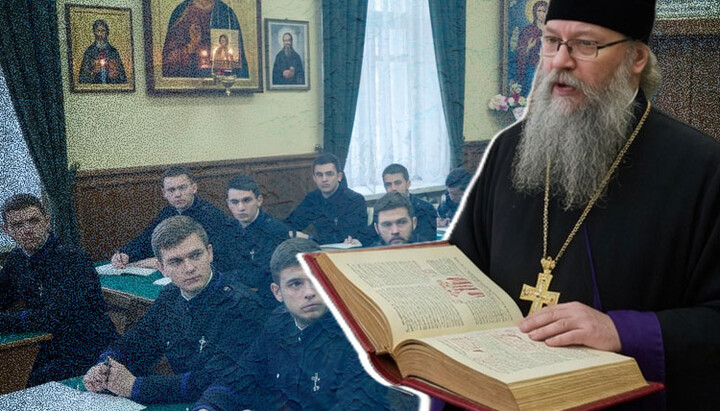
Lecture at the theological seminary. Photo: UOJ
Time – 1992
Place – Kyiv
Characters – Father Lavr and the seminarians.
“Father Lavr, but not everyone who fails to repent ends in suicide. Most people simply go on living and feeling quite fine. So how is it one or the other?”
“That is because,” Father Lavr replied without the slightest hesitation, “the devil does everything in his power to keep people from recognizing their nakedness. Practically all of modern civilization – scientific and technological progress, the rhythm of life, entertainment, cinema, literature, sports, work, the endless stream of information, everything imaginable – serves one purpose: to ensure that a person never stops, never looks at himself, and never sees that he is naked.
“There was once a philosopher… hmm… Friedrich Nietzsche. He expressed an interesting thought: ‘Art is given to us so that we shall not die of the truth.’
“Do you understand, brethren? So that a man will not see himself naked…”
“Hm… yes… Again, a man can live like everyone else, according to the spirit of this world. Doing what everyone around him does. Studying, working, trying to achieve some social position…
“Like everyone else,” Father Lavr smiled faintly, “everyone lies, and I lie too; everyone commits fornication, and I do the same; everyone bows to idols, and I bow too…
“Such a person may even come to confession saying: ‘I am sinful, Father, like everyone else… but I haven’t stolen, I haven’t killed…’
“A decent fellow overall.”
“But sometimes it happens that this person, who is ‘like everyone else,’ suddenly sees his nakedness. Through some grief, life circumstances, or something else. And then, when he beholds the full horror of that nakedness, yes – only two possibilities remain before him.
“In the prayers before Communion there are these words: ‘And I know that Thou wilt set my sins before me exactly as I committed them…’
“This will happen to every one of us after death without exception. Then we shall suddenly see all our sins exactly as they are, in all their filth and ugliness, even if during life we paid them no attention.
“But sometimes God shows a person while he is still alive what he has done – all his sinful deeds in all their terrible significance…” He repeated thoughtfully: “‘Thou wilt set my sins before me exactly as I committed them…’”
“But Father Lavr,” someone asked belatedly, “doesn’t Scripture also say that Judas repented?”
“Yes, it does say Judas repented,” Father Lavr agreed, and this time, without closing his eyes as he usually did while quoting, he recited:
“‘Then Judas, which had betrayed Him, when he saw that He was condemned, repented himself, and brought again the thirty pieces of silver to the chief priests and elders, saying: I have sinned in that I have betrayed innocent blood. And they said: What is that to us? see thou to that. And he cast down the pieces of silver in the temple, and departed, and went and hanged himself.’”
“Why did this happen? Because repentance must be brought only to God, to Christ. Only He can bear our sins. No one else, brethren, no one.
“Judas’ repentance was repentance within himself… or perhaps before the Pharisees. And it ends… yes, it ends exactly as his did.
“One cannot simply repent privately in one’s heart. We will speak more about that now.”
Father Lavr slowly paced across the classroom.
“But let us return to the account of Adam and Eve.
“From the fact that they realized they were naked and hid from God, we may conclude that they became strangers to Him. A separation occurred.
“First of all, man fell away from God. And if we remember that God is the source of life, then this falling away was precisely man’s death. Man became mortal, ‘dying he died,’ as Scripture says. Illness and death became his inheritance.
“The second separation occurred between Adam and Eve. They became strangers to one another.
“Besides what has already been said concerning nakedness… shame at their nakedness… this means they were no longer as it is written: ‘a man shall leave his father and mother and cleave unto his wife, and the two shall become one flesh.’ And immediately after this Scripture says: ‘And they were both naked, Adam and his wife, and were not ashamed.’
“But now they hide their nakedness from one another, because alienation has entered between them. Yes…”
“And the third separation was within man himself. All the powers of the human soul – and not only the soul, for man has a body, a soul, and a spirit – all of this, which had once existed in harmony and order, became disordered through the Fall.
“The Apostle Paul writes: ‘The flesh lusteth against the spirit, and the spirit against the flesh: and these are contrary the one to the other.’
“And elsewhere: ‘The good that I would I do not: but the evil which I would not, that I do.’
“Moreover, Adam and his wife began committing irrational acts. Utterly irrational acts, brethren…”
“Well yes – hiding from God in a tree!” someone exclaimed.
“If only that were all,” Father Lavr sighed.
“Indeed, it was an utterly foolish attempt to hide from the All-Knowing One. But that was not all. Adam said to God: ‘I heard Thy voice in the garden, and I was afraid.’
“Think about this, brethren – it is completely illogical. Man could not have feared God, because he had never experienced anything evil from Him. God did everything well, including toward man.”
“Perhaps it was fear of God?”
“No. Fear of God means reverence before Him, love for Him, and fear of grieving Him. Adam hides from God because he expects something evil from Him.
“But that is absurd! God had done nothing evil. Everything that comes from God is ‘very good.’
“Again, Adam had become irrational.
“John Chrysostom says: ‘Nothing is worse than sin. Once it enters us, it makes irrational those who were previously wise and full of understanding.’”
“And in this very condition God calls him to repentance.
“God does so very gently. First He allows man to hear His voice ‘walking in the garden,’ then He calls to Adam: ‘Adam, where art thou?’
“Then He asks directly: ‘Hast thou eaten of the tree whereof I commanded thee that thou shouldest not eat?’”
“And here, brethren, we come to a very important moment – an extremely important one.
“Adam needed to name his sin before God. Or at least answer ‘yes’ when God Himself named it.
“This is very important.
“For repentance to take place, for it to be accepted by God, it is not enough merely to regret having sinned. One must NAME the sin, CONFESS it. And not merely confess it, but confess it before God.
“Adam did not name his sin.
“We do not know, brethren, what he thought while sitting in the tree hiding from God. Perhaps he regretted what he had done – most likely he did. But repentance within oneself, merely within one’s own soul – that, brethren… is Judas’ repentance.”
“The Lord gave His apostles, and through them bishops and presbyters, the authority to bind and loose human sins: ‘Whatsoever ye shall bind on earth shall be bound in heaven; and whatsoever ye shall loose on earth shall be loosed in heaven.’”
“Clothed with the grace of the Holy Spirit, priests receive repentance – or rather, God Himself receives it through them.
“In the rite of confession it is said: ‘Behold, my child, Christ stands here invisibly, receiving thy confession… while I am only a witness.’
“God receives confession through priests. That is how He ordained it.
“A priest, a batiushka, does not necessarily have to be a saint or even a righteous man. He may himself be sinful, weak, fond of drink, greedy – all sorts of things happen. One should not be scandalized by this. Though, truth be told, such things are not actually so common. Yes…”
“And at confession a person must name his sin.
“Sometimes this is extremely difficult. Sins differ, and some are shameful beyond words. It may be terribly hard to utter them aloud. But until you have named your sin, you have not cast it out of yourself.
“In the biblical tradition, when someone names a person or thing, this signifies authority over it.
“Recall, brethren: God calls Adam by name – showing His authority over him. Adam gives names to the animals, and later to Eve – a sign of Adam’s authority over them.
“To name something means to possess authority over it.
“If Adam had named his sin, he would have possessed authority over it. But because he did not, the sin possessed authority over him.”
Father Lavr tugged thoughtfully at his beard. He often did this when deciding whether to say something that was on the tip of his tongue.
“When I was in seminary, our professor of pastoral theology told us a story. I do not know whether it came from his own experience or not.
“There was once a man who could not free himself from the sin of foul language. He constantly swore and simply could not stop. At every confession he would say: ‘I have sinned through foul speech.’
“But one day the priest demanded that he repeat before the Cross and the Gospel the very words he used.
“The man was horrified. How could he utter such words before the Cross?
“For some time he refused. But the priest withheld absolution and would not allow him to receive Communion until he obeyed.
“And so, brethren, the man finally managed to say those words in confession. And when he did – when he NAMED them – he conquered the sin.”
“What, he never swore again?”
“Never.”
At that moment the classroom door burst open and Father Viktor – nicknamed “the Helicopter” – strode in rapidly.
“And who do we have here?” He exchanged the kiss of peace with Father Lavr. “First-year students? Excellent…
“Everyone out to clear snow!”
To be continued…
Read also
Trial of a dead pope
Once in Rome, the body of a deceased pope was seated on the throne and put on trial. The accusation relied on a church canon that had once saved his see.
Monastery built in defiance of king
When Orthodox believers in Minsk were left with just one church, townspeople decided to build another – and even a royal decree did not stop them.
Young Mother and Sleeping Christ
Michelangelo carved a Virgin Mary who looks younger than her Son – and signed his name in marble for the only time in his life. Neither of these peculiarities was accidental.
Orthodox books from a Uniate printing press
In the 18th century, Uniate monks at Pochaiv printed books used in prayer by Orthodox Christians and Old Believers alike.
The story of the honey brotherhood
The Mogilev Brotherhood began with members pooling money to brew honey drinks for feast days – and eventually grew to have its own printing press.
Golgotha in the midst of a pogrom
In the autumn of 1938, the Jewish artist Marc Chagall painted the crucified Christ. Synagogues burn and refugees flee around the cross, while the Crucified One Himself is wrapped in a prayer shawl.