How to overcome spiritual paralysis in the modern world
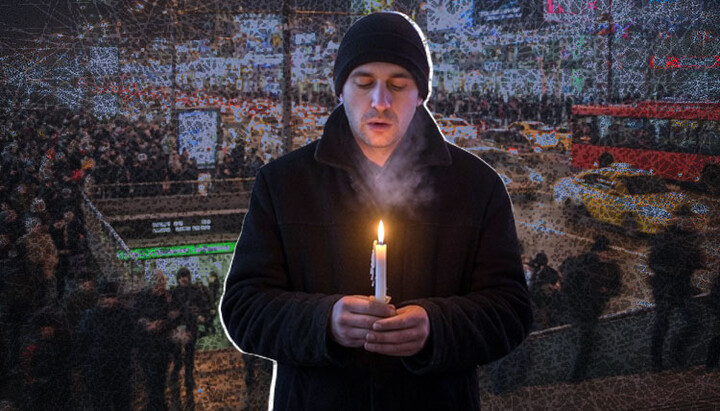
“Man as a candle” in the world of the metropolis. Photo: UOJ
The Sunday of the Paralytic brings us back to a sobering question – what state is our soul in now? “My soul, O Lord, weakened by every sin and by lawless deeds, raise up by Thy divine intercession…” This is not merely a plea for forgiveness. It is a cry for the healing of the very integrity of our person – an integrity shattered like a vase dropped on stone, scattered into fragments by the feverish busyness of a passing world. Only recently, during the Paschal service, it seemed to us that we had drawn near to the gates of the Heavenly Jerusalem. But no sooner had the hymns of victory over death faded than we sank once more into the “paralysis of dead thoughts and noisy, empty chatter.”
The trap of the spiritual sine wave
When the soul loses its Paschal direction, it does not simply stand still – it begins to disintegrate into fragments of alien voices, borrowed fears, and restless desires. We fall into the trap of a “spiritual sine wave” – an endless oscillation between the heights of the Heavenly Jerusalem and the mud of everyday sin.
We live suspended between flashes of communion with God and the heavy gravity of sin.
This instability exposes our deepest problem – we are not rooted in Grace. If our existence were a continuous act of obedience to Christ, then, in the words of the Fathers, “our home would become the uncreated light of Christ.” But instead of the living water of eternal life, we try to feed our spiritual hunger with informational noise. We substitute experience with commentary, transformation with instruction, life with analysis.
There is an abyss between academic theology and the vision of the heart. The mind’s meat grinder churns through texts and reflections, producing a minced mass of opinions about salvation. Meanwhile, true, humble prayer – joined with repentance – leads the spirit into stillness and contemplation.
One can spend decades within the “space of religion,” turning faith into an intellectual exercise. A person may know Scripture down to the last letter – and remain spiritually dead. The real question is not the quantity of knowledge, but the quality of God’s presence in the heart. Theology without lived experience becomes a cemetery of meanings. A person becomes like “a victim of an earthquake, buried under the rubble of his own thoughts.” This is the state where words about God obscure God Himself. True knowledge begins where the mind falls silent, making room for real seeing.
The path to inner freedom
The main obstacle that prevents us from cleaving to God is the mind’s attachment to thoughts. Victory over thoughts is not merely self-control – it is mastery over one’s inner reality. When a person acquires unity of spirit through the rhythm of the Jesus Prayer, he ceases to be a slave to circumstances and becomes, in the language of the Fathers, “a contemplator of divine mysteries.”
This is what the ascetic tradition calls watchfulness. A thought is like a virus in the operating system of the soul. If the soul has grown into the world through the mind, then the Jesus Prayer becomes a surgical instrument, cutting these bonds.
In essence, victory over thoughts is dominion over one’s inner world.
He who conquers his thoughts acquires a self-possession that does not depend on external catastrophes. This is true freedom – the freedom to preserve the inviolability of one’s inner life.
God reveals Himself not to an overfed intellect, but to a “simple heart.” Such a heart becomes a vessel of divine fire. Its bearers – the saints – become “living candles.” Their freedom is absolute, because they are no longer bound by earthly gravity; they look upon the noise of the world from the height of eternity. They know that God does not “come” and “go” – only the clarity of our perception fluctuates. Blessed is the one who has lost the fear of loss, for God, “who is everywhere present and fills all things,” cannot be lost.
Heaven and hell are not places – they are states, determined by what fills the cup of the heart.
The saints received “wings and soared between heaven and earth” not because they denied reality, but because they found their footing in eternity. God does not appear and disappear – only the purity of the heart in which He dwells does. The problem is not the absence of Light, but the opacity of the vessel.
Awakening from spiritual sleep
We live in an age where time itself feels compressed. The “roaring lion” of today is not only a mythical evil – it is the speed of the world, devouring our attention and silencing our inner stillness. The way out of spiritual paralysis is not muscular effort, but awakening. It is a shift from being a passive observer of one’s own decay to becoming a co-worker with divine Grace.
“Awake, you who sleep, and arise from the dead, and Christ will give you light” (Eph. 5:14).
To rise from the bed of paralysis is to make the most difficult move in human life – to transfer the center of gravity from the external to the internal. The Gospel paralytic lay by the pool for thirty-eight years, waiting for the water to move. But he was not healed by chance – he was healed by a personal call from the Word.
We, too, spend years waiting for “the right conditions,” “the right mood,” “the right moment” for spiritual life, failing to see that Christ is already standing beside us. His question – “Do you want to be made well?” – is not rhetorical. It is a challenge to a will that has grown accustomed to the comfort of its own weakness.
We have learned to extract a strange, painful pleasure from our helplessness. Complaints about lack of time, the noise of the world, the burden of thoughts – these become our “bed,” on which we lie quite comfortably, justifying our inaction. But the command “Take up your bed and walk” means one thing: take responsibility for your past and your habits. Stop letting them carry you along the current of disintegration.
Spiritual vigilance in a world that never sleeps is the highest form of asceticism.
Today, the “desert” is not geographical – it runs through the ability to press “off” on the remote control of your involvement in alien meanings. True silence is not the absence of sound – it is the presence of meaning. When we fall silent, we begin to hear the roar of our own passions, and that frightens us. But only by passing through this fear can we reach that depth where “deep calls to deep,” where the human spirit encounters the breath of God.
Read also
The valley of trouble and the gateway of hope
One soldier buried an expensive cloak and some gold beneath his tent. Because of this, all Israel lost a battle. Why did one man’s sin bring disaster upon an entire nation?
From love spells to bishop's throne
Antioch’s most powerful sorcerer sent demons against a devout young Christian woman three times – and failed every time. In the end, a demon himself revealed the truth that led to his conversion.
The Weeping Queen of Blachernae
On the night of the Feast of the Protection, only two people witnessed the miracle in the Church of Blachernae. Everyone else prayed and saw nothing. Yet they, too, received grace.
Deadly spiral of human hatred
The tragedy of Lebanon's civil war lays bare how dehumanization and fear can turn human beings into monsters.
Woe to expectant mothers – or to those of little faith?
God commanded one prophet not to have children, yet told his people in exile to bear sons and daughters. What does this apparent contradiction tell us today?
The help God never asked for
Uzzah wanted only to keep the Ark of the Covenant from falling into the dust. Why did this well-intentioned act cost him his life, and who was really responsible for his death?