Why, by inciting hatred against UOC, you are inciting it against Christianity
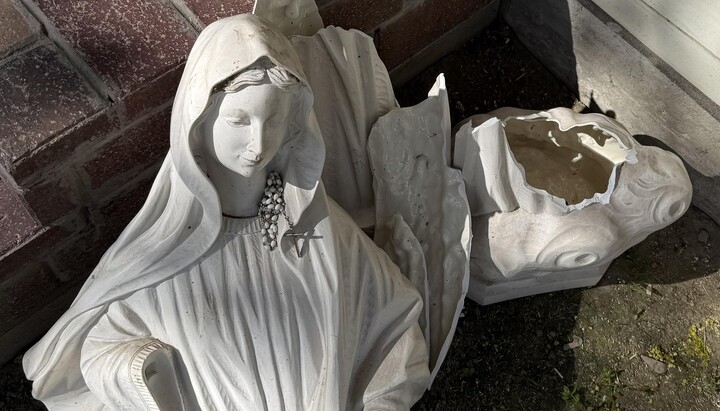
A shattered statue of the Mother of God. Photo: Yuriy Lohaza’s Facebook page
UGCC cleric Teodor Dutchak is indignant that vandals have smashed statues of the Mother of God in a chapel in his native village in Ternopil region for the second time in a week. He stresses that in Western Ukraine this is no longer an accident, but a systemic phenomenon. After all, only recently vandals poured paint over a statue of the Mother of God in Zhovkva, Lviv region.
“Something is not right in the head of a person who destroys what belongs to another religion, who despises people who go to another church. This is abnormal. If a person is normal, then wherever he lives, he must treat every confession with respect,” Dutchak emphasizes.
According to him, “it is very bitter and painful to realize that we live in our Christian state – not under oppression and persecution as before, not underground, but in a free country – and yet such things still happen.” Dutchak “does not know” “what drives people to this.”
But we, perhaps, do know. It is quite possible that Dutchak himself, along with his colleagues, has indirectly had a hand in this problem of vandalism by allowing himself to incite hatred against the UOC. For example, Dutchak recently published a Facebook post calling for the “Moscow priests” to be driven out of the Pochaiv Lavra and sent to “Putin and Gundyayev.” Another UGCC monk, Makariy Dutka, declared that “illiterate and zombified” people attend the UOC. As for the “exploits” of OCU clerics, there is no need to say anything at all. Do we see here “respect for another confession,” for people “who go to another church”? The question answers itself.
UOC representatives have long warned the “patriotic confessions” that inciting hatred toward the Church’s faithful would, in the end, turn against the arsonists themselves. If some Christians hate and insult other Christians, if they permit themselves to persecute them, seize their churches, and destroy them, then ultimately the same may be done to them as well.
In 1945, the German pastor Martin Niemöller delivered a speech in which he tried to explain the passivity of German intellectuals toward the Nazis:
“First they came for the socialists, and I remained silent – because I was not a socialist.
Then they came for the trade unionists, and I remained silent – because I was not a trade unionist.
Then they came for the Jews, and I remained silent – because I was not a Jew.
Then they came for me.”
Only the German intellectuals merely kept silent.
The “patriotic confessions” began it themselves.
Read also
Ternopil post on Feast of Intercession: Has calendar reformn failed?
A significant number of believers have rejected the new church calendar introduced by the OCU and UGCC with government support.
Shoulder straps or a cassock: who writes the script for UOC "fighters"?
Everything indicates that both Veliar and Pshenychny are ordinary performers of someone else's script. There is only one question – does the scriptwriter wear shoulder straps or a cassock?
Why is it legal to kill a person before birth but not after?
Children are the most privileged members of society. Yet that same society officially permits children to be killed – and on a massive scale.
Honoring the Bolsheviks’ successors at Kyiv Lavra
It was under the Reserve that the relics of the saints were desecrated, Lavra churches were turned into an atheism museum, and toilets were installed in sanctuaries.
"Degenerates" and "stupid animals": anti-UOC activists turn on children
Future historians will wonder how a vast country’s information agenda could have been shaped for so long by people so petty, vicious, and utterly contemptible.
Zelensky sees murder of Polish priest but not of Sviatohirsk monk
Why does Zelensky react so emotionally and swiftly to the murder of a Catholic cleric while remaining completely silent about the murder of an Orthodox monk?