A voice from the grave
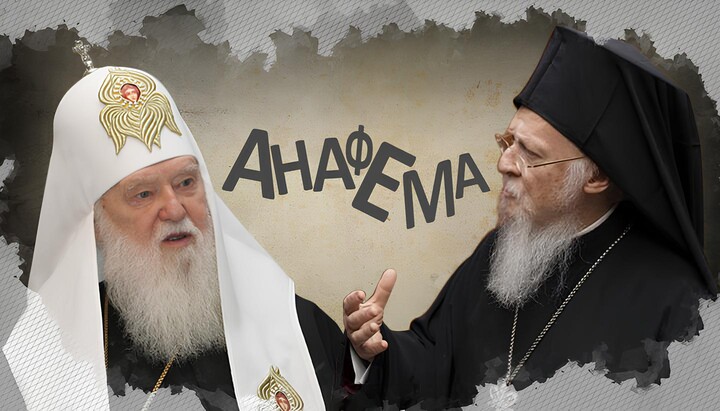
Patriarch Bartholomew was holding secret meetings with Filaret as far back as 18 years ago. Photo: UOJ
From beyond the grave, Filaret has revealed a small but telling piece of compromising evidence against Patriarch Bartholomew. It turns out that before 2008, the head of the UOC-KP flew to the Phanar to meet him and discuss the terms under which his structure might enter the Patriarchate of Constantinople. Until now, we knew that such negotiations had taken place indirectly; we knew that Filaret had written to Patriarch Bartholomew asking to be restored to his rank. But that Filaret and Bartholomew personally discussed the details of a future alliance in face-to-face meetings – this we have learned for the first time.
The point is that, officially, the Patriarch of Constantinople regarded Filaret as anathematized – that is, as a layman stripped of his rank and cut off from the Church. There is an official document to this effect, in which the Patriarch agrees with the ROC’s 1997 decision and states that no one in his Church’s hierarchy would maintain ecclesiastical communion with Filaret or his followers.
So it turns out that a hierarch who calls himself the “head of Orthodoxy” was secretly communicating with a man whom he himself had recognized as under anathema – and negotiating with him about entering his own Church of Constantinople.
We understand that no human being is perfect. Yet somewhere deep down, we still expect Church hierarchs to possess, if not holiness, then at least a certain moral stature. Or at the very least, an impeccable adherence to Christ’s not-so-difficult command: “Let what you say be simply ‘Yes’ or ‘No’” (Matt. 5:37).
Otherwise, how are such hierarchs any different from politicians?
Read also
Shoulder straps or a cassock: who writes the script for UOC "fighters"?
Everything indicates that both Veliar and Pshenychny are ordinary performers of someone else's script. There is only one question – does the scriptwriter wear shoulder straps or a cassock?
Why is it legal to kill a person before birth but not after?
Children are the most privileged members of society. Yet that same society officially permits children to be killed – and on a massive scale.
Honoring the Bolsheviks’ successors at Kyiv Lavra
It was under the Reserve that the relics of the saints were desecrated, Lavra churches were turned into an atheism museum, and toilets were installed in sanctuaries.
"Degenerates" and "stupid animals": anti-UOC activists turn on children
Future historians will wonder how a vast country’s information agenda could have been shaped for so long by people so petty, vicious, and utterly contemptible.
Zelensky sees murder of Polish priest but not of Sviatohirsk monk
Why does Zelensky react so emotionally and swiftly to the murder of a Catholic cleric while remaining completely silent about the murder of an Orthodox monk?
UOC vs. OCU numbers: pollsters count, social media recount
Official polling suggests Dumenko’s structure has an overwhelming lead in the number of parishioners, while social media polls paint a very different picture. Which should we believe?