The conquest of space as a new pretext for repression
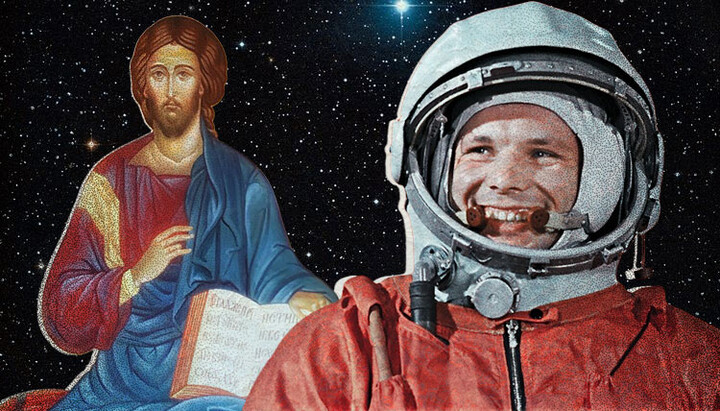
Disputes about Yu. Gagarin's faith. Photo: UOJ
The early 1960s in the Soviet Union. An ordinary school somewhere in a bleak residential district. A teacher notices a frayed string peeking out from beneath the collar of a ten-year-old boy. The child is immediately summoned to the front of the classroom. An aluminum cross is laid upon the principal’s desk, and before a class frozen in fear, a long public humiliation begins.
The adults repeat, with deadly seriousness, the same polished phrases pouring endlessly from every Soviet radio set: Soviet spacecraft have already entered orbit, our people are carving a direct path to the stars, while your parents are dragging the family back into darkness and obscurantism, believing absurd old wives’ tales and betraying the great achievement of those conquering the universe.
While an enormous country sincerely rejoiced over the launch of the first rockets, while boys in courtyards played at being cosmonauts, another drama unfolded behind the triumphal headlines. Scientific achievement and the conquest of space unexpectedly became not only a source of national pride, but also an ideologically flawless weapon for pressuring believers.
A criminal charge for “improper upbringing”
In 1960, Article 227 appeared in the Criminal Code of the RSFSR – along with parallel articles in the criminal codes of other Soviet republics – punishing “encroachments upon the person and rights of citizens under the guise of performing religious rites.”
The wording was so deliberately vague that, in practice, social services, police, and courts received an entirely legal instrument for intrusive intervention in any religious family.
It was terror carefully disguised as state concern for the social health and progress of society.
The loss of parental rights because a mother took her child to Communion on Sunday, or because a grandmother taught her grandson to make the sign of the cross before bed, became a very real threat. It was enough for a schoolchild to casually mention Easter cake during recess for an official commission to knock on the family’s apartment door the next day. Children could be forcibly removed from their homes and sent to state boarding schools in order to “save” them from “religious intoxication” and raise them as builders of communism.
To be a Christian in those years meant voluntarily accepting a heavy social stigma. It meant becoming a second-class person – a marginal figure supposedly obstructing a nation marching confidently toward a radiant future.
Factory committees and “comrades’ courts” became instruments of public humiliation. A believing engineer or worker could be subjected to hours of ideological interrogation in the factory’s “red corner,” pressured into publicly renouncing his convictions. And if a person remained stubborn, the system struck at the most vulnerable point imaginable.
Today, when persecuted communities are evicted from ancient churches through court rulings, it is painful and unjust. But then the pressure crossed directly over the threshold of one’s own home. The fear of losing one’s children because of a denunciation from a vigilant neighbor in a communal apartment or a zealous school administrator became the exhausting background noise of daily life.
The quote that became a national slogan
In this sweeping anti-religious campaign, the authorities exploited the image of the world’s first cosmonaut with maximum intensity. The cutting phrase, “Gagarin flew into space and never saw God,” burned itself into the memory of an entire generation.
Lecturers from the “Knowledge Society” hurled it like a weapon in village clubs. Party officials wielded it triumphantly. It was inserted into school manuals and ideological pamphlets. It was an era when promises were made from the highest tribunes that the nation would soon “show the last priest on television.”
And yet, if one examines the transcripts and archival records carefully, there is not a single documented confirmation that Yuri Gagarin ever uttered those words.
Historians long ago agreed to the effect that the phrase was actually spoken by Nikita Khrushchev during one of the Party’s anti-religious plenums, skillfully attaching the authority of the cosmonaut to his own propaganda. The machinery of Soviet ideology then did the rest, and the fabricated quotation entered popular consciousness.
Of course, portraying Gagarin as a secret confessor of the faith, a political dissident, or a catacomb Christian would be equally false. He was a genuine Soviet officer – a man shaped by a rigid system and by his era. Yet his personality proved far more complex than the flat atheist poster the ideologues tried to carve out of him.
In the autumn of 1964, Gagarin visited the Trinity–St. Sergius Lavra together with his close friend, Air Force Academy instructor Colonel Valentin Petrov. According to Petrov’s own recollections, the two men spent considerable time walking through the church-archaeological museum, studying ancient icons with great interest and speaking openly with the monastery’s abbot.
There was no overt political challenge in this – merely the natural curiosity of a man seeking contact with his historical roots. Yet when news of the visit reached the upper levels of the Party apparatus, a serious investigation followed. Gagarin himself reportedly had to intervene personally to protect his friend, whose rank and career were threatened because of an ordinary excursion beyond the monastery walls.
An inconvenient memory
There was another documented episode the Party curators preferred to erase from the hero’s official biography.
In December 1965, at the Eighth Plenum of the Central Committee of the Komsomol, Yuri Gagarin stepped to the main podium. The surviving transcript records how the first cosmonaut, standing before the highest youth leadership of the Soviet Union, suddenly began speaking directly about the destroyed Cathedral of Christ the Savior.
He spoke, admittedly, not in explicitly religious terms. Gagarin referred to the cathedral as an outstanding monument of military glory, built with the people’s money in memory of the hard-won victory over Napoleon. According to witnesses, an uncomfortable silence instantly descended upon the vast hall. By then, the open-air Moskva swimming pool had long occupied the site where the cathedral had been dynamited in the 1930s, and simply reminding people what had once stood there demanded a certain courage.
That portion of the speech was quickly buried. The central press never circulated it.
For Gagarin, it was an act of respect for historical memory – an attempt to defend the stones upon which his country’s culture had been built. But to the nomenklatura, even such natural human memory sounded like dangerous and deeply hostile free thought.
Leafing through archival folders from those years, one’s perspective inevitably changes. The central figures of that difficult era were not the men standing at high podiums. The true heroes lived in cramped communal apartments and damp concrete five-story blocks.
After exhausting factory shifts, parents would tightly draw the curtains in the kitchen at night in order to light a small vigil lamp before a darkened family icon. Fathers endured humiliating ideological interrogations under threats of dismissal. Mothers taught their children to pray in whispers barely audible through the walls. Newspaper headlines mocked their faith every single day, while the state stood ready at any moment to take away their children.
Decades have passed. The loud anti-religious campaigns that promised the imminent death of the Church have crumbled into little more than yellowing newspaper archives and dusty criminal case files. But the timid whisper of prayer in the darkness of Soviet apartments never disappeared.
It proved stronger than concrete and louder than ideological slogans, preserving for future generations the image of an invisible – yet unconquerable – Church.
Read also
Trial of a dead pope
Once in Rome, the body of a deceased pope was seated on the throne and put on trial. The accusation relied on a church canon that had once saved his see.
Monastery built in defiance of king
When Orthodox believers in Minsk were left with just one church, townspeople decided to build another – and even a royal decree did not stop them.
Young Mother and Sleeping Christ
Michelangelo carved a Virgin Mary who looks younger than her Son – and signed his name in marble for the only time in his life. Neither of these peculiarities was accidental.
Orthodox books from a Uniate printing press
In the 18th century, Uniate monks at Pochaiv printed books used in prayer by Orthodox Christians and Old Believers alike.
The story of the honey brotherhood
The Mogilev Brotherhood began with members pooling money to brew honey drinks for feast days – and eventually grew to have its own printing press.
Golgotha in the midst of a pogrom
In the autumn of 1938, the Jewish artist Marc Chagall painted the crucified Christ. Synagogues burn and refugees flee around the cross, while the Crucified One Himself is wrapped in a prayer shawl.