Why do we read the Bible through the eyes of American Protestants?
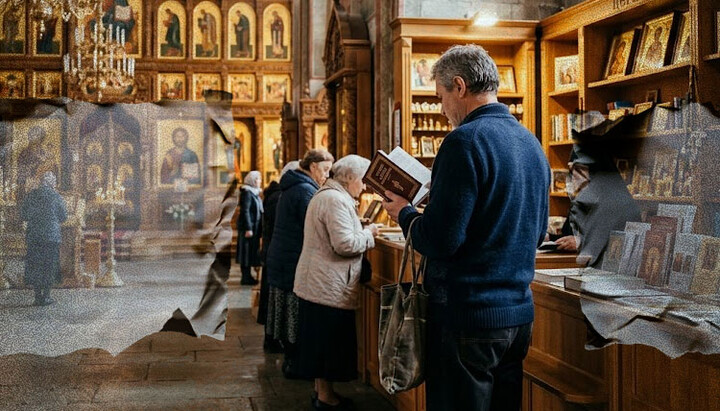
Distorted literature. Photo: UOJ
On the shelf of a church kiosk, somewhere between prayer books and bundles of candles, you can often find thin paperbacks claiming to present the only authentic patristic understanding of creation. A reader exhausted by the uncertainty of modern life searches such books for something simple and solid. He flips through the pages and discovers that the universe was created in exactly one hundred and forty-four hours, that geological eras were invented by scientists, and that dinosaurs once walked the earth alongside the first humans.
Reading this literature leaves one with the unsettling feeling that faith demands a person close his eyes to the real world and try to measure God with a school ruler.
People today are already crushed by circumstances, trapped by narrow choices and constant anxiety. They long to touch ancient wisdom, but instead receive a rigid scheme. The irony is that the literature often presented to us as the pure standard of Orthodoxy did not come from Byzantium at all.
How the foreign became “our own”
Tracing the origin of these brochures is not difficult if one follows the history of the texts themselves. Remove the upper layer of pious editing, and beneath it we find the arguments of twentieth-century American Protestantism.
What is now called “scientific creationism” emerged in an entirely different environment. One of its founders was the Seventh-day Adventist George McCready Price, who began publishing his works in the 1920s. Later, in 1961, the Baptists Henry M. Morris and John C. Whitcomb released their famous book on the biblical Flood, which shaped the development of this movement in the United States for decades.
Their goal was to defend the Bible against what they saw as attacks from modern science, and they chose to do so through a strict literal reading of every verse.
In the 1990s, when borders finally opened, post-Soviet countries were flooded with this kind of literature. People desperately lacked spiritual books.
Local publishers took texts from Western institutes, removed the obvious Baptist or Adventist references, added a few quotations from Russian saints, and sent them to print. For years we read these books sincerely believing we were encountering ancient Tradition itself.
In Orthodox circles this approach is often reinforced by appeals to Seraphim Rose. Father Seraphim truly was an ascetic struggler who lived a harsh spiritual life in the mountains of California. But context matters. As an American, he was deeply familiar with the arguments of conservative Christians in his homeland and partially relied on them.
Behind the insistence that every day of creation must mean precisely twenty-four hours often hides something very simple: fear.
Fear that if even one number in the Old Testament turns out to be metaphorical or poetic, then the whole structure of faith will collapse.
The scale of ancient thought
But if we set these pamphlets aside and open the writings of the great Cappadocian Fathers of the fourth century, we encounter an entirely different spirit. There is no fear of knowledge there.
Basil the Great, while composing his famous Hexaemeron homilies, calmly used the science of his own time. He referred to ancient medicine, to Aristotelian physics, to contemporary cosmology. He did not see students of nature as enemies.
In his ninth homily, the great teacher of the Church says quite plainly: if the prophet Moses remained silent about the shape of the earth because such knowledge is useless for the salvation of the soul, should we really consider human speculation more important than the words of the Spirit?
The ancient Christian writers understood something we often forget today: science tries to answer how the physical world works, while Scripture speaks of Who created it and why we are here.
Augustine of Hippo left an equally clear warning. In his commentary on Genesis, he observed that even non-Christians may understand the workings of heaven and earth through experience and observation. It becomes deeply embarrassing, Augustine writes, when Christians begin speaking nonsense about the physical world and thereby provoke unbelievers to laughter.
For if people discover that we are wrong about things that can be tested and verified, why should they trust us when we speak about the resurrection of the dead?
Time for growth
The patristic tradition never viewed creation as a series of frozen magical tricks performed instantaneously.
The brother of Basil the Great, Gregory of Nyssa, offered in his treatise On the Making of Man an extraordinarily subtle vision of how life unfolded.
He describes a gradual ascent of creation: first plant life appears, then living creatures endowed with sensation, and only afterward does man emerge upon this prepared foundation as a rational being.
There is no fear in these ancient texts that the world develops gradually. It is a vision spacious enough to allow scientists to study the earth and its fossils, while allowing theologians to speak about meaning.
Today believers are often forced into an artificial choice. In a world consumed by polarization, we are presented with a false dilemma: either you become a secular rationalist, or you must reject science altogether in order to qualify as a “good Christian.”
But Orthodoxy is far wider than this manufactured conflict. It does not demand that we renounce reason or close our eyes to facts in order to remain within the Church.
And sometimes, to remember this freedom, it is enough simply to set aside a translated English-language pamphlet and look up at the night sky – a sky too immense to fit inside any ideological scheme.
Read also
Facade of bones and facade of light
Antoni Gaudí spent forty-three years building a church in Barcelona, knowing that this construction was for the ages.
Trial of a dead pope
Once in Rome, the body of a deceased pope was seated on the throne and put on trial. The accusation relied on a church canon that had once saved his see.
Monastery built in defiance of king
When Orthodox believers in Minsk were left with just one church, townspeople decided to build another – and even a royal decree did not stop them.
Young Mother and Sleeping Christ
Michelangelo carved a Virgin Mary who looks younger than her Son – and signed his name in marble for the only time in his life. Neither of these peculiarities was accidental.
Orthodox books from a Uniate printing press
In the 18th century, Uniate monks at Pochaiv printed books used in prayer by Orthodox Christians and Old Believers alike.
The story of the honey brotherhood
The Mogilev Brotherhood began with members pooling money to brew honey drinks for feast days – and eventually grew to have its own printing press.