Forty days without a leader and the spiritual collapse of a nation
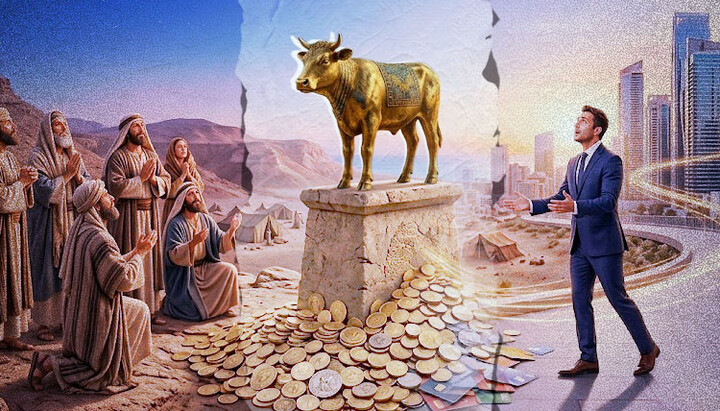
The Cult of the Golden Calf: Past and Present. Photo: UOJ
“When the people saw that Moses delayed to come down from the mountain, the people gathered themselves together unto Aaron, and said unto him: Up, make us gods, which shall go before us; for as for this Moses, the man that brought us up out of the land of Egypt, we know not what is become of him” (Ex. 32:1), the Old Testament recounts.
The people do not say, “We do not know what has become of God.” They say, “We do not know what has become of Moses.” In their minds, God is inseparable from His mediator. Moses disappears – and it seems the Lord has vanished with him.
This is where Israel’s catastrophe begins: faith attached to the authority of a man ceases to function the moment that man is absent for forty days.
There is another important detail in this story. The people give Aaron a task, but leave him no room to refuse. “Make us gods” is not a request – it is a demand. Aaron, Moses’ brother and second in rank after him, suddenly finds himself alone before an agitated crowd whose patience has run out. He could have refused – but he did not.
Where did the gold come from?
Aaron gives the order: “Break off the golden earrings, which are in the ears of your wives, of your sons, and of your daughters, and bring them unto me” (Ex. 32:2). The people obey immediately.
Where did yesterday’s slaves in the wilderness get gold? The answer appears in an earlier chapter. As they left Egypt, the Israelites “borrowed of the Egyptians jewels of silver, and jewels of gold,” and the Lord gave the people favor in the sight of the Egyptians, “so that they lent unto them” (Ex. 12:35–36). This was the gold they carried out of Egypt.
And from this gold they cast the calf. The very treasure they had taken out of slavery was melted down into the image of a deity that grants freedom to no one.
When the calf is finished, the people cry out: “These be thy gods, O Israel, which brought thee up out of the land of Egypt” (Ex. 32:4). The miracle of real liberation is attributed to a lump of metal that had cooled only an hour earlier.
Why a calf?
The choice was not accidental. The image of a bull or calf was a widespread symbol of divinity throughout the ancient Near East. In Egypt – the land Israel had just left – there existed the cult of Apis, the sacred bull believed to embody the presence of a god. In Canaan – the land toward which they were journeying – the supreme god El was associated with bull imagery.
In other words, the Israelites chose precisely the religious form that was familiar from their former life and awaited them in the life ahead. Between the Egypt they had just escaped and the Canaan they had not yet reached, they forged something common to both worlds.
Another detail is equally revealing – Aaron’s wording. After erecting an altar before the calf, he proclaims: “Tomorrow is a feast to the Lord” (Ex. 32:5). In the original text, the sacred name Yahweh is used. Aaron does not openly turn to the worship of a foreign god. He calls the calf by the name of the true God. Professor Alexander Lopukhin, in his commentary on this passage, notes that Aaron did not perceive the worship of the calf as a transition to an alien cult. Like the less spiritually mature members of the people, he regarded the calf as an image of the Existing One Himself.
And here lies the subtle deception: idolatry that preserves the correct Name of God no longer appears to be idolatry – neither to those committing it nor, often, to those observing it from the outside.
The Descent of Moses
On the fortieth day, Moses descends from the mountain. In his hands are the tablets written by the finger of God. Below, he hears the noise of the camp, which Joshua mistakes for the sound of war – “the noise of them that shout for mastery, and the noise of them that cry for being overcome.” But Moses hears more clearly: “It is the noise of them that sing” (Ex. 32:17–18).
Moses draws nearer, sees the calf and the dancing, and casts the tablets from his hands, shattering them at the foot of the mountain (Ex. 32:19). Forty days earlier, on this same mountain, the Lord had given him the Law – the foundation of the covenant. And now that covenant lies in fragments upon the ground.
The covenant is broken by the very side that had received it, because the other side had already violated it.
Then Moses takes the calf, burns it in the fire, grinds it to powder, scatters it upon the water, and forces the people to drink it (Ex. 32:20). The act seems strange, yet there is a grim logic in it. The people had eaten and drunk before the calf – now Moses returns their god to them in liquid form. Their deity enters them through the throat, and through the throat it will pass out again.
St. Gregory of Nyssa, who devoted an entire work to Moses, interpreted this whole story as an image of the soul’s inner journey. Moses ascending the mountain symbolizes the path toward God through renunciation of the earthly and sensual; the people falling at the mountain’s foot symbolizes the opposite movement – toward what is familiar, tangible, and convenient. Between these two movements stretches the burden of waiting. And it is during this waiting that the human heart decides where it truly wishes to go.
The new idolatry
This event is too alive to remain merely an ancient story. The people waited for Moses for forty days. In Scripture, forty is the measure of prolonged trial: Christ fasted for forty days in the wilderness before beginning His ministry, and the same people would later wander forty years before reaching the Promised Land.
When a trial drags on, man reaches instinctively for whatever material lies closest at hand. For something that can be melted down in a single evening. Something that does not require waiting another forty days.
The tragedy is not that a person openly renounces God. The tragedy is the mindset of Aaron: to preserve the correct Name over the wrong image and still proclaim, “Tomorrow is a feast unto the Lord.”
It is terrifying when an idol bearing the name of the Existing One can dwell inside a temple for decades without arousing the slightest suspicion among the faithful.
Read also
Facade of bones and facade of light
Antoni Gaudí spent forty-three years building a church in Barcelona, knowing that this construction was for the ages.
Trial of a dead pope
Once in Rome, the body of a deceased pope was seated on the throne and put on trial. The accusation relied on a church canon that had once saved his see.
Monastery built in defiance of king
When Orthodox believers in Minsk were left with just one church, townspeople decided to build another – and even a royal decree did not stop them.
Young Mother and Sleeping Christ
Michelangelo carved a Virgin Mary who looks younger than her Son – and signed his name in marble for the only time in his life. Neither of these peculiarities was accidental.
Orthodox books from a Uniate printing press
In the 18th century, Uniate monks at Pochaiv printed books used in prayer by Orthodox Christians and Old Believers alike.
The story of the honey brotherhood
The Mogilev Brotherhood began with members pooling money to brew honey drinks for feast days – and eventually grew to have its own printing press.