The throne of Paphos: succession or spiritual adultery?
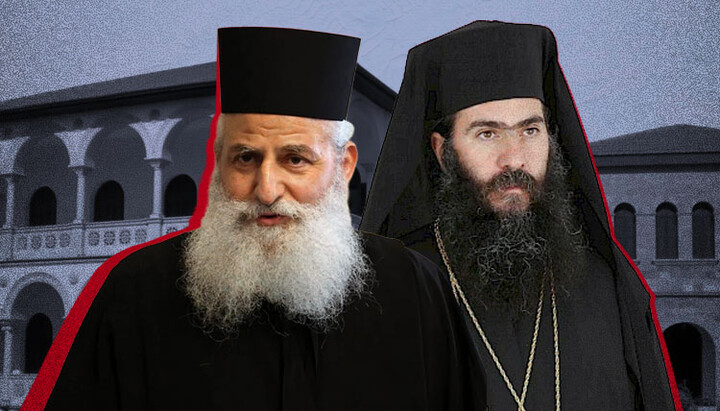
Another cleric has been appointed to the see of Metropolitan Tychikos. Photo: UOJ
When the removal of a bishop from his see is at stake, there can be no true peace without a just trial and canonical precision. Otherwise, accusations rooted in relationships, personal feelings, and emotions – rather than in the Canons of the Church – will only give rise to problems that tear apart the Body of Christ.
This is precisely why the recent events surrounding the Metropolis of Paphos have unfolded as a deep ecclesiastical crisis shaking the Church of Cyprus. Formally, on May 26, the Holy Synod of the Church of Cyprus elected Archimandrite Grigorios Ioannidis as the new Metropolitan of Paphos. According to Philenews, he received 11 votes, while Hieromonk Sophronios Stasinos received one, and four members abstained. Grigorios’ consecration and enthronement are scheduled for June 11, 2026.
It should be recalled that before this, the Synod of the Church of Cyprus amended its Statute. However, the legitimacy of these amendments remains an open question, given that the Metropolitan of Paphos – the second-ranking metropolis of Cyprus after Nicosia – was absent from the vote on the new Statute. Under the new version of the document, ordinary believers will no longer take part in the election of metropolitans; only members of the Holy Synod will do so. Thus, formally, Archimandrite Grigorios was elected in accordance with the new Statute of the Church of Cyprus. But in this situation, the word “formally” must be emphasized.
The fact is that a significant part of the flock, theologians, and clergy of Cyprus perceive this election not as the healing of the wound caused by the unlawful removal of Metropolitan Tychikos from the see of Paphos, but as the consolidation of a disputed and spiritually dangerous situation.
The faithful of the Metropolis of Paphos quite rightly refer to Canon 16 of the First-Second Council, which states: “On account of the disputes and disturbances that occur in the Church of God, it is necessary to determine this also: that no bishop shall be appointed in a church whose presiding hierarch is still alive and remains in his dignity, unless he himself voluntarily renounces the episcopacy. For it is first necessary to bring to completion a lawful investigation of the charge for which he is to be removed from the episcopacy, and only then, after his deposition, to elevate another to the episcopacy in his place.”
Metropolitan Tychikos is alive. He has not submitted a voluntary resignation. He has not received a “lawful investigation of the charge,” and accordingly he does not publicly recognize his removal as lawful, continuing to regard himself as the canonical archpastor of Paphos.
From this perspective,
the see of Paphos has not been widowed. Its hasty replacement therefore places before the whole Church a painful question: can a throne be “filled” if the previous bishop was removed without a genuine trial, without canonical charges being presented, and with the gravest violations of judicial procedure itself?
Why Grigorios’ election is being called “spiritual adultery”
In the Orthodox tradition, the bond between a bishop and his eparchy cannot be reduced to an employment contract or an administrative appointment. A bishop is not the manager of a religious structure who can be replaced by a majority vote. He is the witness of ecclesial unity, the shepherd of a specific people, and the primate of a particular local Church. That is why ancient ecclesiastical thought often described the bond between a bishop and his see in the language of marriage.
It is from this that the grave canonical term μοιχεπιβασία arises – rendered in church journalism as “adulterous accession” or, more simply, spiritual adultery: the occupation of another man’s see when that see has not truly become vacant. A theological and canonical analysis published on June 1, titled “Paphos: Can a Throne Be Filled While Tychikos Declares His Presence?”, states plainly that Church history knows widowed sees, but it does not know sees that become “vacant” simply because someone has decided to treat them as such.
“When a bishop is alive, objects, appeals, rejects the procedures he considers anti-canonical, and declares that he remains the canonical shepherd of his eparchy, then the central question is not who will become his successor, but whether his throne has been widowed at all,” the publication says.
This argument was also supported by the well-known Greek theologian Protopresbyter Arsenios Vliagkoftis. According to him, if Tychikos did not recognize the lawfulness of his removal, if he did not leave voluntarily, and if no impeccably conducted canonical trial took place, then the election of a new metropolitan does not solve the problem – if there was one at all – but only deepens it.
Of course, the official line of the Archdiocese and the majority of the Synod rests on a different premise: its supporters believe that the Tychikos case is closed and that the Metropolis of Paphos must “return to normal.” But ecclesiastical reality is not exhausted by a vote. If the people of God and a great number of Greek theologians see in the Synod’s decision not only injustice but a canonical wound, that wound will not heal merely because it is ignored.
The voice of Tychikos: “I was not heard”
Metropolitan Tychikos’ official appeal of May 25, 2026, deserves special attention. It is not merely an emotional letter from an offended man. It is the confessional text of a bishop who, while remaining within the mind of the Church, asks for the simplest thing: to be judged truthfully, according to the canons, and with a real right to defend himself.
In his appeal, Metropolitan Tychikos reminds his flock that he was born and raised in Paphos, that he served this metropolis for about 25 years as protosyncellus – roughly equivalent to an eparchial secretary in the Slavic Church tradition – and that he perceived his election not as a “throne of power,” but as a cross of responsibility. He says he was removed from his see “in an atmosphere of slander, pressure, and false accusations,” while the procedure itself, in his words, had nothing to do with a fair trial.
Several points in his appeal are especially important.
First, he states that the decision to remove him had been predetermined before the “judges” had truly heard the “accused.”
Second, he says the accusations were never presented to him clearly and in full. To this day, he does not know in full who accused him, what exact evidence was submitted, or on what basis he was deemed unworthy of ministry.
“The decision to remove him came before the accusations” – this is how one may briefly summarize one of the central ideas of Metropolitan Tychikos’ appeal.
No less important is his position regarding his request for forgiveness. Tychikos emphasizes that it was not an admission of guilt. It was, in his words, a “plea of humility and pain” for the sake of peace, unity, and love in the Church. In this way, he effectively dismantles a possible manipulation:
If a hierarch asks forgiveness as a Christian, it does not mean he recognizes the justice of a guilty verdict.
The appeal also contains a legally significant section. The hierarch states that he intends to appeal to civil courts and, if necessary, European judicial bodies in order to determine whether a fair procedure was observed, whether he had a real opportunity to defend himself, and whether the Holy Canons, the Constitution of Cyprus, and basic principles of human rights were applied. At the same time, he stresses that he does not wish to wage war against the Church. On the contrary, he explains his actions by the desire to prevent the stain of an unjust condemnation from remaining upon the Church.
That is why his appeal cannot simply be dismissed as “disobedience.” In the Orthodox tradition, obedience is not blind assent to procedural and administrative falsehood. True obedience is born in truth. If a man is judged without a clear accusation, without open evidence, and without a full defense, then the demand for a canonical trial is not rebellion – it is an ecclesiastical necessity.
The appeal went unheard – but accusations of a “clique” rang out
Judging by subsequent actions, Metropolitan Tychikos’ appeal did not prompt the Synod to stop and try to review a case in which so many violations had been committed. Instead, the official side chose a different path: a new metropolitan was elected, his enthronement is already being prepared for June 11, and Tychikos himself was asked to leave the premises where he had been living on the grounds of the Metropolis of Paphos.
At the same time, accusations began to circulate that behind Tychikos stands some group – literally, a “clique” – from Thessaloniki, connected with the “non-commemorators” or “separated ones,” that is, those who ceased commemorating Patriarch Bartholomew and Archbishop Ieronymos of Greece because of ecumenism.
Speaking on ANT1, Archbishop Georgios said that with the election of a new metropolitan, calm was supposedly returning to Paphos, while he dismissed protests that drew several thousand people as unserious. He also said that many critics of the actions of the Holy Synod of the Church of Cyprus are not themselves from Cyprus but from abroad, and mentioned “a group from Thessaloniki that shamelessly reviles everyone and everything.”
This tactic, unfortunately, is all too familiar from church conflicts: instead of answering the substance – where is the clear accusation, where are the case materials, where is the full defense, where is the canonical trial – attention is shifted to certain people allegedly influencing the situation “from outside.” For us, in our Ukrainian reality, this is painfully familiar: instead of compliance with the country’s Constitution, we constantly hear about “Moscow influence,” which is used to “justify” the persecution of the Church.
On the other hand, even if certain harsh voices from Greece really are being heard, this does not cancel the main question: was Metropolitan Tychikos himself judged fairly?
It should be noted that Metropolitan Tychikos’ lawyers have sharply rejected the accusation that he is being influenced by some “clique.” A press release published on June 2 states that the hierarch was not incited by anyone, did not support anyone in actions against the Church, and did not participate in any plan for a “church coup” in the Metropolis of Paphos.
Moreover, the lawyers turned the question back on the accusers: if the official side speaks of influence from Greece, then why, according to the defense, was it precisely a letter from Greece – a document of the Ministry of Education – that Archbishop Georgios used as evidence against Metropolitan Tychikos, while the accused metropolitan himself was never given access to it? Does this fact not suggest that Archbishop Georgios himself was subject to “outside influence”?
Why the order of the Athens Prosecutor’s Office may become a turning point
One of the most important new elements in the case is the order of the Athens Prosecutor’s Office dated May 20, 2026, requiring the Greek Ministry of Education, Religious Affairs, and Sports to provide the requested package of documents in the case of Metropolitan Tychikos of Paphos.
The matter concerns a document which, according to Tychikos’ lawyers, belongs to the Greek Ministry of Education. The defense says this document was used by Archbishop Georgios as “evidence” in the accusatory line against the metropolitan, but Tychikos himself was never given the opportunity to see it or respond to it on the merits.
If this is confirmed, the situation will take on an extremely serious character. In any fair trial, the accused must know not only the general wording of the accusations, but also the evidence on which they are based. A person cannot be condemned on the basis of a document he has never seen. Still less can this be done in the Church, where judgment must be not only lawful but spiritually pure.
That is why the demand to disclose the document is not a technical detail. It is the heart of the question of justice. If the document was used as part of the accusatory material, it must be produced. If it was not produced, the trial cannot be considered complete. And if the document does not exist, or if it does not contain what was attributed to it, then the entire “construction” of the accusation – phony as a three-dollar bill – comes under question.
Eviction as a symbol: a shepherd is turned into an “obstacle”
It should be noted that after Archimandrite Grigorios was elected, the dispute also moved into a domestic, almost humiliating plane. Tychikos was sent a letter demanding that he vacate the room where he had lived on the grounds of the Metropolis of Paphos. At first the letter was to be delivered personally; later it was sent via Viber.
On June 4, Metropolitan Tychikos was evicted, and the process took place amid strong pressure and intimidation. The day before, on June 3, a significant number of police officers had gathered around the metropolis buildings throughout the day. Archbishop Georgios of Cyprus had earlier publicly stated that he was prepared to use the police to remove Tychikos from church premises.
And here the full tragedy of the situation becomes visible. A man who served Paphos for a quarter of a century is now being treated as an organizational obstacle to the enthronement of the “new metropolitan.” Even if one leaves the legal aspect aside, pastorally this looks profoundly painful. The Church cannot heal wounds by such methods.
A blow to the authority of the Church of Cyprus
Perhaps the most lamentable outcome of this entire situation is that the case of Metropolitan Tychikos has long ceased to be an internal dispute among a narrow circle of hierarchs. It has become a public scandal undermining trust in ecclesiastical authority as such.
The clearest testimony to how this situation is being perceived in society may be a video in which journalists discuss Metropolitan Tychikos’ eviction, the actions of the leadership of the Church of Cyprus, and the entire affair.
One fragment sounds especially grave:
“You know, I do not know how long this whole story will drag on with people who... how should one even call them... are clergymen. I do not know how far this will go, or what their holiness consists of, so to speak, but at some point we will have to look into our own souls and assess how close each of us is to God. Because what is happening with the Church is going too far. The question of where we are, and where church figures are in relation to God, and how theologically justified everything they do and say really is – that is a very serious question.”
These words matter because they show that even secular observers sense the discrepancy between the language of church authority and the spirit of the Gospel. When a case against a hierarch consists of documents no one has seen, vague accusations, pressure, suspicions of ties to some “cliques,” threats of new punishments, and attempts at eviction, society sees not the Church of the Living God, but an ordinary administrative system fighting against a man.
And this wounds the Church. It wounds Her mission. It wounds the trust of ordinary believers. It wounds not because Tychikos is defending himself, but because, by all appearances, no one ever truly wanted to hear him on the substance of the case. The Church is strong not when She can swiftly suppress uncomfortable questions, but when She is not afraid of the truth. For the most frightening thing begins when the faithful start to think that the Church may no longer be the pillar and ground of the Truth, but merely a structure pursuing private interests.
Read also
Pentarchy with Rome: A return to the roots or a new schism?
Patriarch Bartholomew wants to revive a council of five patriarchates, including Rome. What would reunion with Catholics look like, and what role would be left for the other Churches?
Concubine or daughter? On words that cannot be used about the Church
An archon of the Church of Constantinople likened the UOC to Moscow’s “concubine.” But for St. Epiphanius of Cyprus, “concubines” are heresies.
Shameful chronicle of one week: how the OCU was born
Exarchs under escort, a call from the operations room, and 36 votes for Epifaniy: what a member of the Phanar delegation revealed about the 2018 "Council".
Can UOC eparchies be dissolved before court ruling on Metropolia?
DESS is launching separate proceedings against UOC eparchies, monasteries, and institutions while the case involving the Kyiv Metropolia is still pending.
Two murders, one silence
Zelensky condemned the killing of a Catholic priest in Poland the very same day. A month earlier, a UOC monk was murdered at the Sviatohirsk Lavra – and the president has remained silent ever since.
A bow to Phanar? Why did UOC academy congratulate Constantinople’s exarch?
A delegation from the Kyiv Theological Academy congratulated the Phanar’s exarch, who has remained silent about the persecution of the UOC. Who authorized this gesture, and why did even OCU supporters fail to appreciate it?