Children of one schism: How Kyiv Patriarchate became Phanar's unpaid bill
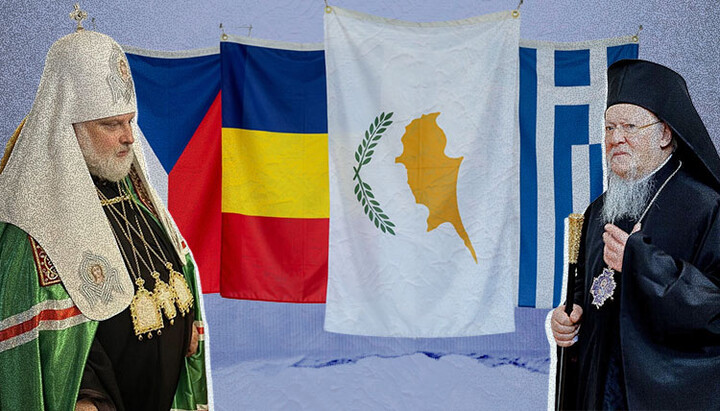
The UOC KP is establishing its own structures on the canonical territory of Local Orthodox Churches. Photo: UOJ
When a “vicariate” of a structure that is not recognized by a single Local Orthodox Church in the world suddenly appears in Romania – a country with an ancient autocephalous Church – it is easy to shrug and dismiss it as a local incident.
A few defrocked monks drifted into schism. So what?
Unfortunately, that is precisely how many people react – in Cyprus, in Greece, and even in Constantinople itself.
But such an attitude is dangerous.
Because the appearance of the UOC-KP in Cyprus, Greece, the Czech Republic, Romania, Italy, and Portugal is not an accident. It is a symptom of a disease that was claimed to be "healed" in 2018–2019 without ever actually being healed.
That disease has a simple name: schism.
The map of expansion
Let us clarify from the outset that we are not speaking about the late Filaret Denysenko, who died in March 2026 at the age of ninety-eight.
We are speaking about the new head of the “Kyiv Patriarchate” – Nikodym Kobzar, the former “Archbishop” of Sumy, whom a group of UOC-KP hierarchs elected “Patriarch” the day after Filaret’s death.
It is under Nikodym, not Filaret, that the Kyiv Patriarchate has shifted from defense to offense – and its primary targets are the other Local Churches.
In the few short months since his election, Nikodym has:
- Accepted a group of communities into a “Czech Vicariate” and appointed a “bishop” for the Czech Republic. The communities mentioned include Prague, Teplice, Bílina, Most, Duchcov, Děčín, Chomutov, Litoměřice, and Ústí nad Labem.
- Established a diocese in Greece. It includes the abbot and brethren of the Panagia Glyfokilousa Monastery in Keratea, the rector and clergy of St. Therapon’s Church in Ano Liosia, the Church of St. Paisios and the Church of the Life-Giving Spring in Attica, and the Church of St. Cosmas of Aetolia.
- Received into the UOC-KP a community in Romania – the Monastery of All Saints in the village of Săgasa – placing it directly under his authority.
- Accepted a community from Uganda. Archpriest Charalambos Otsena joined Nikodym’s organization together with the Parish of St. Joseph. The decree specifically notes that the Ugandan cleric and his flock are now directly subordinate to the head of the Kyiv Patriarchate.
- Established a “vicariate” in Cyprus by decrees issued on May 28, 2026, accepting former clergy and monks associated with the Monastery of St. Avvakoum and granting the new monastery stavropegial status.
- Created patriarchal vicariates in Italy and Portugal, conferring upon a certain Nicola Nunzio Rimaudo the title of “Archbishop of Milan.”
- Received into the UOC-KP a community of the Constantinople Patriarchate in the Spanish city of Dénia.
Let us repeat: all of this happened in the span of just a few weeks.
Yes, each individual case can be dismissed as involving marginal figures who have little or no influence in their home countries.
But first, that is not entirely true – especially in the cases of the Czech Republic and Cyprus.
And second, the problem remains.
Taken together, these supposedly marginal figures form a very clear system.
And that system operates according to a single formula: whenever a Local Church suspends or defrocks someone, the Kyiv Patriarchate receives him, appoints him where necessary, ordains him if necessary, and establishes a structure around him.
Today it is the Czech Republic or Romania. Tomorrow it could be any country in the world where a handful of problematic or dissatisfied clerics can be found. And if they cannot be found, the UOC-KP will simply send its own.
There is little reason to doubt it.
Failing to grasp the real problem
The hierarchies of the Local Churches, it seems, have not fully grasped the threat posed by the UOC-KP.
And they have failed to grasp it not only because most of them have never had to deal with parallel ecclesiastical structures operating on their canonical territory, but also because they do not truly understand what the Kyiv Patriarchate is.
For example, the Cypriot theologian Theodoros Kyriakou, speaking on television, expressed concern that the UOC-KP had established its own structure on the territory of the Church of Cyprus – namely, the Monastery of St. Avvakoum and the Parish of the Archangel Michael.
He accurately described the mechanism employed in this case: the decrees are genuine, Nikodym’s seal and signature are authentic, there have been no denials from the monks involved, and the structure is genuinely subordinate to Kyiv.
He also correctly noted that the Church of Cyprus will eventually have to make a decision rather than pretend that “they were defrocked and therefore it does not concern us.”
Yet his analysis contains two fundamental errors.
And both reveal that even thoughtful Greek theologians have not yet reached the heart of the issue.
Mistake one: “It’s Russian influence”
Kyriakou attempts to explain what is happening by invoking eastern Ukraine and Russian influence. His argument appears to be that the Kyiv Patriarchate, although unrecognized, operates where pro-Russian sentiment remains strong – perhaps because Nikodym comes from Sumy.
This interpretation may be politically convenient, but theologically and canonically it is empty. In reality, it is simply absurd. Not only because there are no longer regions in Ukraine whose populations could realistically be described as pro-Russian. But also because the Kyiv Patriarchate views the Russian Orthodox Church as the occupier of Ukrainian Orthodoxy and derives its own legitimacy from resistance to “Moscow dependence.”
To explain its activities as the work of Moscow is to misunderstand both why this project was created and what it remains to this day.
The UOC-KP is the antithesis of the Russian Orthodox Church.To attribute its emergence to “pro-Russian forces” is like explaining a fire by pointing to the firefighters.
The convenience of this explanation is obvious. It removes responsibility from the real source of the problem.
If “the Russians” are to blame, then neither the Ecumenical Patriarchate nor the model proposed by Patriarch Bartholomew bears responsibility – the model in which the Ukrainian schism was supposedly healed by decree and by issuing a document declaring that the patient should henceforth be considered healthy.
Yet that very model is the problem.
Mistake two: “Dumenko defrocked him”
Kyriakou repeats another argument now promoted by the OCU itself: Nikodym was defrocked by the OCU’s Synod, therefore he is no patriarch.
Formally, that is true. But this is where the central sleight of hand occurs. To defrock someone, one must first possess authority over him. And the OCU has no authority over the UOC-KP. For one simple reason: almost immediately after the OCU was created, Filaret revoked the incorporation of his structure into it.
And he did so repeatedly and publicly.
On June 20, 2019, Filaret announced the restoration of the Kyiv Patriarchate. His “council” explicitly rejected both the 2018 Unification Council and the decision creating the OCU.
In this connection, Filaret reminded OCU head Epifaniy Dumenko that he had no authority to liquidate the UOC-KP, “because the Kyiv Patriarchate and the Ukrainian Orthodox Church–Kyiv Patriarchate are not part of the Orthodox Church of Ukraine.”
“We may be an unrecognized autocephalous Church, but we are independent,” Filaret said at the time.
According to Denysenko, the Tomos placed the OCU in a position of dependence on Constantinople, whereas the Kyiv Patriarchate had nothing whatsoever to do with that structure.
Filaret repeatedly emphasized that the OCU was not his Church because Dumenko was entirely dependent upon Constantinople. He maintained this position unchanged until his death.
For that reason, today’s Kyiv Patriarchate responds to Dumenko in a perfectly consistent manner according to its own logic: OCU decisions concerning Nikodym are “canonically null and void” because the UOC-KP is a separate structure. This has been stated explicitly, for example, by “Metropolitan” Ioasaf Shibaev.
The OCU’s double standard: The Marutsak affair
The most interesting aspect of this story is the way the OCU treats Filaret’s legacy in practice rather than in words.
Officially, the OCU insists that the “ordinations” performed in the name of the UOC-KP after December 2018 – including those of the current head of the Kyiv Patriarchate – are invalid. Yet in practice it imposed absolutely no penalties on the man who initiated and performed those ordinations: Filaret Denysenko himself.
For years the OCU referred to Filaret as its “Honorary Patriarch.” When he died, it buried him as “His Holiness.”
And here the double standard becomes almost tangible. At Filaret’s funeral in March 2026, Andriy Marutsak was allowed to participate. The UOC-KP regarded him as an “archbishop” and secretary of its “synod.” Not only was he admitted – he prayed together with OCU hierarchs vested as a bishop and wearing an omophorion.
The problem is that the OCU does not recognize his “episcopal consecration.”
As early as June 22, 2019, Marutsak had been suspended from ministry by a decree of Epifaniy while still holding the rank of archimandrite.
Needless to say, the OCU has never recognized his “episcopal” rank.
And so a very simple question arises: who was standing beside Filaret’s coffin in an omophorion next to Dumenko? If he was truly a bishop – because he was permitted to participate in the funeral precisely as a bishop – then the OCU is not telling the truth when it claims not to recognize his ordination. If he was merely a suspended archimandrite dressed in episcopal vestments, then this is precisely the kind of “canonical chaos” that OCU representatives accuse the Kyiv Patriarchate of creating.
In other words, the OCU cannot simultaneously maintain that Filaret’s post-2018 ordinations are invalid while praying with those whom he “ordained,” commemorating him as a patriarch, and burying him with patriarchal honors.
Either Filaret’s ordinations mean something – in which case they all mean something, including Nikodym’s. Or they mean nothing – in which case neither do the ordinations upon which the OCU itself stands.
The central paradox: whose ordinations are more “canonical”?
And here we arrive at perhaps the most uncomfortable question facing the Ecumenical Patriarchate – the very question Greek theologians have gone to great lengths to avoid.
Both the OCU and the UOC-KP sprang from the same source: the project of Filaret Denysenko.
They are two branches of the same tree.
Epifaniy Dumenko received his “episcopal consecration” from Filaret before 2018, when Filaret was under anathema and recognized by no Orthodox Church whatsoever – including the Ecumenical Patriarchate – as a legitimate bishop. Nikodym Kobzar, by contrast, received episcopal consecration on December 15, 2019, when Filaret had already been “restored” by Constantinople to episcopal status.
Now let us put all the facts together.
According to Constantinople’s own logic, after October 2018 Filaret was a lawful bishop in communion with the Church. If that is so, then the “ordinations” he performed after his restoration rest on a stronger canonical foundation than the “ordinations” he performed while still under anathema.
In other words, from the standpoint of Phanar’s own reasoning, Nikodym’s consecration should be more canonical than Epifaniy’s – not less.
Nikodym himself has made precisely this argument. According to him, “the Constantinople Patriarchate considers the ordinations of the UOC-KP legitimate,” whereas the ordinations of OCU clergy before 2019 were accepted merely “by economy.”
Thus Phanar has become trapped by its own decision. In order to legitimize the OCU, it had to retroactively “heal” all of Filaret’s ordinations from the period when he was under anathema. But having declared the source healed, it cannot now dismiss the fruits of that same source as invalid simply because they appeared later and turned out to be inconvenient. One cannot recognize the root while denying the branches that grew from it after the root itself was declared healthy.
Schism is not healed by decree
And here we reach the heart of the matter.
The root of the current situation lies neither in Russia nor in Sumy.
It lies in the autumn of 2018, when the Ecumenical Patriarchate reviewed the appeals of Filaret and Makariy Maletych and declared them, together with their followers, restored to hierarchical dignity and returned to ecclesiastical communion. That decision became the foundation for the creation of the OCU and the granting of the Tomos.
But schism is not a legal technicality that can be switched on and off by a decree from an ecclesiastical office. Schism is a spiritual disease. It is a distortion of ecclesiastical consciousness in which a person places his own truth above the unity of the Church. And such a disease cannot be healed without changing the schismatic disposition of the soul through repentance.
Yet, as everyone knows, Filaret never repented. More than that, he openly questioned the canonical legitimacy of the entire current hierarchy of the OCU. One of his most famous statements was this:
“If I was under anathema, then all these bishops [of the OCU] are invalid. Epifaniy is not merely not a metropolitan – he is not even a priest. If the Ecumenical Patriarch lifted my anathema in 2018, then the entire episcopate is invalid.”
And so we arrive at a striking conclusion.
The Ecumenical Patriarchate sought to solve the century-old “Ukrainian issue” through an administrative act: lift the penalties, recognize the hierarchy of former schismatics, create a new structure, and issue a Tomos. But without repentance, without a conciliar reckoning with past errors, and without a canonically coherent approach to the entire chain of earlier and later ordinations, the problem was never truly resolved. It was simply reformulated and elevated to a new level. And now its consequences are being felt not only in Ukraine but also in the Czech Republic, Romania, Italy, Portugal, Cyprus, and Africa.
More than that, the UOC-KP is now taking parishes away from the Constantinople Patriarchate itself. According to the 2026 Yearbook of the Ecumenical Patriarchate, the community in the Spanish city of Dénia that joined the Kyiv Patriarchate previously belonged to the Church of Constantinople.
Why this concerns everyone
For Orthodox ecclesiology, the territorial principle is not a bureaucratic technicality. It is a safeguard of the Church’s very unity.
One territory. One Church. One bishop.
The moment a parallel jurisdiction subordinate to an external “patriarch” appears on the canonical territory of a Local Church, it is not merely a particular Church that comes under threat.
The very principle upon which Orthodox order rests is placed in jeopardy.
The danger of the “Ukrainian schism model” lies in its reproducibility.
In one country the entry point may be suspended clergy.
In another, an immigrant community.
In a third, administrative disputes.
But every time the same mechanism will be at work.
And every time the Kyiv Patriarchate will offer refuge to those who have fallen into conflict with their Church.
Because these schismatic groups perform “sacraments” that civil authorities often recognize for legal purposes – marriages, the registration of children, and so forth – the consequences extend beyond the Church itself and into society at large.
Two fruits of the same project
Let us therefore call things by their proper names.
The OCU and the UOC-KP are not two unrelated structures that merely happen to resemble one another. Nor is this a story of “the true Church” versus impostors. They are two different fruits of the very same Filaret project.
One branch was recognized by Constantinople and granted a Tomos. The other remained under the name “Kyiv Patriarchate” and, under Nikodym, is now building parallel structures abroad on the basis of the very same historical and personal foundation:
We are heirs of Filaret.
We possess his ordinations.
We are an independent church.
And there is no substantive answer to that claim without revisiting the decision of 2018. Because both branches draw nourishment from the same root. And that root was declared healthy by Patriarch Bartholomew himself.
That is where the tragedy lies.
By recognizing the OCU without genuine repentance and without a true canonical resolution of the schism’s underlying nature, Constantinople created a problem not merely for Ukraine but for Orthodoxy as a whole. Nikodym’s actions in the Czech Republic, Africa, Romania, Greece, Cyprus, Spain, Italy, and Portugal are only the visible part of that problem. The invisible part is far more serious.
As long as the Local Churches continue explaining these developments in terms of “Russian influence” or the personal ambitions of individual clerics, they will be treating the symptoms while leaving the disease untouched.
And the disease is simple – and as old as the world itself. A schism that has not been healed through repentance will sooner or later break out again. And when it does, it may not reappear where it was first planted.
Read also
The deception that decided the fate of the Tomos
In 2008, the "Filaret problem" derailed Yushchenko's plan. In 2018, Poroshenko solved it in just one hour – with a police escort for the Greeks and verbal promises to Filaret.
Lawyers in the crosshairs: How UOC is being stripped of its right to defense
Activists harass UOC lawyers outside courthouses, call them “traitors” on air, and promise them a “warm welcome” at hearings. The Church’s right to a legal defense is at stake.
How to respond to persecution: Lessons from St. Silouan the Athonite
The Church can and should be defended, but without malice. Why love for persecutors is not weakness but the only way to preserve the Spirit of Christ in the midst of the struggle.
Where the Spirit of the Lord is, there is freedom
Reflections on the controversies surrounding the creation of the OCU.
Pentarchy with Rome: A return to the roots or a new schism?
Patriarch Bartholomew wants to revive a council of five patriarchates, including Rome. What would reunion with Catholics look like, and what role would be left for the other Churches?
Concubine or daughter? On words that cannot be used about the Church
An archon of the Church of Constantinople likened the UOC to Moscow’s “concubine.” But for St. Epiphanius of Cyprus, “concubines” are heresies.