KDAiS rector calls survey on banning UOC a manipulation
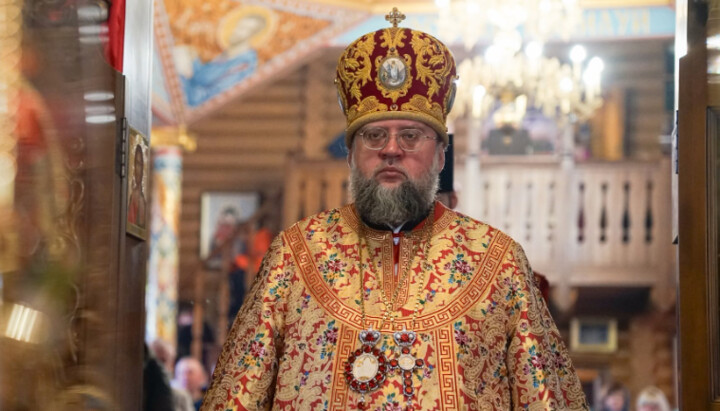
Archbishop Sylvester of Bilohorodka. Photo: Archbishop Sylvester’s Facebook page
The rector of the Kyiv Theological Academy and Seminary, Archbishop Sylvester, has analyzed the findings of the sociological study Assessment of the Religious Situation in Ukraine. The hierarch identified flaws in the wording of questions concerning the Church’s canonical status and criticized the methods used to shape public opinion. The information was reported by the UOC Information and Education Department.
Archbishop Sylvester pointed to the legal inconsistency of discussing bans, noting that 44% of respondents were unable to determine the status of the religious organization in question.
“In this context, it is absolutely inappropriate to ask respondents whether the UOC should be banned because of its alleged subordination to the Russian Orthodox Church,” Archbishop Sylvester stated. “The wording of the questions itself openly guided respondents toward predictable answers.”
According to the hierarch, the survey also demonstrated the enduring authority of the Primate of the canonical Church. Sociologists recorded an increase in public trust toward Metropolitan Onuphry, from 18% in 2015 to 28% in 2026. At the same time, a majority of Ukrainians showed a limited awareness of the leaders of the OCU and the Phanar. Between 35% and 62% of respondents admitted they did not know who Epifaniy Dumenko or Patriarch Bartholomew are.
“The level of trust in Metropolitan Onuphry has noticeably increased over the past ten years,” Archbishop Sylvester emphasized. “This happened despite the fierce media campaign aimed at discrediting both the UOC as a whole and its Primate personally.”
The archbishop argued that attempts by officials and media outlets to portray the UOC as a structure losing influence have completely failed.
Referring to the survey results, he also stressed that there is no broad public support for radical measures against believers.
“From the standpoint of religiosity, Ukrainian society has turned out to be a far more complex system than some government officials or journalists try to portray,” Archbishop Sylvester said.
The hierarch warned that further attempts to intensify church seizures under the guise of parish “transfers” would only provoke growing public resistance.
“It is long past time to put an end to violence as a means of resolving religious disputes,” he concluded.
As previously reported by the UOJ, the rector of the Kyiv Theological Academy and Seminary recently spoke about the significance of the First Ecumenical Council.
Read also
Shevchuk to Ukrainians in Latvia: Whatever your former church, join UGCC
The head of the UGCC urged all Ukrainians living in Latvia to join his Church.
UOC priest’s father killed in AFU military service laid to rest in Sumy
UOC clergy held a funeral service for Ukrainian serviceman Serhii Taptunov at Holy Trinity Cathedral in Sumy. He was buried at a city cemetery with military honors.
Patriarch Daniel calls for dialogue to overcome divisions in Church
The Bulgarian Primate explained the significance of joint celebrations with Patriarch Bartholomew amid ongoing disagreements.
Patriarch Bartholomew says his see ensures unity in Christ’s Body
Speaking at the Bulgarian Church's Holy Synod, Patriarch Bartholomew declared that the Archbishop of Constantinople serves as the unifying link and guarantor of Orthodox unity.
Patriarch Daniel calls for preserving Church unity
In a sermon at St. Alexander Nevsky Cathedral in Sofia, the Bulgarian Primate emphasized humility, repentance, and fidelity to the Orthodox faith as the path to overcoming divisions.
Bulgarian and Constantinople Patriarchs attend Liturgy at Sofia Cathedral
Metropolitan Barnabas presided over the Liturgy at St. Alexander Nevsky Cathedral in Sofia as part of celebrations marking two anniversaries of St. John of Rila.