Stories of the early Church: how shepherds were separated from the flock
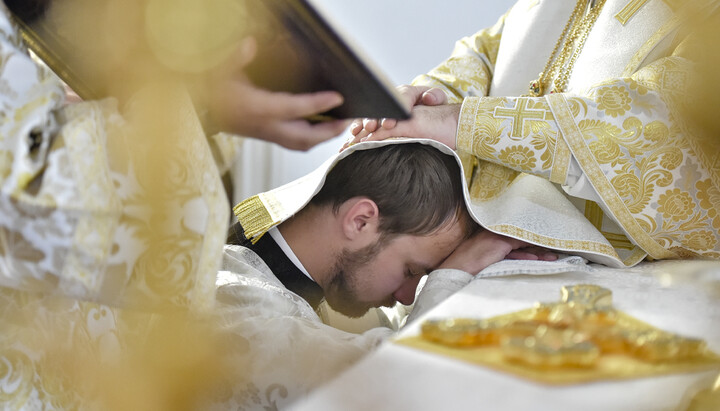
The Sacrament of Holy Orders. Photo: open sources
As mentioned in the previous article, as early as the 3rd century, the clergy sought to stand not "among the laity, but above them." In the subsequent 4th–8th centuries, this aspiration became reality. After the Church was effectively integrated into the state under Constantine the Great, it ceased to be a relatively small persecuted community. It became a major social institution, with millions of believers, property, monasteries, courts, influence over society and the state, relations with imperial authority, and a complex administrative structure.
The former model of governance and life activity no longer worked. It was replaced by another, in which the clergy were no longer an organic part of the community but a distinct, relatively closed group of people who stood (or were expected to stand) above the laity in ascetic, liturgical, and administrative terms.
All of this was reflected in disputes over the marriage and celibacy of the clergy, the exclusion of the laity from participation in the election of clerics, and the restriction of lay participation in the liturgy.
Disputes about clerical marriage
In the early centuries, the Church had no objection to the married life of its pastors. "...a bishop must be blameless, the husband of one wife..." (1 Tim. 3:2). The Apostolic Constitutions also state: "Let a bishop, or presbyter, or deacon, who is married, be the husband of one wife, whether she be alive or dead." The 5th Apostolic Canon prescribes: "A bishop or a presbyter or a deacon shall not cast off his wife under pretext of piety. And if he casts her off then let him be excommunicated; and if he persists, let him be deposed." Yet the very existence of this canon indicates that such a practice – casting off one's wife under the guise of piety – had already begun to appear within the Church.
From the 4th century, under the influence of monasticism, celibacy began to be regarded as a higher form of ministry. Among the faithful, the view spread that the clergy should stand above the laity in moral terms, and that celibate clergy were more “grace-filled” than married ones. In some cases, Christians even came to avoid receiving the sacraments from married priests, claiming that doing so could lead to defilement.
For example, a certain Eustathius, who was Bishop of Sebastia in the 4th century, "commanded, as from sin, to abstain from the blessing (Eucharist – ed.) and communion with a married priest, even if he had entered marriage lawfully before receiving ordination" and said that "it is better to pray in private homes than to attend the liturgy of a married priest.”
Saint Epiphanius of Cyprus also spoke out against the married life of the clergy, although in somewhat milder terms. Quote: “You may say to me: in some places presbyters, deacons, and subdeacons still beget children. But this is not according to the rule, I shall say, but due to the laxity of human thinking and the lack of worthy ministers because of the multitude of believers.”
On the issue of clerical celibacy, there was a very long and intense debate, which was resolved differently in the East and in the West.
This question was raised at the First Ecumenical Council in Nicaea in 325, and many then inclined toward establishing mandatory celibacy for all ranks of the clergy. But the strict ascetict Paphnutius of Thebes unexpectedly spoke out in defense of marriage. Quote: "Do not impose a heavy yoke on ordained persons: marriage is honorable, and the bed undefiled. Lest from excess of strictness harm should come to the church; for not all can take upon themselves the struggle of passionlessness. It is enough that according to the ancient tradition of the church, one who enters the service of the Church while unmarried should remain so. And whoever married before ordination should by no means leave his wife." The Council approved Paphnutius's opinion, but did not adopt any canon on this question. In 340, the Local Council of Gangra anathematized those who considered it inadmissible to receive the Eucharist from a presbyter who was married.
However, debates on this issue did not subside for several more centuries. Its final resolution in the East took place at the end of the 7th century, when the Council in Trullo, the so-called Quinisext Ecumenical Council, confirmed the requirement of celibacy for the episcopate while allowing priests and deacons to live in marriage.
But in the West, the question of celibacy was initially viewed more strictly. Saint Ambrose of Milan interpreted the Apostle Paul’s words that a bishop must be “the husband of one wife” to mean that he must have had one wife before ordination. After ordination, however, he was obliged to abstain from marital cohabitation. The same view is expressed by Blessed Jerome: "He (the Apostle Paul – ed.) does not say: let a bishop be chosen who marries one wife and bears children, but – who married one wife and has children in obedience and order. You certainly recognize that one is not a bishop who bears children during his episcopate."
The Local Council of Elvira in Spain at the beginning of the 4th century decreed: "Bishops, presbyters, and deacons, as well as all clerics in ministry, are prescribed to completely abstain from their wives and not to beget children. Whoever acts otherwise shall be excluded from the dignity of the clergy." This rule was confirmed by a number of Local Councils in Carthage. It is noteworthy that in practically all these decisions, the Councils referred to the fact that this is what "the apostles taught" and what "antiquity preserved," although it was evident that this was not the case.
In the Middle Ages, this line was brought to a strict canonical form: the First Lateran Council of 1123 forbade clerics to enter marriage, and the Second Lateran Council of 1139 declared such unions not marriage in the proper sense.
Struggle for episcopal elections
In the early Church, community participation in the election of clergy was very significant. The Didache (Teaching of the Twelve Apostles) explicitly called upon the church community to "appoint bishops and deacons for yourselves." In the 3rd century, this principle was still maintained. Cyprian of Carthage said that the ordination of a sacred minister should take place in the presence of the people, so that the candidate’s worthiness might be confirmed by public testimony.
A similar order existed in the 4th–5th centuries. Ambrose of Milan, who himself was chosen as bishop by the people, said that the election of a bishop should be “by the consent of the people.” Basil the Great wrote that the election of a bishop concerns every community member. In the 5th century, Pope Leo the Great wrote: “At the ordination of priests one must await the voice of the citizens, the testimony of the people, the judgment of the honorable, and the election of the clergy, so that in all things the apostolic order may be preserved.”
However, even in the early centuries, the shortcomings of the popular election of clergy became apparent.
First, the people were often guided by non-religious criteria. They elected not zealous pastors, but eloquent speakers, wealthy people, or clever politicians. And second, during elections the community often divided into hostile parties supporting different candidates. Moreover, each party did not disdain anything to secure its own candidate. With the “state integration” of the Church and the influx of a mass of people with a pagan mindset, these problems were greatly exacerbated.
Many hierarchs of that time spoke about these problems. For example, Gregory the Theologian wrote: "Now there is danger that the most sacred rank might become the most ridiculous among us, because episcopacy is acquired not by virtue, but by intrigues."
The enmity of opposing parties sometimes even led to bloodshed. For example, in 366 in Rome, men named Damasus and Ursinus claimed the papal throne. Their supporters engaged in a series of violent clashes in the streets and even inside churches, resulting in hundreds of casualties.
Another vivid example – the case of Bassianus and Stephen in Ephesus, examined at the Council of Chalcedon (451). Stephen's side accused Bassianus accused Bassianus of having seized the episcopal see with the support of an armed crowd and an official "with a drawn sword." Their opponents, however, claimed that Stephanus’ supporters, in their desire to place him on the episcopal throne, seized Bassianus, took him out of the church, beat him, dragged him through the public squares, and imprisoned him.
All this led to the gradual restriction of the laity participation in the election of clerics. Already in the 4th century, the Local Council of Laodicea decreed that election to priesthood cannot be entrusted to "a gathering of people." Justinian's legislation (6th century) prescribed that only noble citizens participate in the election of clerics. However, in practice this meant that government officials, wealthy and influential people often elected clerics at their discretion, not always conscientiously.
In response to this, the VII Ecumenical Council (787) established that the election of a bishop, presbyter, or deacon performed by secular rulers is invalid, and a bishop should be "elected by bishops." However, despite this, "secular rulers," and especially sovereigns in subsequent centuries, played a decisive role in appointing the episcopate and clergy in general.
With the removal of the people from the election of clerics, the clergy gradually transformed into a separate class of society, with its own traditions and predominantly hereditary order of filling church positions.
New strict prohibitions for laypeople
The separation of the clergy from the people was manifested not only in matters of marriage and elections. It became visible in church life itself: in worship, preaching, access to the altar, etc.
In the 4th–8th centuries, the right of laypeople to preach publicly in church was finally restricted. The Council in Trullo (691–692) prohibited a layperson from publicly teaching in church, as well as from entering the altar. An exception was made only for the emperor in special cases.
The Council of Chalcedon (451) forbade those who had once entered the clergy to transfer to military service or secular rank. Justinian's legislation went even further: a cleric who arbitrarily abandoned his rank could lose property and status rights.
At the same time, attempts were made not to allow the final closure of the spiritual estate within itself.
Thus, the Council in Trullo condemned the practice whereby clerics were selected exclusively from the descendants of the clergy without any examination of their worthiness. But the direction had already been set: the clergy was increasingly separating itself from the people and gradually turning into a distinct ecclesiastical-social class.
Loss of true Christian freedom
The history of the 4th–8th centuries testifies to the gradual change in church consciousness. The clergy separated from the people and stood above them. The cause of this was not only the desire to elevate oneself and rule, but also the aspiration to overcome those shortcomings that significantly intensified among the people after Christianity became the state religion: low level of morality, irresponsibility in choosing clerics, and division into hostile parties.
But gradually this separation began to be perceived not only as a special calling, but as a condition inherent to the clergy as a distinct social class. The people, who in the early Church had been active participants in ecclesiastical life, increasingly became passive recipients: they came to church, received the Sacraments, listened to teachings, obeyed the orders of the hierarchy and participated less and less in resolving church matters.
Thus arose a dangerous substitution: the Church in people's minds became associated not with all its members, laymen and clerics, but primarily with the clergy.
From this understanding arose, for example, such a term as "parishioners," i.e., people who come to church for worship or for occasional rites and then leave it.
Knowledge of church history, however complex and contradictory it may be, enables us to reflect more deeply on what the Church is in its very essence and what belonging to the Church means for every Christian, both layman and cleric. And whatever forms the Church may have taken throughout its history, we must never forget the words of the Apostle Paul, addressed to the Corinthians and all Christians: "...you are the temple of the living God, as God said: 'I will dwell in them and walk among them; and I will be their God, and they shall be My people'" (2 Cor. 6:16).
In the following publications we will speak about Church governance: from bishops to patriarchs.
Read also
Trial of a dead pope
Once in Rome, the body of a deceased pope was seated on the throne and put on trial. The accusation relied on a church canon that had once saved his see.
Monastery built in defiance of king
When Orthodox believers in Minsk were left with just one church, townspeople decided to build another – and even a royal decree did not stop them.
Young Mother and Sleeping Christ
Michelangelo carved a Virgin Mary who looks younger than her Son – and signed his name in marble for the only time in his life. Neither of these peculiarities was accidental.
Orthodox books from a Uniate printing press
In the 18th century, Uniate monks at Pochaiv printed books used in prayer by Orthodox Christians and Old Believers alike.
The story of the honey brotherhood
The Mogilev Brotherhood began with members pooling money to brew honey drinks for feast days – and eventually grew to have its own printing press.
Golgotha in the midst of a pogrom
In the autumn of 1938, the Jewish artist Marc Chagall painted the crucified Christ. Synagogues burn and refugees flee around the cross, while the Crucified One Himself is wrapped in a prayer shawl.