The Moon of the Law and the Sun of Grace
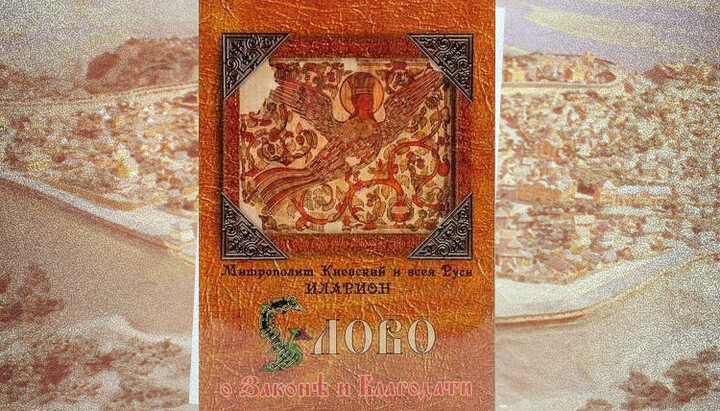
Metropolitan Hilarion of Kyiv’s “Sermon on Law and Grace.” Photo: UOJ
In the middle of the Sermon on Law and Grace, its author – Metropolitan Hilarion of Kyiv – speaks of two lights. One is faint and reflected: the light of the moon. The other is bright and natural: the light of the sun. The writer identifies moonlight with the Law – the old shadow of the New Testament, the bondwoman Hagar, the night. Sunlight he identifies with Grace: freedom, dawn, day, before which every candle fades. “The chill of night vanished,” the saint concludes, “when the warmth of the sun had warmed the earth.”
He carries the same rhythm of thought further: the Law, for him, is like a dried-up lake; Grace is like a spring that never runs dry. One tonal current of the text softly flows into another, as in a classical piece of music.
Gold laid over dark ground
Every gilding has its ground – the dark base upon which the gold is laid. So too this text, radiant in its beauty, had a very dark historical ground beneath it.
A year or two before Metropolitan Hilarion’s words were spoken, Kyiv endured what the chronicle would call a “fierce slaughter.” A Pecheneg horde stood beneath the city ramparts; in the open field, enemies clashed to the death; and by evening, the city had barely held. The poetic lines about the warmth of the sun were laid over soil that had not yet cooled from bloodshed.
This land had received Baptism only half a century earlier. By all ordinary measures, it should still have been learning to spell out the letters of Church life syllable by syllable. Instead, it immediately began to speak in mature rhythmic prose, with measured consonances and antitheses that other lands took generations to reach.
Less than one human lifetime separates the baptismal font from this text. That fact speaks eloquently of the spiritual maturity of the Rus’.
The saint’s unexpected voice
The authorship of the work is attributed to a priest from the princely village of Berestove near Kyiv – not to some foreign rhetorician trained in Constantinople. Moreover, he became the first hierarch placed on the Kyiv cathedra without the consent of the Byzantine church authorities.
Constantinople was accustomed to looking down on newly baptized peoples: you came to Christ late, you are younger in conversion, and you must keep to the rules given to you. Vladyka Hilarion answers this with the force of literary speech. The sun, he says, rises over everyone at once. Grace knows no elder and younger, no chosen and secondary peoples. And therefore, the one baptized yesterday inherits exactly the same fullness as the one baptized centuries ago.
The Kyiv prince on a par with Constantine
Then Hilarion does something that would have made people in Constantinople wince. In the third part of the Sermon, he turns to praise Prince Vladimir, under whom Rus’ was baptized. And he praises the ruler on a grand scale: he gives him an imperial title, kagan, and then places the recent pagan on a level with Constantine the Great himself. “Like the great Constantine,” he says, “equal to him in mind, equally Christ-loving.”
This was an act of no small courage. For the Christian world, Emperor Constantine was an almost iconic figure – the first emperor to open the doors of freedom to the Church. And suddenly, beside him, on the same height, stood the Kyiv prince, whose land had accepted the Christian faith only recently.
In this way, Hilarion writes Rus’ into the common history of salvation as a full line – not as a footnote in the margins.
The Sun of Grace, he insists, rose over this land just as confidently as over all other peoples.
Why beauty for those who had barely survived?
Many are used to thinking of beauty as a luxury of peaceful, well-fed times – as though it ripens only in the quiet of wealthy libraries, while wherever people are being killed and homes are being burned, there is no room for elegance. But Metropolitan Hilarion’s Sermon tells a different story. In essence, ancient Rus’ culture found its source immediately after a historical catastrophe – and perhaps even because of it.
When the familiar world collapses, a person begins to choose words with particular precision in order to express the condition of a suffering soul.
A rightly formed phrase or artistic image often becomes the thing people hold on to when there is nothing else left to hold. Here, beauty is not a secondary detail of the interior, but a roof – that which keeps the whole building of life from finally collapsing.
And so the Sermon does not fall upon its readers and listeners like the thunder of victory. It calls them to prayer and hope in God. And if we return to the symbols with which we began – the moon and the sun – we see that the saint gives the advantage to the bright and direct light, not to the dim and reflected one. Grace is always stronger than the Law, because it transmits divine love, not punishment.
Read also
Trial of a dead pope
Once in Rome, the body of a deceased pope was seated on the throne and put on trial. The accusation relied on a church canon that had once saved his see.
Monastery built in defiance of king
When Orthodox believers in Minsk were left with just one church, townspeople decided to build another – and even a royal decree did not stop them.
Young Mother and Sleeping Christ
Michelangelo carved a Virgin Mary who looks younger than her Son – and signed his name in marble for the only time in his life. Neither of these peculiarities was accidental.
Orthodox books from a Uniate printing press
In the 18th century, Uniate monks at Pochaiv printed books used in prayer by Orthodox Christians and Old Believers alike.
The story of the honey brotherhood
The Mogilev Brotherhood began with members pooling money to brew honey drinks for feast days – and eventually grew to have its own printing press.
Golgotha in the midst of a pogrom
In the autumn of 1938, the Jewish artist Marc Chagall painted the crucified Christ. Synagogues burn and refugees flee around the cross, while the Crucified One Himself is wrapped in a prayer shawl.