The Lavra strike: a wound, a weapon, or a warning?
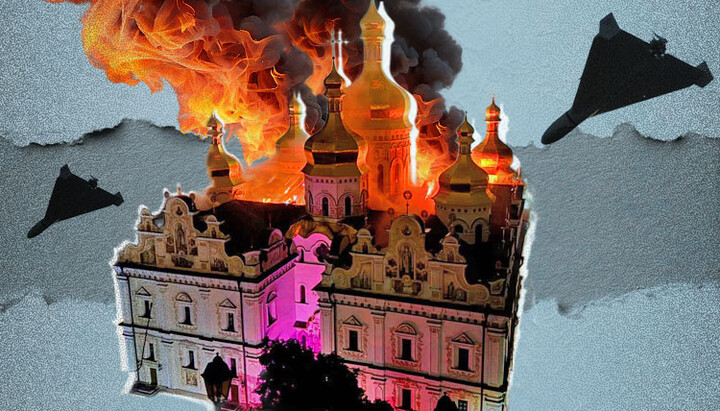
War has reached the Kyiv-Pechersk Lavra. Photo: UOJ
On June 15, 2026, an event occurred that cannot be viewed as just another episode of a major war: as a result of a nighttime attack on Kyiv, the Dormition Cathedral of the Kyiv-Pechersk Lavra was damaged. Yes, hundreds of churches have already been destroyed during more than four years of war, but this time the blow struck the very heart of Orthodoxy in Rus’. It is tragic. It is symbolic. But what exactly does this symbol mean? And what conclusions should we draw?
What struck the cathedral: a Geran drone, a Patriot missile, or debris?
The Security Service of Ukraine claims that the Dormition Cathedral was struck by a Russian Geran-2 drone. President Volodymyr Zelensky also stated that a drone hit the cathedral.
The head of the Kyiv-Pechersk Lavra National Reserve, Maksym Ostapenko, spoke of two impacts. He claimed that the drones approached “along a clear and obvious trajectory” and that the strike on the cathedral was not accidental.
The Russian version is entirely different: according to it, the cathedral was hit by a malfunctioning Patriot air-defense missile.
Some insight may be gained from a video recorded by MP Mykola Tyshchenko on the roof of the Dormition Cathedral. The footage shows that the copper roofing was almost completely destroyed, but the metal framework and supporting beams remained intact. At the impact site, only several dozen bricks were damaged, while the masonry itself sustained no serious destruction. This is despite the fact that the warhead of a Geran-2 carries about 90 kilograms of explosives.
The most plausible explanation was offered by political analyst Kostiantyn Bondarenko. According to his military sources, there was only one drone, which was shot down over the Lavra. Its engine fell near the Refectory Church, some fragments struck the Dormition Cathedral, and a significant portion of the debris landed on the grounds of the neighboring Arsenal complex.
This would explain why the roof of the cathedral lacks the kind of damage normally associated with a direct Geran-2 strike. There have been cases in Ukraine where such drones caused the collapse of entire floors of residential buildings.
There is another curious detail. OCU head Serhii Dumenko stated that a monk from the Theodosius Monastery “happened to be on the bell tower filming at that very moment.” This immediately raises several questions:
What was a monk doing on a bell tower at 1:30 in the morning? What could he have been filming at that hour? How did a man end up at the Theodosius Monastery at night if it is a women’s monastery? How did he have Dumenko’s personal phone number? Or does every monk in the OCU have direct access to its primate?
Simple answers seem unlikely.
Is a massive cash grab looming behind the restoration effort?
Less than a day after the strike, while workers were still clearing debris, Lavra Reserve director Maksym Ostapenko announced that more than UAH 500 million would be needed for restoration.
Who carried out the calculations and how they could have been completed so quickly remains unknown. Yet there is something noteworthy here.
As already mentioned, the visible damage to the Dormition Cathedral appears relatively limited. The interior remained intact. Approximately 80 percent of the copper roofing was destroyed. Experts estimate that replacing the entire 800-square-meter roof would cost up to $300,000, including labor. Additional restoration work may be required that is not obvious to non-specialists. But UAH 500 million amounts to more than $11.1 million. How exactly could such a sum be spent? Moreover, Ostapenko immediately warned that the figure would likely increase.
It is worth remembering that the reconstruction of the entire cathedral in 1999–2000 cost UAH 69 million, roughly equivalent to $12.5–13 million at the time.
A fundraising account has now been opened, and Ukrainians are being asked to contribute toward the restoration of the Dormition Cathedral. Will the Lavra restoration become a multi-million-dollar bonanza? Who will oversee the expenditures? Is a new roof really worth such enormous sums, or will the money be used for other purposes?
The questions remain unanswered.
Grief for export
After the strike, President Zelensky visited the Lavra and described what happened as “barbarism” and “an open attack on the Christian community.” That may be true. But how then should one describe the destruction of the Tithes Monastery in Kyiv, St. Volodymyr’s Church in Lviv, or the Transfiguration Church in Ivano-Frankivsk by Ukrainian authorities? Was that also “barbarism” and “an open attack on the Christian community”? Or is it somehow different?
The Dormition Cathedral is holy. But it is holy not because it appears on UNESCO lists or is recognized as an architectural monument. It is holy because it is a church – a place where prayers are offered and where the unbloody Sacrifice is presented to God during the Divine Liturgy. The same was true of the churches destroyed by the authorities themselves. Barbarism does not become something else merely because it is committed by one’s own side.
The picture is revealing. The authorities demolish churches at home without a trace of regret – yet as soon as a Russian attack damages the Dormition Cathedral, public displays of grief begin before the cameras. And these displays prove remarkably effective. Zelensky showed Donald Trump photographs of the burning cathedral at the G7 summit and apparently secured political concessions. Ostapenko announced a sum sufficient to build a second Dormition Cathedral and seems likely to receive it. Meanwhile, the OCU and other opponents of the UOC have found a new pretext for intensifying pressure on the Church.
The strike on the Lavra as a pretext for pressure on the UOC
Instead of bowing their heads before a burning shrine, the OCU and state officials used the tragedy as a convenient opportunity to increase pressure on the UOC.
On June 15, the State Service of Ukraine for Ethnopolitics and Freedom of Conscience issued a statement addressed to the “hierarchy, clergy, monastics and faithful” of the UOC. The agency declared that the UOC should “withdraw from the Moscow Patriarchate, which has long justified evil, infanticide and blasphemy.” The fact that the UOC has long since declared its independence from the Russian Orthodox Church did not seem to matter.
Commenting on the strike, Serhii Dumenko likewise called on UOC believers to pursue “unity.” He repeated the familiar claim that UOC faithful merely “disguise themselves” as members of a Ukrainian Church while remaining subordinate to the Moscow Patriarchate and carrying out the instructions of “the bloody Patriarch Kirill.”
Avraamii Lotysh, the OCU-appointed “abbot” of the Lavra, called on the monastery’s brotherhood to “come to their senses” and “return” to the OCU. How one can return to a body to which the Lavra brotherhood has never belonged was left unexplained.
Thus, the strike on the Lavra was transformed into a strike against the Church.
During the war, hundreds of UOC churches have been destroyed or damaged. Yet not a single word of sympathy or support for the UOC has come from the authorities. There have only been accusations and reproaches, along with the entirely illogical demand that the Church leave the ROC – which it has already done – and join a schismatic structure because Russia is destroying its churches.
Moscow speaks
The Russian authorities’ explanation for the strike has already been mentioned. But what did the Russian Orthodox Church say?
Officially, it remained silent, though several prominent figures commented.
Archbishop Savva Tutunov, a vicar of the Patriarch of Moscow, wrote on Telegram that those responsible for the strike were “a people who voluntarily renounced the Russian name and the Orthodox faith.” He compared the fire on the roof of the Dormition Cathedral to the fire in Odessa’s Trade Unions House and said it would continue to “burn through Ukraine as retribution for cruelty, indifference, cowardice and betrayal.”
Other statements followed. On June 16, Archpriest Nikolai Balashov, an adviser to Patriarch Kirill, said the ROC viewed the damage to the Dormition Cathedral “with sorrow and prayers for peace,” calling the Kyiv-Pechersk Lavra a shared shrine of Orthodox Russians and Ukrainians.
On June 18, Vakhtang Kipshidze, deputy head of the ROC Synodal Department, stated that the strike should be viewed “in the context of everything happening” in Ukrainian church life. “While mourning the damage done to this church – which, by the way, is a modern reconstruction rather than a historic building – and without knowing the exact circumstances, we must understand that everything happening in the Lavra today is in fact a schism orchestrated by the state and by forces external to Ukraine.”
What did the UOC say?
On June 15, the UOC issued an official statement. Metropolitan Clement, Chairman of the Synodal Information and Education Department, declared that the UOC “firmly condemns Russia’s military aggression against Ukraine, which has led to the deaths of thousands and the destruction of holy sites... The wounds suffered by the Dormition Cathedral this night reflect the profound tragedy of the entire Ukrainian people... The tragedy at the Lavra should inspire all Christians to intensify their prayers for the immediate end of the madness of war, for which there can be no justification.”
The abbot of the Kyiv-Pechersk Lavra, Metropolitan Paul, also spoke out. He called the damage to the Dormition Cathedral a great sorrow for the fullness of the Orthodox Church and a spiritual catastrophe.
It should also be noted that the strike triggered a wave of criticism directed at Metropolitan Onuphry for not making a public statement. The logic was predictable: if he remains silent, then he must be afraid, unwilling to condemn the attack, or “sold out to Moscow.”
Yet Metropolitan Onuphry rarely comments publicly on current events. He remains silent not only about the strike on the Lavra but also about church seizures, persecution and other major issues. Does this mean he supports them? Certainly not. Unlike the leaders of many other confessions, His Beatitude generally confines his public remarks to spiritual matters and delivers them in sermons rather than political statements.
Conclusion
We believe that everything happens according to God’s providence. In the end, it may not matter exactly how the Dormition Cathedral was damaged. What matters is that this is a sign. A warning. A message from above. But what is Heaven trying to tell us?
Here lies the greatest tragedy. In 2022, one Orthodox nation launched an aggressive war against another Orthodox nation. In 2026, that war reached the cradle of Orthodoxy in Rus’. The Lavra is a place of prayer and Divine Liturgy. The place of the ascetic labors of Saints Anthony and Theodosius. The resting place of the relics of the Saints of the Caves. And now its principal cathedral stands scarred by fire.
Is this not a call from above: Stop. Repent. Cease killing one another.
Yet no one seems willing to hear that call. Russia sends drones over the Lavra. Ukraine expels monks from it. Every side turns the strike on the Dormition Cathedral into material for its own campaign: some use it to influence Trump, others to secure funding, others to justify a “holy war,” others to increase pressure on the UOC, and still others to attack Metropolitan Onuphry.
Very few speak about repentance. Very few warn that if we do not come to our senses, the consequences may prove even more terrible than anything we have already experienced.
The Gospel contains a passage that seems especially relevant here:
“At that time there were some present who told Him about the Galileans whose blood Pilate had mingled with their sacrifices. And Jesus answered and said unto them, ‘Do you think that these Galileans were worse sinners than all the other Galileans because they suffered such things? I tell you, no; but unless you repent, you will all likewise perish. Or those eighteen on whom the tower in Siloam fell and killed them – do you think they were worse offenders than all the others living in Jerusalem? I tell you, no; but unless you repent, you will all likewise perish’” (Luke 13:1–5).
Read also
Yelensky’s plan: Why is DESS demanding what the UOC has already done?
DESS is demanding that the UOC take steps it has already taken, while offering no assurance that further demands will not follow. What is behind Yelensky’s ultimatum?
Why OCU hierarchy lacks canonical ordination: what Local Churches say
The OCU head refuses to address invalidity of his ordinations. But almost all Local Churches speak of it – even those that recognized the OCU.
Why nation-first advocates do not call for peace
Ukraine’s population is declining by nearly one million people a year, and experts are warning of the nation’s demographic extinction. Yet the leaders of the Orthodox Church of Ukraine (OCU) and the Ukrainian Greek Catholic Church (UGCC) continue to call for war and mobilization.
The deception that decided the fate of the Tomos
In 2008, the "Filaret problem" derailed Yushchenko's plan. In 2018, Poroshenko solved it in just one hour – with a police escort for the Greeks and verbal promises to Filaret.
Lawyers in the crosshairs: How UOC is being stripped of its right to defense
Activists harass UOC lawyers outside courthouses, call them “traitors” on air, and promise them a “warm welcome” at hearings. The Church’s right to a legal defense is at stake.
How to respond to persecution: Lessons from St. Silouan the Athonite
The Church can and should be defended, but without malice. Why love for persecutors is not weakness but the only way to preserve the Spirit of Christ in the midst of the struggle.