The burning Lavra: Why a Christian cannot be part of a war of hatred
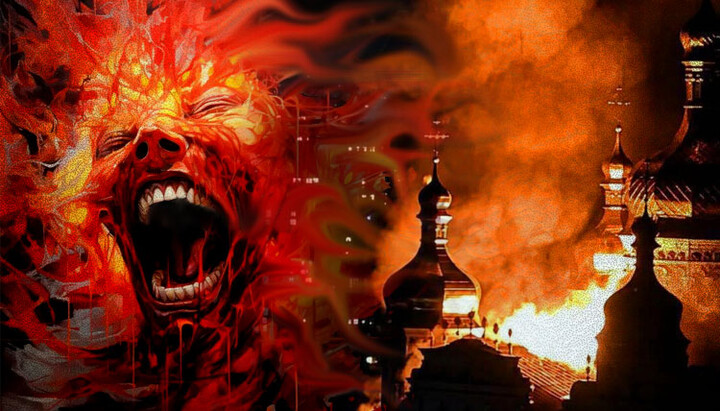
The attack on the Lavra unleashed a thirst for revenge in Ukrainian society. Photo: UOJ
On the night of June 15, 2026, a tragedy unfolded in Kyiv that wounded the hearts of countless believers. Following a Russian strike, the roof of the Dormition Cathedral of the Kyiv-Pechersk Lavra caught fire. The blaze spread across nearly 800 square meters, severely damaging the copper roofing of one of Ukraine’s most revered Orthodox shrines.
The pain is real. The grief is real. No Christian can look upon such destruction with indifference.
The natural response of a believer to a desecrated or damaged church is sorrow and prayer. That is why, when news of the attack spread, social media filled with tears, folded hands, and candle emojis. It was a normal human reaction.
Yet what followed in the political and public sphere has become no less alarming – and perhaps even more alarming – than the fire itself.
Rage instead of prayer
Days after the attack, standing beside the scarred walls of the cathedral, Volodymyr Zelensky gave an interview. There was not a single word about prayer. Not a single word about repentance. Not a single word about Christian humility.
“The strike on the Lavra filled me with rage,” he said, adding that “something must follow rage.”
The President vowed to “bring the war back” to Russian territory.
“They strike us every day – and we will respond every day,” he declared, citing attacks on targets in Russia and promising to expand Ukraine’s long-range strike capabilities.
One supposedly “Orthodox” Telegram channel went even further, openly calling on the Ukrainian military to retaliate by striking the Russian Orthodox Church’s military cathedral in Moscow.
Notice how the mechanism works.
A holy place burns.
But instead of calls for prayer, repentance, or an end to a war that has already claimed hundreds of thousands of lives, there are calls for revenge.
The burning cathedral becomes fuel for future deaths.
The destruction of the House of God is transformed into a political argument. The grief of believers is converted into “righteous anger” – and righteous anger is converted into missiles.
And here we encounter a terrible paradox that should force every Christian to stop and reflect.
The very people who yesterday mourned the attack on a sacred shrine, lighting virtual candles and offering prayers, were often the same people who, the next day, greeted retaliatory strikes, destruction, and deaths across the border with enthusiasm and applause.
The shrine that should have inspired prayer became an instrument for inflaming hatred.
If that is not a spiritual catastrophe, what is?
This has happened before – and we know how it ends
The use of religious shrines and believers’ feelings to escalate a conflict is a familiar path, one repeatedly confirmed by history and no less terrifying for that reason.
We have seen where it leads in the wars that ravaged the former Yugoslavia in the 1990s.
In that bloody conflict, religion became the primary marker of identity: a Serb meant an Orthodox Christian, a Croat a Catholic, a Bosniak a Muslim. Politicians deliberately exploited this factor to inflame hostility toward those of other faiths and to mobilize entire populations for war. The destruction of Orthodox churches, Catholic cathedrals, and Islamic mosques was not merely collateral damage – it became an instrument of propaganda, a pretext for a new wave of hatred.
As Serbian sociologist Milan Vukomanović notes, “the ethnomobilization that took place in the former Yugoslavia during the 1990s established a strong connection between the religious, confessional, and ethnic identities of its peoples.”
Bosnian professor Dino Abazović adds: “In situations of war and crisis, people readily turn to totalizing and universal systems, including religion, which presents itself as the guardian of tradition.”
As a result, the conflict assumed an increasingly brutal character, with revenge for desecrated shrines giving rise to new rivers of blood. According to Vukomanović, senior representatives of religious communities “did very little for reconciliation, and even what they did was not sincere – it did not come from the heart.” Religion was used by those who wanted war – and, tragically, it served them faithfully.
An important clarification must be made: Ukrainians and Russians are distinct peoples, with their own histories, cultures, and statehoods, even if their histories share much in common. There is no equivalence here, nor can there be. Yet the mechanism by which politicians exploit religion remains the same in every country and every era. When political power takes up the banner of faith, it does so not to save souls, but to throw more lives into the furnace of war. And the tragedy of the Lavra is being used in precisely this way – to justify “righteous anger” and calls for revenge.
What does the Gospel say?
But can a Christian become part of this spiral of hatred? Can he justify revenge by pointing to the destruction of a church? The answer given by Holy Scripture is unequivocal and leaves no room for exceptions.
Christ brought into the world a commandment that many still regard as absurd and impossible to fulfill: “Love your enemies, bless those who curse you, do good to those who hate you, and pray for those who spitefully use you and persecute you” (Matt. 5:44). There are no wartime exemptions in this commandment. There are no footnotes permitting us to hate those who destroy our shrines. It is proclaimed without qualification – and it is precisely this absoluteness that gives it its power.
The Apostle Paul explicitly forbids Christians from assuming the role of avengers: “Beloved, do not avenge yourselves, but rather give place to wrath; for it is written, ‘Vengeance is Mine, I will repay,’ says the Lord” (Rom. 12:19).
Vengeance belongs to God, not to man.
When we attempt to take revenge, we place ourselves in the Creator’s position. We say to God: “You are too slow, too merciful, so I will take matters into my own hands.”
This is not merely a sin – in a certain sense, it is blasphemy.
Moreover, hatred destroys the Christian from within, severing his communion with God. The Apostle John warns us: “Whoever hates his brother is a murderer, and you know that no murderer has eternal life abiding in him” (1 John 3:15).
John equates hatred with murder because hatred kills the soul of the one who harbors it. That is why, whenever we rejoice over another person’s death, we are first and foremost destroying ourselves.
A Christian understands that it is impossible to pray to God while simultaneously wishing death upon other people. The Apostle John places us before an unforgiving mirror: “If someone says, ‘I love God,’ and hates his brother, he is a liar; for he who does not love his brother whom he has seen, how can he love God whom he has not seen?” (1 John 4:20).
Rejoicing over the deaths of others – even when those deaths are presented as just retribution – is certainly not Christianity. It is its very opposite.
The Apostle Paul writes: “Let all bitterness, wrath, anger, clamor, and evil speaking be put away from you, with all malice” (Eph. 4:31).
Yet today it is precisely rage and malice that are being actively cultivated in society under the guise of patriotism and righteous indignation.
The paradox that should stop us
Let us return to where we began.
A person posts a candle emoji beneath a report about the shelling of the Lavra – and a day later posts fire and applause emojis beneath news of a strike on a Russian city.
He mourns the Lavra – and then rejoices in someone else’s suffering.
He calls himself a Christian – yet lives according to the law of “an eye for an eye,” the very principle Christ overturned (Matt. 5:38–39).
This is not merely inconsistency. It is a spiritual illness, and it must be spoken of plainly.
When religious feeling is used not to draw a person closer to God but to inflame hatred within him, it ceases to be faith. It becomes an idol, worshipped in place of Christ.
And it is difficult not to agree that everyone is using the strike on the Lavra for their own campaign: some to persuade Trump, others to secure budget funding, still others to justify a “holy war,” and others to increase pressure on the UOC.
And notice this: no one speaks of repentance. No one suggests that the fire in the Dormition Cathedral might be a sign from above – a call to stop, reflect, and come to one’s senses.
A call to repentance
The fire in the Dormition Cathedral of the Lavra must not become a pretext for rage or fresh calls for killing, because for a believer such events are never merely accidental.
The Gospel of Luke recounts how Christ was told about the Galileans whose blood Pilate had mingled with their sacrifices. Jesus answered: “Do you suppose that these Galileans were worse sinners than all other Galileans because they suffered such things? I tell you, no; but unless you repent you will all likewise perish” (Luke 13:2–3).
Every tragedy, every destruction of a shrine, is a call to personal repentance. It is an invitation to look into our own hearts and ask: Have I become part of this war of hatred? Have I allowed malice to burn away my love for Christ?
Politicians do what politicians do – they mobilize society, seek escalation, and speak of retaliation. That is their choice, and they will answer for it before God.
But Christians are called to something else.
We are called to be the salt of the earth and the light of the world (Matt. 5:13–14).
We are called to be peacemakers, “for they shall be called sons of God” (Matt. 5:9).
We must not allow hatred into our souls, because by doing so we set ourselves against Christ.
The war will end sooner or later.
But what will remain of us?
If hatred destroys the image of God within us, if we learn to rejoice in death and justify revenge in the name of God, what kind of world will we build afterward?
On what foundation?
With what materials?
The burning dome of the Dormition Cathedral is an image of our age.
But let it not become a call for new fires.
Let it instead remind us that the fire of hatred consumes first and foremost the one who kindles it.
Read also
A political commissar’s vocabulary: Three interviews with Epifaniy Dumenko
In just six days, the OCU leader managed to call an end to church seizures “capitulation,” describe Lavra monks as “hired hands,” and portray the U.S. vice president as a victim of propaganda.
The Council of Crete: a decade of unity in name only
Constantinople marked the anniversary of the Council of Crete with a theological conference in France. They spoke about the unity of Orthodoxy, although over the past years there has noticeably been less of it.
Yelensky’s plan: Why is DESS demanding what the UOC has already done?
DESS is demanding that the UOC take steps it has already taken, while offering no assurance that further demands will not follow. What is behind Yelensky’s ultimatum?
Why OCU hierarchy lacks canonical ordination: what Local Churches say
The OCU head refuses to address invalidity of his ordinations. But almost all Local Churches speak of it – even those that recognized the OCU.
Why nation-first advocates do not call for peace
Ukraine’s population is declining by nearly one million people a year, and experts are warning of the nation’s demographic extinction. Yet the leaders of the Orthodox Church of Ukraine (OCU) and the Ukrainian Greek Catholic Church (UGCC) continue to call for war and mobilization.
The deception that decided the fate of the Tomos
In 2008, the "Filaret problem" derailed Yushchenko's plan. In 2018, Poroshenko solved it in just one hour – with a police escort for the Greeks and verbal promises to Filaret.