The Requiem breaks off at a tearful prayer
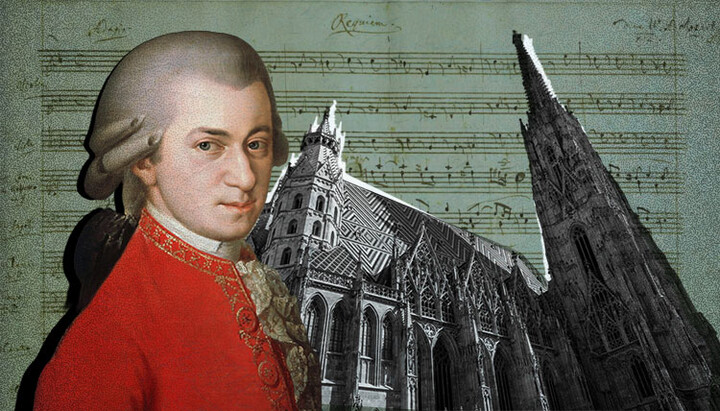
Wolfgang Amadeus Mozart. Photo: UOJ
When the singing of the Dies Irae from Mozart’s Requiem begins in the concert hall, the wooden floor starts to tremble from the blows of the timpani. Then the trombones and bassoons enter all at once, with their full mass. The sound of the choir ascends over several bars – and by the time it reaches full force; and with the basses singing "Dies irae, dies illa" at full voice, you can feel the music pressing you back into your seat.
The Requiem is music of terror, a score of death, written by a dying composer. Yet the word "requiem" itself translates differently from what we might think.
Requiem is a form of requies: rest, repose, peace after a long journey. The Requiem Mass opens with the words "Requiem aeternam dona eis, Domine" ("Grant them eternal rest, O Lord"). The focus here is not on the terror of God's judgment, but on the long-awaited rest that comes after suffering.
Fear that sounds like prayer
The sequence Dies Irae is a monologue of the accused. Behind its fearsome title lies an unbroken chain of supplications, and if one listens carefully to the text that Mozart sets to music, this becomes evident. "Rex tremendae majestatis," ("King of tremendous majesty") the supplicant cries out, only to plead a few lines later: "Salva me, fons pietatis" ("Save me, O fount of mercy"). The emotional shift is like a sudden change in the weather: a moment ago the thunder was roaring, and then, almost unexpectedly, comes the quiet, almost childlike plea: "Save me."
Then the next section begins, titled Recordare, and the tone of the work changes sharply. "Quaerens me, sedisti lassus, redemisti crucem passus" ("Seeking me, Thou didst sit weary; Thou didst redeem me, having suffered the cross"). The man reminds God of their shared history of salvation. He is certain: the Judge came to earth precisely for him. This is a deeply intimate tone for music we are used to perceiving as terrifying.
The Confutatis section is even more complex. The lower male voices lead: "Confutatis maledictis, flammis acribus addictis" ("When the accursed are confounded, consigned to the harsh flames") in a heavy, massive sound. But then the sopranos enter delicately: "Voca me cum benedictis" ("Call me among the blessed").
Once again a petition is heard. The man does not know whether he will be among the saved. He sincerely asks for mercy.
The Confutatis ends almost in a whisper: "Cor contritum quasi cinis, gere curam mei finis" ("A heart broken like ash, take care of my end"). Here, the music stops depicting judgment and becomes what it was from the very beginning: a prayer of a human being speaking of his fear. The entire journey – from the deafening Dies Irae to the quiet "take care of my end" – leads to a single culmination: the Lacrimosa.
A break in the middle of a phrase
In the summer of 1791, a messenger arrived in Vienna from an anonymous patron with a request to compose a requiem. Mozart was thirty-five years old, and his strength was already rapidly fading. By autumn he could barely leave the house. Nevertheless, the score progressed: he sketched out detailed vocal parts and a bass line for the Kyrie and for the entire sequence – Rex tremendae, Recordare, and Confutatis. The last in the sequence was the Lacrimosa.
"Lacrimosa dies illa, qua resurget ex favilla judicandus homo reus" ("That tearful day, when from the ashes shall rise the guilty man to be judged"). This is a first-person confession, written by a man who already feels his strength leaving him and his end approaching.
Mozart wrote only eight bars of this movement of the Requiem. Two are orchestral introduction, six are choral, in a rising crescendo in which all voices gradually join in. By the eighth bar, the choir reaches forte, and the manuscript breaks off. In the facsimile of the original, kept in Berlin, this is clearly visible: the ink line on the rough, yellowish paper grows thin, trembles , and ends in the middle of the musical staff. The lower third of the page is already blank. There is not a single note on it.
This was not the only unfinished idea of Mozart’s. In the 1960s, among archival drafts, a sketch for a grand fugue on the word Amen was found – it lay in the same place as the sketch for Rex tremendae, which means it was written in the same autumn of 1791. Mozart planned to close the sequence with an enormous polyphonic structure – all voices at once, in a strict fugue. This Amen also remained only a draft of a few bars.
The composer’s pupil Süssmayr later completed the Lacrimosa, composed the Sanctus, Benedictus, and Agnus Dei, and finished the work as best he could. But the notes in this score written by Mozart’s own hand go only as far as the eighth bar – to the middle of the penitential lament, to the exposed crescendo on "judicandus homo reus".
Mystery of the empty page
The Hollywood tradition views this story mystically as an evil fate: the unfinished score is a sign of doom, proof that death took its toll. There is some truth in this. Death did indeed intervene in the composer’s work. The hand of genius did indeed stop.
But the music that reached this breaking point is arranged in a remarkable way. Mozart managed to write a confession.
"Judicandus homo reus" is the cry of a sinful man who is to be judged. This is uttered in the music and brought by all voices to a loud forte. What follows in the text is a plea for mercy: "Huic ergo parce, Deus" ("Therefore spare him, O God"). These words were added by Süssmayr: Mozart’s hand did not reach the petition for mercy. And the planned Amen, meant to be the architectural conclusion of the entire sequence, a vast polyphonic affirmation, also remained only a sketch.
The great man wrote his confession of guilt and stopped. In the distance Mozart could hear the Amen he had wanted to write but did not have time to do so. Süssmayr concluded the work with a modest Amen of a few chords. This, incidentally, is the only Amen we hear at the end of the Lacrimosa. And it sounds furtive and timid as though the new author understands that he is speaking here on behalf of his predecessor.
Dust motes slowly swirl in a ray of winter sunlight above Mozart’s empty writing desk, with scattered papers and sheets of music. Requiem aeternam. Eternal rest.
Read also
Young Mother and Sleeping Christ
Michelangelo carved a Virgin Mary who looks younger than her Son – and signed his name in marble for the only time in his life. Neither of these peculiarities was accidental.
Orthodox books from a Uniate printing press
In the 18th century, Uniate monks at Pochaiv printed books used in prayer by Orthodox Christians and Old Believers alike.
The story of the honey brotherhood
The Mogilev Brotherhood began with members pooling money to brew honey drinks for feast days – and eventually grew to have its own printing press.
Golgotha in the midst of a pogrom
In the autumn of 1938, the Jewish artist Marc Chagall painted the crucified Christ. Synagogues burn and refugees flee around the cross, while the Crucified One Himself is wrapped in a prayer shawl.
Stories of the Early Church. Level of governance: patriarch
How did several episcopal sees rise above the rest, why did the Church’s administrative map come to mirror that of the empire, and is the patriarchate a sacred form of Church governance?
A Chronicle without an author
We are accustomed to calling The Tale of Bygone Years the work of St. Nestor. Yet another monk left his signature on it, while the chronicle itself passed from one generation of scribes to the next.