The impurity of a divided heart
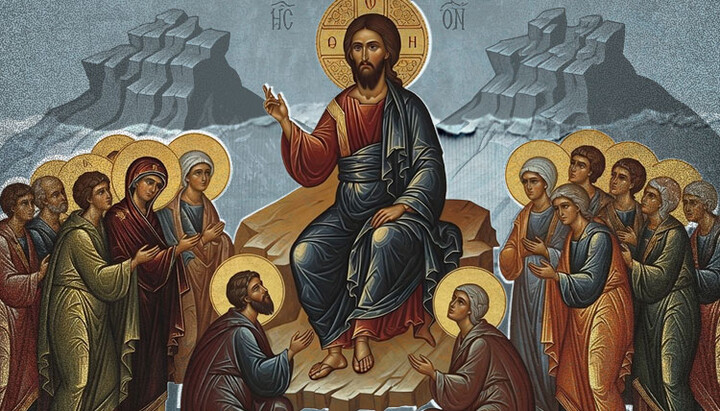
The commandment of purity. Photo: UOJ
When the choir sings “Let us who mystically represent the Cherubim” at the Liturgy, our thoughts are often nowhere near the things above. We try to pull a reverent mask over our face, while inside the sharp hum of anxiety never stops. And then shame comes over us because we are praying badly.
But this is not laziness or lack of faith, as we usually accuse ourselves of thinking. It is a sign that we have misunderstood what purity of soul really means.
Original purity
In the commandment “Blessed are the pure in heart, for they shall see God,” the Greek word used is katharos. We are used to thinking of purity as something sterile, imagining a pure soul as a hospital room that has been washed and disinfected. But in the language of the Gospel, the word sounds very different.
Katharos was used of grain winnowed from chaff, wine and milk not diluted with water, and metal without foreign impurities – gold, for example, with no slag in it. The same word, incidentally, was also used of an army cleansed of cowards and traitors.
So too, a pure heart is not a heart without sin. It is a heart without a hidden double bottom.
Here we should stop and admit honestly: under the weight of circumstances, many of us now feel anger, numbness, and exhaustion. This is what is inside our hearts. But the evil is not in that. The evil lies in trying to hide this inner state behind a respectable façade and pass off turmoil as peace.
Christ did not judge sinners
If we read the Gospel closely, we discover something unexpected: Christ almost never rebuked those who saw the impurity within themselves. He rebuked those who carefully hid that filth from others.
“You cleanse the outside of the cup and dish, but inside they are full of extortion and unrighteousness,” He says to the scribes and Pharisees. And then He gives an even harsher image: “You are like whitewashed tombs, which outwardly appear beautiful, but within are full of dead men’s bones and all uncleanness.”
Outside – a decent whitewash. Inside – decay that never stops.
It is a sobering thought for those of us who work hard to keep a proper expression on our face, not allowing ourselves even for a second to admit: I am hurting. I am tired. I am angry. I am doing wrong.
A cup washed only on the outside may seem clean to people. But the One to whom we constantly pray sees what is inside it – and waits for our healing.
Double-mindedness is the real filth
The Danish thinker Søren Kierkegaard wrote a book titled Purity of Heart Is to Will One Thing. Starting from the words of the Apostle James, “Cleanse your hearts, you double-minded,” he shows that impurity is dividedness – the attempt to serve God and a convenient image of ourselves at the same time.
We want to be believers, and we want to be seen as unshakable. We want to trust God, and at the same time we want to control every detail of tomorrow.
This is that very double-mindedness – not a fiery rebellion against faith, but a polite attempt to sit on two chairs at once.
God will not despise a broken and contrite heart
There is one text that resolves this contradiction better than any other, and it is heard at the very heart of the Liturgy – in the Eucharistic canon. These are the words of Psalm 50.
King David wrote them after the murder of his faithful soldier Uriah and after adultery with Uriah’s wife – after committing two mortal sins, one after the other. And in this state, with no right to justify himself, he asks: “Create in me a clean heart, O God.”
A few lines later, he explains what this clean heart will be made of: “The sacrifice to God is a broken spirit; a broken and humbled heart God will not despise.”
A contrite heart is broken and shattered. It is brought by the repentant person to God exactly as it is – cracked open.
An “ideal” heart cannot be broken. It may be beautiful, but it is empty. David brings God his fracture, his wound – and it is received as the highest sacrifice, the only one God truly desires.
Of course, we cannot cover our bitterness toward others with talk of “being honest before God.” That is not what this is about. This is about what happens inside us before we have time to say or do anything.
St. Macarius the Great wrote of the heart as a field where there are abysses and wild beasts. Yet it is precisely there that Christ comes, and there that His throne stands. He comes to the place where fear, anger, and numbness now reign – not to some imaginary perfect world.
Reflecting on the Beatitudes, we must admit that our hearts are far from pure. They are blackened with soot and cracked through. They are like a broken cup lifted up to the One who can not only hold it, but mend it and restore it to its original wholeness.
Read also
The help God never asked for
Uzzah wanted only to keep the Ark of the Covenant from falling into the dust. Why did this well-intentioned act cost him his life, and who was really responsible for his death?
Freedom begins when there's nothing left to take
Fear of persecutors takes root in our attachment to possessions. We turn to St. Basil the Great to understand why the prefect's threats held no power over him.
The bride in the window frame
The author of the earliest account of St. Thecla’s life was defrocked. Yet it was his book that preserved the only ancient description of the Apostle Paul’s appearance.
Drinking priest, or the flip side of parish life
In his epistle, the Apostle Jude describes a scene familiar to anyone who has seen a church meal turn into a drinking party.
A lesson from a speechless donkey
The famous seer struck his donkey three times for refusing to go forward. All the while, she was saving his life – and seeing what he could not.
The time when the soul ripens
Modern society has turned youth into a cult and old age into a period of merely “living out one’s days.” The Christian perspective reveals the profound spiritual meaning of our later years.