
The Bride in the Window Frame
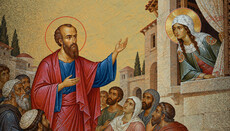
The author of the first account of the life of St. Thecla was deprived of his priestly office. Yet it is this very book that preserved the only ancient portrait of the Apostle Paul.
Around the year 200, the Carthaginian theologian Tertullian wrote a treatise on Baptism. In his time, some people argued that women could teach and baptize, and cited Thecla, a disciple of the Apostle Paul. Tertullian replies that “the presbyter in Asia, who composed that writing, as if adding something of his own to Paul's renown, was convicted, and confessed that he had done it out of love for Paul, and was removed from his position.”
So here is the first review of the book we know as the “Acts of Paul and Thecla.” Its author was found out and deprived of his office. Later, the historian Eusebius of Caesarea classed the “Acts of Paul” among the spurious books, and Blessed Jerome among the apocrypha. True, scholars still debate whether Tertullian was speaking of precisely the text that has come down to us.
Yet the Church has not forgotten Thecla and honors her memory to this day. She is called equal-to-the-apostles and protomartyr, and her name is invoked at the tonsure of women into monasticism. How did a saint from a non-canonical apocryphal text end up in the Church calendar?
A Unique Portrait of the Apostle
To begin with, the New Testament is silent about what the Apostle Paul looked like. The aforementioned “Acts” describe him in detail as “a man small of stature, bald-headed, bandy-legged, of noble bearing, with eyebrows meeting, rather hooked in the nose, full of grace.”
No majestic figure of a preacher. Short, bald, bandy-legged, with eyebrows joined above the nose. And yet in him there was a dignity and grace noticeable at first glance. We have no other ancient descriptions of the Apostle Paul's appearance.
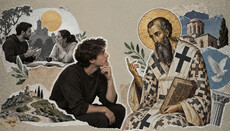
Paul preached in Iconium, and the young Thecla listened to him, gazing from a window for three days and three nights. Her mother complains in despair that Thecla “clings to the window like a spider.”
When Paul is thrown into prison, Thecla makes her way to him at night. She pays for the chance to see her teacher with everything she has. She gives her bracelets to the doorkeeper and her silver mirror to the jailer. And once more she sits at the apostle's feet until morning.
A Mother Demanding the Pyre for Her Daughter
At the trial, her own mother demands death for Thecla. “Burn her who refuses marriage, in the midst of the city theater,” she cries to the executioner.
What was her daughter's offense? The main charge lies in the final word: “one who refuses marriage.” A girl who had turned down an advantageous marriage was ruining her family's plans, and her mother did not forgive her for it. The pyre, however, did not destroy Thecla.
Popular retellings say that Thecla cut her hair and came to look like a young man.
Thecla really does ask her teacher: “I will cut my hair and follow you wherever you go.” Paul answers with fatherly sobriety: “The time is evil, and you are beautiful; may no new temptation come upon you, worse than the first.”
The apostle did not allow her to make such a sacrifice. But soon, setting out to join Paul in Myra, she nevertheless “girded herself and altered her tunic in the manner of a man's garment” and goes to him together with youths and maidens.
The Lioness, the Seals, and the Dispute over Baptism
The most dramatic part of this story unfolds in Antioch, where Thecla is given to the beasts to be torn apart. A lioness lies down at her feet, then kills an attacking she-bear and herself perishes in a fight with a lion. Then Thecla throws herself into a pool full of seals and exclaims: “In the name of Jesus Christ, I baptize myself on my last day!”
This scene became the stumbling block in theological disputes.
The plot of the apocryphon, in which St. Thecla essentially baptized herself, turned into an argument in the dispute over who has the right to administer the Sacrament.
The Peaceful Repose of a Holy Woman
After the pyre, the lions, and the seals, the life ends on a surprisingly calm note. Thecla departs for Seleucia, “where, having enlightened many with the word of God, she fell asleep in a good sleep.”
A later version of the life adds a striking finale, in which the ninety-year-old Thecla hides from her pursuers in a mountain that opens before her. Tradition names the place of her repose sometimes as Seleucia, sometimes as the Syrian Maaloula. The Church calls her protomartyr for her sufferings on the pyre and in the arena, although, according to the life, she died peacefully.
Legend Is No Obstacle to Holiness
So the author of the life of the protomartyr Thecla was deprived of his office, and the book itself was classed among the apocrypha. Yet the saint has been venerated for almost two thousand years. The explanation is simple: the Church honors the saint on the basis of traditions that preserved her memory independently of the content of a dubious writing.
That is why the story of St. Thecla must be approached with caution.
In places we have tradition, in places legend, in places real people and real locations. And at the center of the story is a girl who listened to the apostle's words at a window for three days, gave up her precious mirror for a night at his feet, and did not renounce God either before the pyre or before the beasts.