From a traveler’s cloak to a priest’s vestment
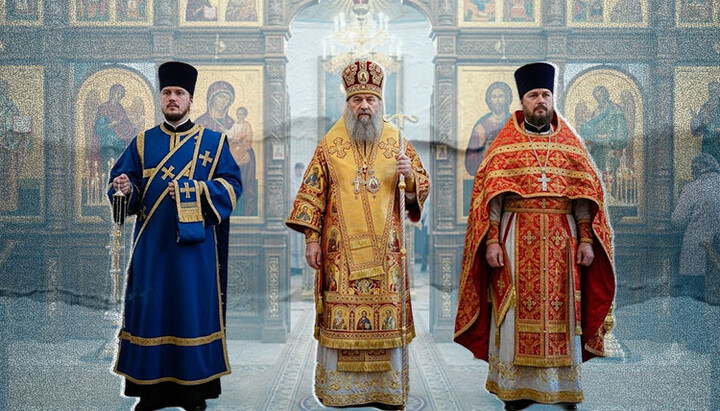
Modern clerical vestments. Photo: UOJ
We are accustomed to seeing church vestments made of gold brocade and treating them as something timeless and self-evident. Yet where did their distinctive forms come from? If we trace the evolution of ceremonial vestments back to their earliest ancestors, we arrive at something remarkably ordinary: the travel cloak of a Roman wayfarer caught in a storm somewhere on the road between Antioch and Ephesus.
A cloak designed for practicality
The Latin name of this cloak was paenula. It was a heavy woolen garment sewn in a bell-like shape, with an opening for the head and no sleeves. It was pulled over the head and usually reached almost to the ground. There was nothing luxurious about it. It was designed not for beauty, but for protection from wind, cold, and rain.
The Apostle Paul writes to Timothy: “Bring the cloak that I left with Carpus at Troas” (2 Timothy 4:13). Scholars continue to debate whether Paul was referring to an outer garment or perhaps a container for books. What matters, however, is that the Greek phelonion and the Latin paenula referred to the same warm traveler’s garment – not to a liturgical vestment.
The garment had one significant drawback: it restricted arm movement, as the fabric pulled tightly across the shoulders.
The first Christian communities adopted this clothing for church leaders not because it was beautiful, but because it was familiar and commonplace in their time.
The distinction between ordinary clothing and sacred vestments emerged gradually. Once the phelonion became associated with worship, its impractical design was modified. The front was cut away below the chest to allow the presbyter to move his arms freely. The modern phelonion, with its characteristic high collar and raised front hem, is the result of centuries of adaptation of what was originally a traveler’s cloak.
A towel that became an angel’s wing
If the phelonion covered the shoulders, the orarion was intended for movement and gesture.
The origin of the word remains debated. Some scholars derive orarion from the Latin orare – “to pray.” Others connect it to os, meaning “mouth,” suggesting that it was originally used to wipe the lips of communicants. A third theory links it to a cloth used in synagogues to signal the congregation when to respond “Amen.” It is entirely possible that all three explanations contain part of the truth.
By 364, the canons of the Council of Laodicea already mention the orarion as an established vestment. By then it had long ceased to be a simple cloth.
A deacon would raise one end of the orarion to signal the people to sing or pray. The gesture resembled that of a traffic officer directing movement – except that the deacon directed the flow of communal prayer.
Byzantine commentators later gave this gesture a deeper meaning. The fluttering ends of the orarion reminded them of angelic wings.
Symeon of Thessalonica wrote that when deacons crossed the orarion over their bodies before Communion, they symbolically resembled the seraphim who cover themselves with their wings before God.
Interestingly, when a deacon becomes a presbyter, the orarion moves from the shoulder to the neck. Its two ends are joined in front, and it receives a new name: the epitrachelion.
The symbolism of angelic service remains, but the epitrachelion becomes the vestment of a priest who celebrates the sacraments. The traditional number of seven embroidered crosses reflects the seven sacraments of the Church.
The dalmatic that was renamed out of humility
Perhaps the most ironic story concerns the bishop’s sakkos.
In the 11th and 12th centuries, Byzantine emperors developed the custom of presenting items from their own ceremonial wardrobe to the patriarchs of Constantinople. Among these gifts was the dalmatic – a wide garment with broad sleeves, shorter than a tunic, originally associated with the Roman province of Dalmatia and later incorporated into imperial court dress.
Yet after receiving this imperial garment, the patriarchs did not boast about their royal gift.
Philaret of Moscow notes that Byzantine hierarchs deliberately renamed the dalmatic sakkos – literally “sackcloth” – so that the vestment would not appear to be an appropriation of imperial honor. It was a symbolic gesture of episcopal humility.
The sakkos reached the Russian Church only in the fifteenth century, and initially only the metropolitan was entitled to wear it. A century later it became the vestment of the patriarch, and from the beginning of the eighteenth century it was adopted by all bishops.
The transformation of an imperial gift into a universal episcopal vestment took nearly six centuries. Every bishop who puts on a sakkos today wears a garment that still echoes a royal wardrobe long vanished from history.
The fate of a crown
The final vestment has perhaps the most unexpected story of all: the mitre.
Until the middle of the fifteenth century, only one Orthodox hierarch regularly wore a mitre in a form recognizable today – the Patriarch of Alexandria.
Then came the event that transformed the entire life of the Byzantine world. In 1453, Fall of Constantinople brought an end to the empire that had embodied Greek Orthodoxy for a thousand years.
Researchers of church vestments note that it was after this catastrophe that the Patriarch of Constantinople began wearing a headpiece modeled on the imperial crown.
It is difficult to say whether anyone consciously intended this gesture as a declaration by the Church under persecution. Yet history speaks for itself: after the emperor’s fall, the Patriarch remained the only visible leader of the Orthodox Romans.
There was no longer anyone else to wear the imperial crown. The patriarch assumed it, not as a claim to imperial authority, but as a sign that the Christian people endured even after the empire had disappeared. In time, other bishops adopted the mitre as well.
Thus the ordinary clothing of an empire – a traveler’s cloak, a ceremonial towel, an imperial dalmatic, and a royal crown – acquired entirely new meaning. Today these garments are worn not as symbols of worldly status, but as vestments dedicated to the service of God.
Read also
Trial of a dead pope
Once in Rome, the body of a deceased pope was seated on the throne and put on trial. The accusation relied on a church canon that had once saved his see.
Monastery built in defiance of king
When Orthodox believers in Minsk were left with just one church, townspeople decided to build another – and even a royal decree did not stop them.
Young Mother and Sleeping Christ
Michelangelo carved a Virgin Mary who looks younger than her Son – and signed his name in marble for the only time in his life. Neither of these peculiarities was accidental.
Orthodox books from a Uniate printing press
In the 18th century, Uniate monks at Pochaiv printed books used in prayer by Orthodox Christians and Old Believers alike.
The story of the honey brotherhood
The Mogilev Brotherhood began with members pooling money to brew honey drinks for feast days – and eventually grew to have its own printing press.
Golgotha in the midst of a pogrom
In the autumn of 1938, the Jewish artist Marc Chagall painted the crucified Christ. Synagogues burn and refugees flee around the cross, while the Crucified One Himself is wrapped in a prayer shawl.