Why did Zelensky receive OCU’s “Lavra abbot”?
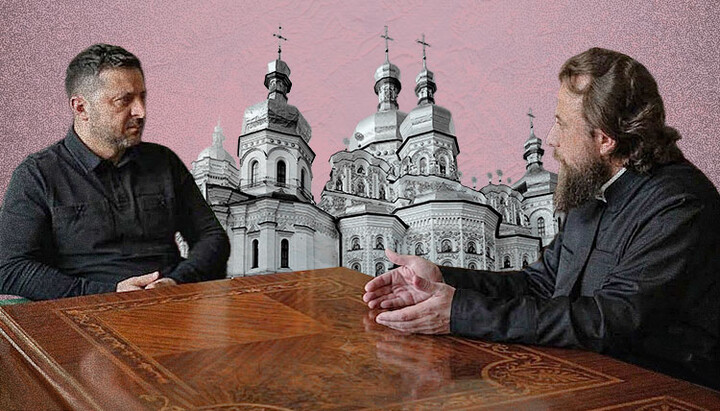
The OCU’s “Lavra abbot” supports Zelensky’s initiatives at every turn. Photo: UOJ
On July 11, 2026, a rather revealing event took place: President Volodymyr Zelensky received Avraamiy Lotysh, the OCU’s “abbot of the Lavra,” at the Presidential Office.
This is noteworthy because throughout his presidency, Zelensky has not hosted representatives of Christian jurisdictions at his official residence – not even the leaders of the highly government-loyal OCU and UGCC. In 2019, shortly after taking office, he met with UGCC head Sviatoslav Shevchuk, UOC-KP leader Filaret Denysenko, and OCU head Epifaniy Dumenko. But those meetings took place on their turf, not his. At the Presidential Office itself, the president’s religious guests have generally been Jewish leaders.
That raises an obvious question: how did Lotysh manage to secure an audience?
Many still remember the events of 2023, when members of the UOC Holy Synod led by Metropolitan Onuphry came to the Presidential Office seeking a meeting with Zelensky amid the government’s sudden campaign against the Church. The president refused to receive them. Security guards would not even allow the elderly hierarchs to sit down on a concrete block outside the building. Soon afterward, an air-raid siren was activated – and, remarkably, fell silent almost immediately after the bishops left Bankova Street.
So why was Lotysh granted access to the presidential residence? What made him important enough to receive a privilege denied even to Metropolitan Onuphry?
Judging from the press release published by Lotysh, nothing particularly significant was discussed. He thanked the president “for his constant attention to the Holy Dormition Kyiv-Pechersk Lavra, for his openness to dialogue, and for his concern for the fate of one of Ukraine’s greatest shrines.”
Lotysh said it was valuable “once again to see how deeply informed the president is about the life of the Lavra.” He assured readers that Zelensky “understands all the challenges facing the monastery today, understands our needs, pays close attention to every issue, and sincerely seeks to help.”
Yet Zelensky himself has never publicly suggested that he has any particular interest in the OCU’s “challenges” at the Lavra. Unlike Petro Poroshenko, who regularly showcases his personal piety, Zelensky has not even been seen crossing himself at religious events.
That makes Lotysh’s praise sound, at the very least, exaggerated.
Still, the OCU’s “Lavra abbot” was welcomed into the Presidential Office and even received a joint photo with the president. Zelensky does not look particularly enthusiastic in the picture – but the meeting happened nonetheless.
How should one interpret such a meteoric rise?
The “profitable” strike on the Lavra
Not long ago, Lotysh was complaining that the authorities were neglecting – and even hindering – the OCU at the Lavra.
“There are restrictions that prevent us from moving forward and developing,” he lamented.
Then, on June 15, everything changed.
A Russian strike hit the Dormition Cathedral.
Within weeks, the Lavra became a focal point not only for Ukrainian society and government officials but also for the international community. Zelensky and other senior officials suddenly rediscovered that the Lavra was a sacred site. Foreign delegations began arriving at the monastery to inspect the damage. Zelensky even showed Donald Trump a photograph of the cathedral engulfed in flames.
Although only the roof was damaged, government officials have already secured reconstruction funding from several countries, while estimates of the damage seem to grow with each new statement.
In other words, the strike generated considerable political and financial dividends.
MP Andriy Osadchuk openly described the attack as a “beneficial” event that helped draw Western attention back to Ukraine. According to him, it served as an effective tool for combating the “routinization” of the news cycle.
The attack proved even more beneficial for Lotysh.
Acting as the monastery’s de facto host, he escorted delegation after delegation through the damaged cathedral. It was Lotysh who personally guided Zelensky through the site after the strike. Later, he accompanied the president during Constitution Day celebrations at the Lavra.
Almost overnight, a previously unknown figure became someone acceptable in the corridors of power. In terms of access and communication with state officials, Lotysh suddenly emerged as a rival to Epifaniy Dumenko himself.
Yet even such a fortunate opportunity might not have been enough without one additional factor: the personal qualities of the OCU’s “Lavra abbot.”
Want a career? Flatter and please
At state-sponsored events in the Lavra, Lotysh personally escorted Volodymyr and Olena Zelensky around the monastery grounds and scarcely left their side.
Addressing the First Lady, he implored her to “take care of the president.”
“Agreed? We need him now more than ever. Without him, we will never win this war. We are happy now – for you, for our army, and for our Ukraine.”
As he spoke, a deferential smile spread across his face.
It was the same smile observers saw years earlier when he kissed the hand of His Beatitude Metropolitan Onuphry after receiving the right to wear a second pectoral cross.
There is little doubt that Lotysh wore the same expression when he thanked Metropolitan Pavel of the Lavra – first for admitting him into the brotherhood, then for elevating him to the rank of archimandrite and appointing him sacristan.
And after 2023, he readily transferred that enthusiasm to Epifaniy Dumenko, describing him as “a true father of the Church” and “a man very close in spirit” – so close, he said, that “it even became easier to breathe.”
Each time, Lotysh seemed to know exactly what his audience wanted to hear.
There is little reason to believe his conversations with Zelensky are any different.
He appears prepared to endorse virtually any initiative advanced by the current president – including ideas many Christians would regard as openly anti-church.
A pantheon in the Lavra
And this is not merely about the persecution of the Ukrainian Orthodox Church.
Zelensky’s latest idea – the construction of a National Pantheon on the grounds of the Kyiv-Pechersk Lavra – is startling in its own right.
The word pantheon literally means “a temple of all gods.” While the term is no longer used in an explicitly pagan sense, the underlying concept remains much the same: the state proposes to honor national heroes in a place of quasi-sacred veneration.
It is also worth considering who is expected to be buried there. The list includes OUN-M leader Andriy Melnyk, OUN-B leader Stepan Bandera, Ukrainian People’s Republic military commander Symon Petliura, and others. People may debate their political legacies endlessly, but one fact is beyond dispute: each of them is associated with bloodshed – both Ukrainian and non-Ukrainian.
The Lavra is the Third Lot of the Mother of God, one of the holiest places on earth. It is the resting place of the Venerable Fathers of the Kyiv Caves, whose relics have remained incorrupt for centuries. The very idea of burying alongside them figures held responsible for mass killings is, from a Christian perspective, sacrilegious. The fact that those killings may have been committed in pursuit of an independent Ukraine does not alter that reality in the teaching of Christ.
It should also be noted that many of the figures already slated for burial in this Orthodox shrine were Greek Catholics.
How did Avraamiy Lotysh respond to Zelensky’s initiative? Did he use his newfound access to try to dissuade the president?
No.
He wholeheartedly endorsed it.
Lotysh described the decision as a landmark event that would allow the world to learn about the people who secured Ukraine’s independence and sovereignty.
“Our national heroes will be buried there – heroes the whole world should know, because thanks to them we have our country, our sovereignty, and our independence,” he declared.
He reserved special gratitude for Zelensky, emphasizing that it was the president’s political will that made both the pantheon project and the installation of a bust of Hetman Ivan Mazepa in the monastery possible on such a scale and with such “solemnity.”
Partnership at any price
For several years now, Ukrainians have been told that the OCU is the authentic church of the Ukrainian people and the place where their spiritual thirst can be satisfied.
Yet the story of the pantheon in the Lavra serves as a litmus test. It once again demonstrates, according to the author, that the salvation of Ukrainians is not the OCU’s primary concern. Its hierarchy appears focused on something else: partnership with the state at virtually any cost.
And this goes beyond the pantheon issue. One may recall the recent statement by Viktor Yelensky that the OCU and the UGCC are prepared to seek compromises regarding LGBT recognition for the sake of Ukraine’s accession to the European Union.
In other words, even issues on which Christian confessions have traditionally stood firm become matters for negotiation when state approval and a “European future” are at stake.
Against that backdrop, the advocacy trips of the All-Ukrainian Council of Churches and Religious Organizations to Western countries – promoting narratives about "religious freedom in Ukraine: that critics regard as misleading – seem almost unsurprising.
Built into the state system
It is well known that Avraamiy Lotysh and the OCU “brotherhood” at the Lavra are listed as employees of the National Reserve and receive salaries from it. The detail is symbolic.
The Orthodox Church of Ukraine, like certain other religious structures, has become deeply integrated into the state system.
Not everyone, like Lotysh, is directly supported by state funding. Yet many appear willing to endorse virtually any government initiative, even those that seem to conflict with Christian principles.
“Put not your trust in princes, nor in the sons of men, in whom there is no salvation,” the Psalmist David warns. Modern Ukrainian confessions, however, often appear to follow a different logic: they hear David’s warning and proceed to do the opposite.
Yet the psalm does not end there. It continues with a reminder of what eventually happens to every earthly ruler: “His spirit departs, he returns to his earth; in that very day his plans perish.”
Stalins, Khrushchevs, Zelenskys – they pass away. Their decrees are revoked. Political circumstances change. Everything built upon the favor of princes eventually returns to the dust from which it came.
But the psalm continues: “Blessed is he whose help is the God of Jacob, whose hope is in the Lord his God.”
A Church built upon the rock outlives empires.
Structures that serve princes disappear with them.
Read also
Pentarchy with Rome: A return to the roots or a new schism?
Patriarch Bartholomew wants to revive a council of five patriarchates, including Rome. What would reunion with Catholics look like, and what role would be left for the other Churches?
Concubine or daughter? On words that cannot be used about the Church
An archon of the Church of Constantinople likened the UOC to Moscow’s “concubine.” But for St. Epiphanius of Cyprus, “concubines” are heresies.
Shameful chronicle of one week: how the OCU was born
Exarchs under escort, a call from the operations room, and 36 votes for Epifaniy: what a member of the Phanar delegation revealed about the 2018 "Council".
Can UOC eparchies be dissolved before court ruling on Metropolia?
DESS is launching separate proceedings against UOC eparchies, monasteries, and institutions while the case involving the Kyiv Metropolia is still pending.
Two murders, one silence
Zelensky condemned the killing of a Catholic priest in Poland the very same day. A month earlier, a UOC monk was murdered at the Sviatohirsk Lavra – and the president has remained silent ever since.
A bow to Phanar? Why did UOC academy congratulate Constantinople’s exarch?
A delegation from the Kyiv Theological Academy congratulated the Phanar’s exarch, who has remained silent about the persecution of the UOC. Who authorized this gesture, and why did even OCU supporters fail to appreciate it?