Kyiv authorities hold forum to discredit UOC communities in Europe
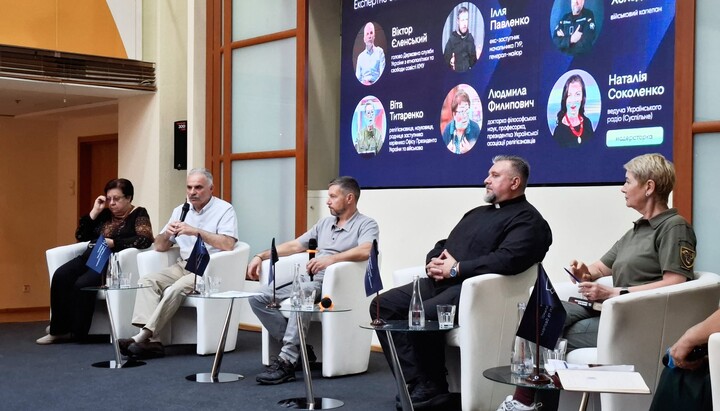
Forum “ROC in Europe: Infrastructure of Russian Influence.” Photo: Facebook page of the Institute for National Resilience and Security
A forum titled “ROC in Europe: Infrastructure of Russian Influence,” organized by the Institute for National Resilience and Security, was held in Kyiv. This was reported on the institute’s official page.
During the presentation of the study, its authors claimed that several jurisdictions linked to the Moscow Patriarchate operate in Europe, including parishes of the Ukrainian Orthodox Church. According to their estimates, there are up to 130 UOC communities in EU countries which, together with parishes of the Russian Orthodox Church and the Russian Orthodox Church Outside of Russia, serve approximately 1–1.2 million believers.
In their published statement, the organizers claimed that these communities allegedly exercise influence not only through religious activities, but also through humanitarian aid, educational projects, work with children, and the creation of a familiar spiritual environment for Ukrainian refugees. UOC parishes were described as structures that may “disguise themselves as Ukrainian communities.”
The forum was attended by Deputy Head of the Presidential Office Olena Kovalska, Head of the State Service of Ukraine for Ethnopolitics and Freedom of Conscience Viktor Yelensky, representatives of the Ministry of Foreign Affairs, the Main Intelligence Directorate, the Cabinet of Ministers, the Security and Defense Forces, the academic community, as well as OCU cleric Serhiy Berezhnyi.
According to the organizers, participants discussed “protecting Ukrainian identity” and “countering Russian influence” among Ukrainians living in European countries.
Commenting on the forum’s conclusions, UOC cleric Deacon Andriy Hlushchenko said that such events are aimed at discrediting parishes of the Ukrainian Orthodox Church established to provide spiritual support to Ukrainian refugees after the start of the full-scale war.
According to him, the forum described UOC communities as structures that “mimic a Ukrainian church” and allegedly “steal Ukrainian refugees.” The deacon also noted that participants simultaneously discussed establishing a fully fledged OCU eparchy in Europe, despite the restrictions contained in the OCU’s Tomos.
“What we are dealing with is ordinary envy and dishonest methods of competition,” Father Andriy said. In his view, the success of UOC parishes in Europe stems primarily from the fact that the Church has managed to establish dozens of communities for displaced Ukrainians, where they receive spiritual and pastoral support.
As previously reported by the UOJ, UOC parishes in Europe donated funds for the treatment of Ukrainian soldiers.
Read also
OCU bishop made $300K, kept entire battalion off front lines – scholar
Religious scholar Nikolai Mitrokhin estimated how much “Bishop” Kyrylo earned by selling fraudulent OCU deacon ordinations to 291 men eligible for military service.
Albanian Church Primate calls for overcoming nationalism in Orthodoxy
Archbishop Joan addressed an international forum in France, speaking on conciliarity and the need to overcome nationalism within Orthodoxy.
Nizhyn Eparchy launches aid drive for shelling victims in Pryluky
UOC churches have set up donation boxes to help people affected by missile strikes on Pryluky and other parts of the region.
UOC chapel consecrated in Seliatyn, Bukovyna
A local family in Seliatyn built a chapel in gratitude to the Mother of God.
Metropolitan Onuphry leads patronal feast at St. Sergius Church in Kyiv
The Primate of the UOC celebrated the festal Divine Liturgy alongside fellow hierarchs at St. Sergius of Radonezh Church in Kyiv’s Solomianka District.
Kyiv-Pechersk Lavra monks honor memory of St. Sergius of Radonezh
The brethren of the Kyiv-Pechersk Lavra held services commemorating St. Sergius of Radonezh.