The hidden heroism of Byzantium's underground Church
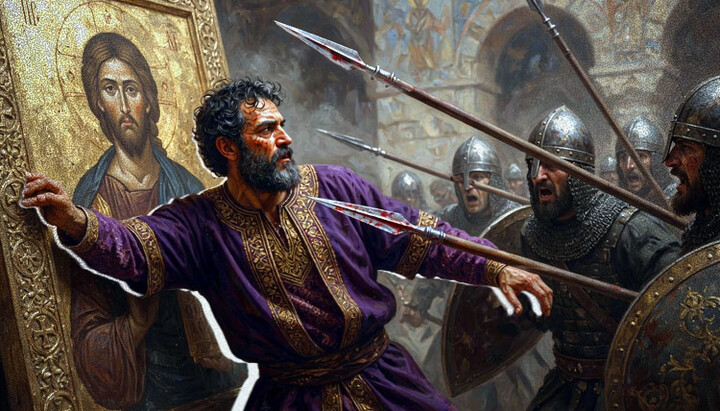
Defending the holy icons. Photo: the UOJ
Church history textbooks often leave us with the impression that Byzantium's destiny was forged beneath palace vaults. Professors quote metropolitan intellectuals, carefully classify the arguments of patriarchs, and create the illusion that the religious catastrophe which lasted for decades amounted to little more than a theological debate – one in which the losers were sent into exile while the victors celebrated with wine from the emperor's cellars.
The historical record tells a very different story.
The second period of Iconoclasm, which began in 814, plunged the empire into an era of total surveillance, with the machinery of state control reaching even its most remote frontiers. Let us descend from the heights of imperial Byzantium into an ordinary village in Thrace or Cappadocia – into a peasant hut heavy with the smells of manure, rancid oil, and sheep's wool.
For the impoverished farmer who lived there, the family icon was not merely an object. It was a member of the household.
Before its darkened face he was married. Before it he wept through droughts, baptized his children, and washed the bodies of the dead. The saint painted upon that weathered board silently witnessed every burden of his life.
Then the state burst into this centuries-old world and declared the Christian faith itself a criminal offense.
The village priest, trapped between his starving parish and intimidating provincial officials, was often the first to break. Fear of prison and confiscation of church property compelled many to sign decrees sent from Constantinople. Churches were desecrated by imperial agents, while household icons were ordered to be surrendered for public burning.
Ordinary believers suddenly faced a terrifying choice: obey the law, or risk everything to save what was holy.
Cappadocian inspections and the wax of disguise
The defining feature of the second Iconoclast period was the relentless efficiency of its bureaucracy.
Emperor Theophilos transformed the destruction of sacred images into a carefully organized state enterprise.
Throughout the provinces appeared imperial commissioners known as silentiarii – investigators dispatched from the capital, armed with sweeping powers and accompanied by military detachments.
The chronicles of George Hamartolos and St. Theophanes the Confessor preserve vivid descriptions of these punitive inspections.
Arriving in a village, the commissioners conducted what amounted to systematic house-to-house searches. They turned upside down not only parish churches but private homes, barns, and cellars.
Much like the Soviet authorities centuries later, they searched for "forbidden religious objects." Particular attention was paid to household utensils. If inspectors found the image of a cross or a saint carved into a clay jug, a wooden spoon, or a storage chest, the object was destroyed immediately.
Families faced crushing fines capable of reducing them to destitution. Those who protested were publicly flogged in the village square.
The state deliberately poisoned trust within society itself. A single denunciation from a neighbor hoping to seize your land could send an entire family to prison. Yet under this pressure, Byzantine peasants developed remarkable forms of quiet resistance. Simple farmers proved more resourceful than the empire's lawyers.
Knowing that a large icon could never truly be hidden inside a tiny cottage, they began disguising them. Brightly painted faces were covered with limewash or coated in liquid wax until the sacred image looked like nothing more than an old, filthy plank. During inspections the silentiarii would glance at these boards with disgust and toss them aside as worthless scraps of timber.
Once the soldiers had departed, the villagers gently washed away the lime with warm water.
The icon returned to its place of honor.
The Eucharist in the barn
As parish churches increasingly came under clergy who had submitted to imperial policy, authentic church life disappeared underground. Its new centers became provincial monasteries and the homes of faithful Christians.
The great organizer of this hidden Church was St. Theodore the Studite. Though repeatedly exiled, he somehow maintained contact with thousands of believers through secret correspondence. His letters became practical manuals for surviving under a totalitarian regime.
In one letter addressed to a craftsman, the saint writes:
"The Church does not consist in walls but in the communion of the faithful; not in the multitude assembled, but in steadfastness of faith. If they take your church from you, remember that you yourself are the temple – only remain faithful to God."
Those words became a manifesto for countless Byzantine villagers.
The Eucharist began to be celebrated inside private homes. Families gathered after nightfall in barns while lookouts stood watch along the edges of the village. An ordinary wooden table became the altar. The Chalice was hidden beneath piles of sheep's wool.
In another letter, the great confessor explicitly approved this practice:
"When persecution is at its height and shepherds have become wolves, every home becomes a refuge, and every faithful head of a household must guard his domestic church without fearing those whose authority extends only over the body."
Monks hiding in the forests and caves of Cappadocia secretly traveled from village to village.
They brought the Holy Gifts.
They baptized children.
They buried the dead.
Despite all its armies, officials, and informers, the imperial state proved powerless against their witness.
The countryside quietly stood in opposition to the empire, frustrating every decree that came from Constantinople.
Faith goes underground
The Iconoclast revolution ultimately shattered against the stubborn faithfulness of millions of ordinary believers. Officials could dominate cities. They could seize churches. But they could never station a soldier beside every barn where Christians secretly gathered.
Just as a farmer buries winter grain beneath cold, muddy soil, knowing it must survive unseen before spring arrives, authentic faith always withdraws into hidden depths when persecution comes. It disappears from public view in order to live.
Then, in 843, when Empress Theodora restored the veneration of icons, thousands of scarred wooden panels emerged once again from Cappadocian cellars and Thracian barns, still bearing the traces of lime with which they had been concealed.
The Triumph of Orthodoxy was, above all, the triumph of unknown farmers who preserved the faith through secret worship beneath the cover of night.
One question, however, remains as urgent today as it was twelve centuries ago:
What ultimately becomes of a state that wages war against its own people in pursuit of ideological fantasies?
And why do rulers, century after century, keep stepping on the very same Cappadocian rake?
Read also
Orthodox Books from a Uniate Printing Press
In the 18th century, Uniate monks of Pochaiv printed books that Orthodox believers and Old Believers used for prayer.
The story of the honey brotherhood
The Mogilev Brotherhood began with members pooling money to brew honey drinks for feast days – and eventually grew to have its own printing press.
Golgotha in the midst of a pogrom
In the autumn of 1938, the Jewish artist Marc Chagall painted the crucified Christ. Synagogues burn and refugees flee around the cross, while the Crucified One Himself is wrapped in a prayer shawl.
Stories of the Early Church. Level of governance: patriarch
How did several episcopal sees rise above the rest, why did the Church’s administrative map come to mirror that of the empire, and is the patriarchate a sacred form of Church governance?
A Chronicle without an author
We are accustomed to calling The Tale of Bygone Years the work of St. Nestor. Yet another monk left his signature on it, while the chronicle itself passed from one generation of scribes to the next.
How a wedding stopped a war
The young princess of Slutsk was married off to keep two powerful noble families from drowning the city in blood. Soon afterward, a Uniate metropolitan complained that Orthodoxy had been reborn in Slutsk.