There is no room for holiness in the religion of the new age
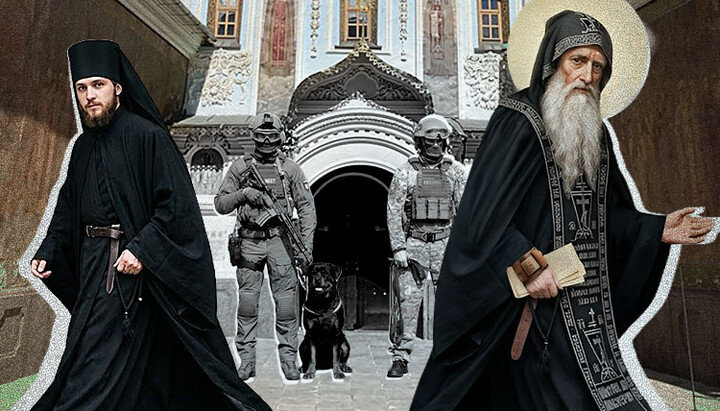
Expelling a saint from his own sanctuary. Photo: UOJ
In the 11th century, a lone traveler in a worn monastic mantle stepped onto the steep banks of the Dnipro. It was the monk Anthony, returning from a long pilgrimage to the Holy Mountain. In his travel bag he carried the blessing of the Athonite elders, while in his heart burned the unceasing Jesus Prayer.
Kyiv at that time was still a young Christian city. Its princes were erecting magnificent stone churches in the Byzantine style, eager to impress their western neighbors with architectural splendor. Yet authentic spiritual life was not flourishing in these newly built churches. It was born instead in a cave dug into a wooded ravine.
Freedom in a narrow underground cell
After returning from Mount Athos, St. Anthony visited all the monasteries of Kyiv. They had been founded and richly endowed by powerful rulers. They offered comfort and security. Yet the Athonite monk did not remain in any of them. Princely monasteries depended entirely on political favor, on the whims of rulers, and on dynastic rivalries.
The monk sought complete freedom of spirit. He rejected comfort and withdrew to a remote hill, settling in an empty cave once dug by St. Hilarion.
The true Church is born wherever people are willing to endure material hardship for the sake of fidelity to God. Such were the first brethren of the Lavra. Historian Anton Kartashev wrote:
"From the very beginning, the Monastery of the Caves stood firmly on its own independent foundation... The monks of the Caves did not bow before princes. Rather, they compelled princes to bow with reverence and awe before their spiritual authority."
The hermit of the caves revealed to rulers an entirely different measure of greatness. He showed that human dignity is determined neither by wealth nor by power, but by purity of conscience and faithfulness to the Gospel.
Soon the princes of Kyiv themselves began making the journey to the caves, seeking to hear the truth about themselves from the lips of the hermits.
An Athonite graft onto the Tree of Kyivan Rus
We know that St. Anthony of the Caves left behind neither theological treatises nor priestly ministry, remaining throughout his life a simple monk. He did not even compose a monastic rule. Yet his silent prayer in an underground cell became a powerful magnet for others longing for the same life of solitude.
The finest people of that age came to the damp caves of Kyiv. Among them were St. Theodosius of the Caves, St. Nestor the Chronicler, the iconographer St. Alypius, and the selfless physician St. Agapitus.
From that underground monastery grew a true spiritual academy that shaped our literature, medicine, and sacred art.
The Kyiv-Pechersk Paterikon preserves the blessing with which the abbot of the Athonite Esphigmenou Monastery sent St. Anthony back to his homeland:
"Anthony, return to the land of Rus, so that you too may become a guide for others. May the blessing of the Holy Mountain be with you."
That blessing became a noble graft upon the wild tree of newly converted Rus. When a gardener wants a tree to bear good fruit, he cuts into the bark of a wild stock and grafts onto it a living branch. Athonite monasticism became precisely such a branch, grafted by the saint onto the trunk of Kyiv.
Through the prayerful experience of the Athonite monks, our land entered into the inheritance of the ancient Christian civilization. St. Justin (Popović) of Serbia described this vocation in striking words:
"Monks are the only true rebels in this world. They rebel against death, sin, and evil."
The monks of the Kyiv Caves carried out precisely such a rebellion, proclaiming that man's greatest treasure is found not on earth, but in Heaven.
Locks on holy places will not quench spiritual thirst
Ten centuries have passed since those days. Today our country speaks constantly about joining Europe's political, economic, and cultural space, about human rights and freedom of conscience. Yet before our very eyes, those same rights are being violated in a crude and blatant manner.
The ancient shrine of the Kyiv-Pechersk Lavra is being turned into a museum complex. The historic caves are being sealed, visitors are admitted only by permit, and the monastic brotherhood is being gradually pushed beyond the monastery walls.
A society that loudly proclaims its commitment to liberal values is cutting away the very root that once made Kyiv a spiritual center not only of Europe but of the entire Christian world.
Today's reformers seem to have forgotten that the Lavra's caves are not a basement for storing museum exhibits. They are a living wellspring from which our people have drawn spiritual strength for centuries. Trying to surround that spring with bureaucratic regulations and lock it behind doors resembles a desperate struggle against one's own history.
When true calamity comes – and it has already come in the form of a devastating war – a museum plaque cannot comfort a grieving heart. The living water of prayer can never be replaced by an admission ticket.
Read also
The Weeping Queen of Blachernae
On the night of the Feast of the Protection, only two people witnessed the miracle in the Church of Blachernae. Everyone else prayed and saw nothing. Yet they, too, received grace.
Deadly spiral of human hatred
The tragedy of Lebanon's civil war lays bare how dehumanization and fear can turn human beings into monsters.
Woe to expectant mothers – or to those of little faith?
God commanded one prophet not to have children, yet told his people in exile to bear sons and daughters. What does this apparent contradiction tell us today?
The help God never asked for
Uzzah wanted only to keep the Ark of the Covenant from falling into the dust. Why did this well-intentioned act cost him his life, and who was really responsible for his death?
Freedom begins when there's nothing left to take
Fear of persecutors takes root in our attachment to possessions. We turn to St. Basil the Great to understand why the prefect's threats held no power over him.
The bride in the window frame
The author of the earliest account of St. Thecla’s life was defrocked. Yet it was his book that preserved the only ancient description of the Apostle Paul’s appearance.