How an Equal-to-the-Apostles saint was branded a harlot
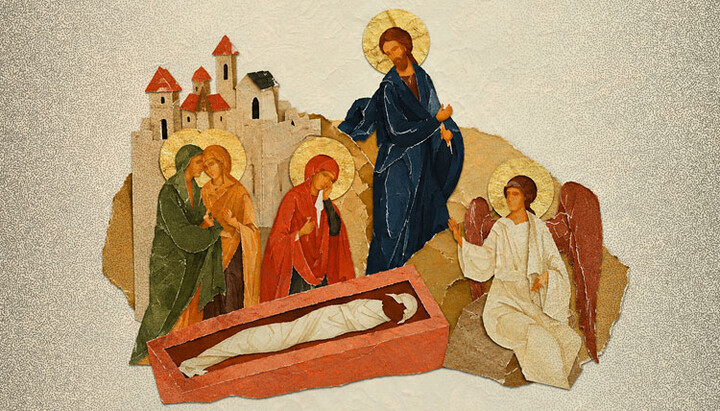
Mary Magdalene at the tomb of Christ. Photo: UOJ
In European paintings, she appears with loose hair and a bare shoulder, weeping beside a skull. Titian, Caravaggio, Georges de La Tour – and later filmmakers and musical writers – seemed convinced they knew everything about this “fallen woman.” Yet the primary source, the Gospel itself, says not a single word about any sexual sin committed by Mary Magdalene.
A striking substitution took place. Instead of a woman of extraordinary courage, we were given the image of a repentant woman of loose morals. It is almost as though history chose to overlook the real feat of her faithfulness to God altogether.
Seven demons – an affliction, not a moral failing
Mary came from Magdala, a fishing town on the western shore of the Sea of Galilee, and the Gospel mentions her only briefly. The Evangelist Luke lists those who followed Christ from town to town and village to village: “And certain women, which had been healed of evil spirits and infirmities, Mary called Magdalene, out of whom went seven devils, and Joanna the wife of Chuza Herod’s steward, and Susanna, and many others, which ministered unto him of their substance” (Luke 8:2–3).
At first glance, this may seem like clear proof that Mary had been sinful. But what is often overlooked is that in Gospel language, “seven demons” describes demonic possession – an extreme form of suffering that says nothing about a person’s moral choices.
No one in the Gospel blames the possessed. They are pitied, and Christ heals them.
Luke does more than name the women who remained faithful to the Savior. He also says that they “ministered unto him of their substance” – in other words, they used their own money to support Christ and the apostolic community. Alongside Mary, he names Joanna, the wife of the steward of Herod Antipas. These were women of means who materially supported the ministry of Christ and His apostles.
Courage at Golgotha
The Gospel reveals the true nature of Mary’s spiritual feat. On the night Jesus was arrested, all His disciples fled. Then came the trial before the high priests, the crowd shouting “Crucify Him!”, the death sentence, and the road to execution. At the Cross, only the women remained. Matthew, Mark, and John all record this independently of one another (see Matt. 27:55–56; Mark 15:40; John 19:25). Of the Twelve, only John the Theologian stayed. The rest hid in fear behind the locked doors of the Upper Room.
The historical context matters. To stand beside a man condemned for rebellion was to identify yourself publicly as his supporter. To do so within a few steps of soldiers who could arrest you meant knowingly risking the same fate.
The apostles fled because their expectations had collapsed. The Messiah was supposed to defeat oppressors, not hang on a Cross. The women had no such political expectations – they had love, and that love did not disappear even when the Messiah was put to a shameful death. St. John Chrysostom emphasized that it was precisely here that “their courage was especially revealed.”
And both at the Cross and later at the burial cave, the Evangelists place Mary first among the women they name. In an ancient text, such ordering was hardly accidental.
The chief witness to the miracle
Imagine a court case. The accused is already dead. His closest friends have scattered. And the only witnesses to what happens next are women whose testimony, under the laws of the time, carried no legal weight.
If someone had wanted to invent a story of Christ’s Resurrection that would sound persuasive to everyone, the last person they would have chosen as its principal witness was a woman.
After Jesus’ execution, Jerusalem remained a dangerous place for His followers. Yet Mary went to the sealed tomb guarded by soldiers. She had no idea who would move the heavy stone for her, but she went anyway, determined to complete the burial rites that had been interrupted by the onset of the Sabbath.
St. Dimitry of Rostov wrote of this: “Mary Magdalene showed herself more courageous and devoted than the apostles. When almost all the apostles fled and hid, Mary Magdalene overcame fear through love.”
The beautiful sermon that rewrote her life
So where did the skull and the loose hair of European art come from?
Around the year 591, St. Gregory the Great, Pope of Rome, delivered one of his homilies on the Gospel. In it, he merged three different women into one: Mary Magdalene, Mary of Bethany, the sister of Lazarus, and the unnamed sinful woman who anointed Jesus’ feet in the house of Simon the Pharisee (Luke 7:36–50). The logic was essentially homiletic: merging the three produced a single powerful story of sin, repentance, and forgiveness.
But in this case, powerful storytelling unfortunately prevailed over historical truth. Western iconography – followed by literature and cinema – inherited a vivid heroine with a false biography.
The Christian East never accepted this identification. St. Dimitry of Rostov wrote that “the Eastern Orthodox Church now, as before, regards all three as distinct persons, unwilling to base historical information on arbitrary and merely probable interpretations.” He also noted that St. Jerome, St. Augustine, and St. Gregory the Great identified the women with one another, while St. Irenaeus, Origen, and St. John Chrysostom distinguished between them.
He also offered a simple argument from common sense. Mary followed Christ openly for a long time. His enemies were constantly searching for any pretext to accuse Him and would hardly have ignored something so useful. A woman with a notorious past among the Teacher’s closest followers would have been a gift to His accusers. Yet the sources say nothing of the kind.
Significantly, even in the West, Thomas Aquinas gave Mary a very different title in his commentary on the Gospel of John: “She became the apostle of the apostles, for she was entrusted with announcing the Lord’s Resurrection to the disciples.”
The Roman Church did not begin officially distinguishing these women until the calendar reform of 1969. Since then, July 22 has been dedicated specifically to Mary Magdalene, while Catholics commemorate Mary of Bethany on July 29. What might seem like a minor calendar decision effectively brought centuries of dispute to a close.
A reversal of roles
On Sunday morning, the disciples are huddled behind locked doors. Behind them lie betrayal, flight, and the wreckage of everything they had hoped for. Then a woman appears – one who until now had remained in the background, tending to everyday needs, supporting the community from her own means, taking no part in theological disputes.
And yet it is she who becomes the first to bring the news that the apostles will soon carry to the ends of the earth. Because she loved Jesus and remained faithful to Him to the end
She stayed when others fled. She came when others hid. And she was the first to hear the news that would change the world: Christ is Risen.
Read also
Drinking priest, or the flip side of parish life
In his epistle, the Apostle Jude describes a scene familiar to anyone who has seen a church meal turn into a drinking party.
A lesson from a speechless donkey
The famous seer struck his donkey three times for refusing to go forward. All the while, she was saving his life – and seeing what he could not.
The time when the soul ripens
Modern society has turned youth into a cult and old age into a period of merely “living out one’s days.” The Christian perspective reveals the profound spiritual meaning of our later years.
Faith is not a checker piece in a spectator sport
Arguments about faith on social media increasingly resemble no-holds-barred fights. We turn to a saint who, sixteen centuries ago, knew how to speak to those interested only in turning theology into a combat arena.
The metropolitan who fought with a pen
St. Cyprian of Kyiv was robbed, expelled, and barred from his see. He answered with letters, books, and canons – and before his death, forgave everyone.
Loneliness under one roof
Spouses can share a home for years, raise children, and faithfully attend church – yet remain strangers to each other.