The amber light of summer maturity
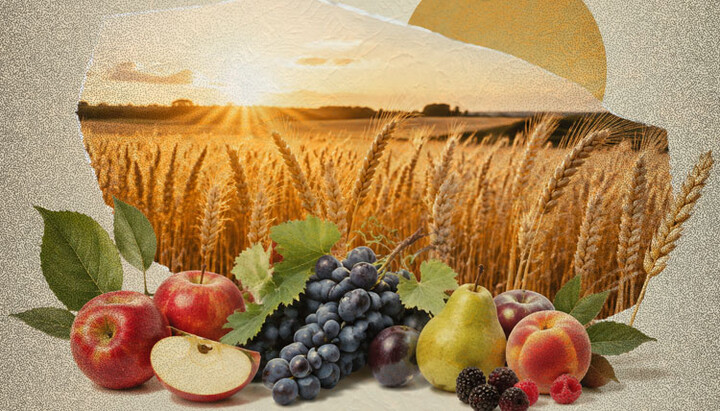
Summer fruits. Photo: UOJ
August light possesses a unique quality. It no longer warms with the blind, fierce force of the midday June sun; it flows in slanting, amber rays, lengthening shadows and laying bare the relief of existence. August is "summer evening," a threshold space where the natural cosmos pauses at the point of its highest fullness while simultaneously taking its first deep breath toward winter.
August is a living parable, a visible theology of harvest and dormition. In this season, nature moves from formation to decline. For us, it is a mirror of our own destiny, a conversation about the eschatology of everyday life, about the nature of fading, and about what happens when time begins to draw its conclusions.
The victory of Kairos over Chronos
Chronos is linear, quantitative time. A merciless stopwatch counting out moments, seconds, and centuries. In Chronos, every succeeding instant destroys the previous one: the future devours the present in order to turn it into the ashes of the past. To look at August through the eyes of Chronos is to see the fading of daylight, the cooling of water, the the anticipation of nature's imminent death.
Kairos is the time of fullness, the "right moment," when eternity breaks through into earthly realm.
August is the triumph of Kairos in the heart of Chronos when linear time suddenly crystallizes into fruit.
All the long, imperceptible labor of the earth – the spring dampness, the June thunderstorms, and the July heat – has not vanished without a trace in the stream of days gone by. It has condensed, thickened, and taken on a weighty, tangible form in the ripened grain, in the moist heaviness of the grape, in the fragrance of apples.
The harvest is an amnesty of time. The fruit proves that the past is not lost beyond recovery. It has been gathered and saved in a new quality of being. The harvest reveals to us an image of how eternity looks upon history. Earthly history is not an endless, futile repetition of cycles, but a process that has meaning and an outcome. Every reckoning demands an assessment of ripeness. August teaches us that the purpose of blossoming lies not in the blossoming itself, but in what it ultimately becomes.
The eschatology of everyday life
We commonly take eschatology as the teaching about the "end of the world" – a cosmic catastrophe, the Last Judgment, and the rupture of the fabric of reality. Yet there exists an eschatology of the everyday: a quiet, ordinary experience of living through endings within the span of a single human life. Every night when we fall asleep, every completed stage of life (the end of studies, leaving a job, the conclusion of a project), every middle-age crisis are a minor eschatology.
Human beings are thrown into a world where they must continually experience small deaths and gather small harvests. At this threshold, they are often confronted by the fear of emptiness. While the fruit was still ripening, life was filled with movement, striving toward the future, plans, and potential. But then the fruit ripens, the ear of grain fills with gold. A moment comes when one must acknowledge: "What is grown has grown. There will be no other harvest in this season."
This is a moment of honesty before oneself. A person looks back upon the years they have lived or the deeds they have completed and sees their "harvest." For some, there are full granaries; for others, barren blossoms. The eschatology of everyday life is painful because it strips us of the illusion of an ‘endless draft.’ August says: the draft is finished; time is binding the book.
Yet within this very summing up lies a great consolation. For a mature consciousness, the outcome is not a loss of possibilities but the gaining of reality.
Until a choice is made, a person possesses the fullness of possibilities. But by making a choice, one narrows the path to one particular value. The fruit is what has already become reality, and no one can ever take that fact away.
The sacred rest of withering fruit
The central axis of August is the feast of the Dormition. The very word "dormition' changes the way we perceive the end. It offers a fundamentally different paradigm of departure, one that stands in opposition to the tragic understanding of death as final annihilation.
Looking closely at the nature of August, we see that its withering does not have the character of a catastrophe. It is a gracious, quiet, and dignified inclination toward rest. Nature withers not because it has lost its battle with death, but because it has fulfilled its duty. It has given its sap to the fruit; its vital force has not been exhausted into nothingness, but has flowed into the seed that has fallen into the earth and into the granaries that will sustain life through the winter cold.
Here lies the mystery of withering as the withdrawal of visible presence for the sake of preserving the essence. When a tree sheds its leaves, it concentrates life in its hidden depths, in the roots hidden beneath the earth. Outward scarcity becomes the condition for inner self-preservation.
In the human dimension, this "August" period of life is often called the age of wisdom.
Wisdom is not merely the sum of knowledge; it is the ability to bless one’s own withering, ceasing to imitate an eternal spring. When physical strength fades, when outward brilliance dims and social activity declines, a unique opportunity for inner concentration opens before a person.
A person who rightly lives through his own "August" does not clutch desperately at the passing summer. They shift the center of gravity of their "I" from outward activity to inward contemplation. Their withering becomes a "dormition" – an immersion into sacred stillness, where the integration of all lived experience takes place. It is a fullness-filled peace, a peace that precedes resurrection.
The mystery of the falling wheat grain
In Christian philosophy, one of the central questions is the authenticity of human existence. Authenticity is born where a person accepts the finitude of his earthly presence not as a cause for despair but as a frame that gives each moment absolute value. The August rest is not the dead emptiness of non-being; it is the silence of the Sabbath day after the completion of creation. In the book of Genesis, God, having created the world, on the seventh day "rested from all His works." This rest of God was not an absence of action; it was the contemplation of the perfection of His creation: "And God saw everything that He had made, and behold, it was very good."
As one comes to the evening of maturity, it becomes vital to enter this mode of divine repose—to gaze back upon the landscape of one's life and perceive it as a single, coherent whole. At this point, withering gives way to gratitude.
In the end, the true measure of a life is found not in the quantity of accumulated "substance" – wealth, status, or passing impressions – but in the quality of the meaning one has gathered.
This Meaning is held by what in theology is called eternal memory, the ontological repository where everything genuine, pure, and loving that was in a person is cleansed of accidental chaff and preserved for eternity. The withering body and the fading world around it become merely a thinned veil through which the imperishable reality begins to shine.
The withering of nature in August is not a dead end; it is a great transition. The fruit must fall, and the leaf must decay, but only in order to free the seed. "Unless a grain of wheat falls into the earth and dies, it remains alone; but if it dies, it bears much fruit" (Jn. 12:24).
This New Testament metaphor contains the very essence of August’s eschatology. The death of the outward person, the fading of the season, the end of a historical epoch—all are necessary processes in which the outer shell must break down so that the immortal core hidden within it may be set free. Without the withering of summer, there can be no harvest; without winter, there can be no new, transfigured spring.
August teaches us to trust the time that rests in the Creator’s hands. It calls us not to mourn the passing of warm days but to rejoice in the fruits that have been gathered.
In the silence of an August evening, as the earth exhales the warmth it has stored throughout the day and the first great, cold stars emerge in the sky, there dawns a deep existential insight: the repose toward which the world gently inclines is not the abyss of nothingness. It is a cradle in which life, having completed its earthly pilgrimage, quietly falls asleep, awaiting the day when it will awaken in the radiance of the Never-Ending Day.
Read also
The help God never asked for
Uzzah wanted only to keep the Ark of the Covenant from falling into the dust. Why did this well-intentioned act cost him his life, and who was really responsible for his death?
Freedom begins when there's nothing left to take
Fear of persecutors takes root in our attachment to possessions. We turn to St. Basil the Great to understand why the prefect's threats held no power over him.
The bride in the window frame
The author of the earliest account of St. Thecla’s life was defrocked. Yet it was his book that preserved the only ancient description of the Apostle Paul’s appearance.
Drinking priest, or the flip side of parish life
In his epistle, the Apostle Jude describes a scene familiar to anyone who has seen a church meal turn into a drinking party.
A lesson from a speechless donkey
The famous seer struck his donkey three times for refusing to go forward. All the while, she was saving his life – and seeing what he could not.
The time when the soul ripens
Modern society has turned youth into a cult and old age into a period of merely “living out one’s days.” The Christian perspective reveals the profound spiritual meaning of our later years.