"Picaso": Christmas at the Kyiv Seminary
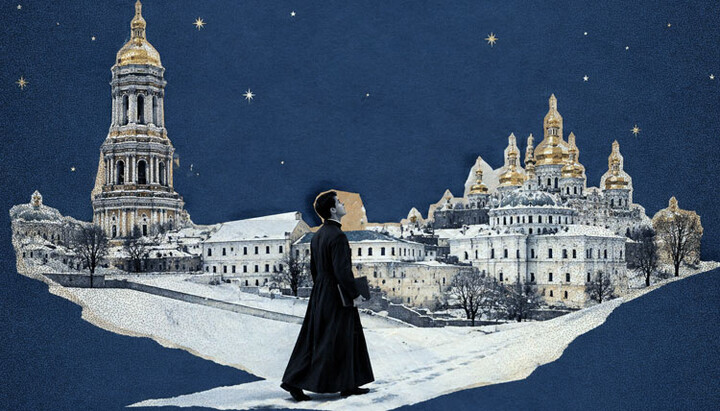
Winter at the Lavra. Photo: UOJ
Time: 1992–1993
Place: Kyiv
Characters: Misha Kaminsky, seminarians, teachers.
New Year’s wasn’t celebrated at the theological seminary at all. They didn’t even hold the thanksgiving prayer service Misha was used to back in his home parish. Everything was strictly according to the Typikon. Besides, the end of December and beginning of January were taken up with first-semester exams, after which the seminarians went home for Christmas and the holidays.
Misha passed all his exams with top marks, and he and several other outstanding students were offered the chance to move straight into the second year. This was common practice at the seminary. The two additional exam sessions that such students skipped could be made up individually during the first months of the second semester.
By the feast of the Nativity of Christ, all the seminary dormitories had emptied out. Only the choir remained – just as Misha had been warned, it was the choir that had to carry all the church services during the holidays. Some of the choristers resented this and envied those who had gone home; others felt quite the opposite. Misha envied no one, but he missed his friends.
Once again, just as in the summer, only five or six of them were left in each dorm room. Gone was the constant noise, bustle and jumble of belongings – things that, as it turned out, one could actually get used to and even grow rather fond of. In the silence that had now settled over the place, Misha felt Georgiy’s absence especially keenly. After all, this was where he was supposed to be...
Misha had no idea how Georgiy was doing there, at that other seminary. There had been no phone calls, no meetings since he left. Only prayers: “Lord Jesus Christ, save, have mercy on and bring to understanding Thy servant Georgiy.”
For Christmas, Misha received a blessing to put on a cassock – the clergy’s everyday garment. The other choristers who until then had worn seminary uniforms received the same precious gift. The moment Misha heard the news from the choir director, he raced home to his parents to get some money. Then, now able to pay for it, he hurried to the church shop where vestments were sold. He tried on a cassock and looked at himself in the mirror. Black suited him.
“Looking good,” he thought, unable to suppress a smile – but immediately remembered how harmful thoughts of vanity were. “Lord, forgive my sinful soul.”
On Christmas Eve, during the morning service, Father Viktor came up to the kliros.
“Well then, blessed ones, nobody forgot his cassock? Everyone folded it up nice and neat?” He scrutinized the three choristers standing there with their first clerical garments held out before them. “Right. Now we go into the altar, make three bows, then one at a time go to His Beatitude for a blessing. Bow, kiss his hand, and straight back out...”
When the Primate’s hand made the sign of the Cross over Misha, he felt such awe and gratitude – and at the same time such a profound sense of his own unworthiness – that tears welled up in his eyes. Love for God, for His Beatitude, for the Refectory Church, the Lavra, for everything sacred, overflowed in his heart. His friends’ eyes were moist as well. They put on their cassocks in the sacristy and returned to the kliros.
After the service, Father Viktor gave them some instructions:
“Right, no turning your noses up at your classmates. You go to lessons in uniform. Cassocks are for services only. Clear?”
After Vertolyot had left, one of the senior students added a piece of advice of his own:
“You’ve got your cassock – take care of it! It’s the same color as your soul.”
Christmas at the Kyiv-Pechersk Lavra was celebrated with great solemnity. Half an hour before the evening service, the bells of the Lavra bell tower would begin calling the faithful to worship. Bomm... bomm... bomm... the great bell boomed. The smaller bells answered it, ringing out joyfully as the service drew near. Monks, priests, laypeople and the seminarians who had remained behind hurried toward the Refectory Church of Sts Anthony and Theodosius of the Caves. Snow crunched softly underfoot, and the frost nipped at their noses.
Inside the church, it was warm and cozy. People gradually filled the nave. The service had not yet begun, and acquaintances greeted one another with kisses and congratulations on the approaching feast. On the kliroses, the choir directors stood craning their necks, searching for their choristers. They were nervous – not everyone who sang the principal parts had arrived yet.
One choir was the seminary choir; the other belonged to the Metropolitan. The latter was a mixed choir of men and women, composed mainly of conservatory students and directed by a legend of Ukrainian church choral singing, Mikhail Semyonovich Litvinenko. For seventeen years, right up until the schism, he had served as choir director at St Volodymyr Cathedral under Filaret. He had done everything in his power to persuade the Metropolitan not to cause a schism. But when he realized his efforts were futile, after the Kharkiv Council and the election of Metropolitan Volodymyr, he fearlessly sang during the Ascension service: “And our lord, His Beatitude Volodymyr, Metropolitan of Kyiv and All Ukraine...” – and went over to the new canonical Metropolitan. It happened right there in St Volodymyr Cathedral, in the presence of Filaret and his supporters, who were simply stunned by such audacity.
There was another good thing about the Metropolitan’s choir: the girls who sang in it were by no means averse to meeting seminarians, marrying them and becoming matushkas – priests’ wives. The seminarians even had a nickname for them: KhBM, short for khochu byt matushkoy – “I want to be a matushka.” The nickname was slightly mocking, though there was nothing shameful about such a desire. On the right kliros stood those who wanted to become priests; on the left, those who wanted to become priests’ wives. The result was strong, large clerical families that went on to bear their cross of service to God in parish churches across the country. Yet this mutual attraction between the two kliroses hardly interfered with the prayerful atmosphere of the services.
Stas, the seminary choir director, was trying to find out what had happened to Kostya Khomich, the leading voice in the second tenor section:
“Where’s Kostik? Is he s-still sleeping or what? Who’s going to lead the part?”
“He’ll probably be here any minute.”
“He’ll be here, he’ll be here,” Stas grumbled. “I’ll g-give him ‘here’... Right... everybody got the music?” This last question was directed at the chorister responsible for making sure everyone had the right sheet music in front of them at the right moment during the service. He was known as the “secret man,” while the cabinet containing the music was called the “secret department.” Quite often, the singers would find out what exactly they were supposed to sing – and to which chant – only seconds beforehand, when the “secret man” placed the required sheet music on the stand in front of them.
At last, the Royal Doors opened, and the venerable Metropolitan’s protodeacon, Father Nikolai, began circling the altar with the censer. At that very moment, a breathless Khomich came racing up onto the kliros. Stas gave him a smack on the back of the head and a dressing-down:
“Have you l-lost your mind?! ... We’re coming in, brothers. If you don’t know it, sit this one out.”
Father Nikolai stepped onto the solea and thundered:
“Ar-i-i-i-i-se!!!”
His bass sent shivers down your spine. It seemed that not only the old ladies sitting on benches along the walls were about to rise, but even the brethren buried in the Lavra cemetery. There probably wasn’t another voice like Father Nikolai’s anywhere in the Orthodox world.
The seminarians thundered back:
“A-a-me-e-en!!!”
The service seemed to pass in a single breath. Afterwards, they sang a few Christmas carols in the church, ate their last Lenten supper in the refectory and quickly went off to bed. If only Christmas Day itself would come sooner – with the breaking of the fast and visits to the senior brethren of the monastery to sing carols.
On the feast itself came the Divine Liturgy, the long-awaited breaking of the fast and caroling until evening. The entire seminary choir went around offering Christmas greetings – first to His Beatitude the Metropolitan, then to the Lavra brethren according to rank: the abbot, the treasurer, the dean and so on.
A great many people came to the Primate, Metropolitan Volodymyr, at his residence in the Lavra to offer their Christmas greetings, and sometimes the seminarians had to wait their turn. His Beatitude loved the seminarians, and the choir in particular. He listened to their carols with great pleasure and rewarded every singer with fatherly generosity.
Then they went to Father Abbot. He gave them less money, but he invited them to his table – and even poured each of them a little glass of cognac.
The treasurer and the other senior brethren of the monastery thanked them for the carols and Christmas greetings in whatever way they could – with money, little icons, delicious pies and so on. Receiving all this was nice, of course, but it wasn’t the main thing. The feast itself was so joyful that you wanted to share that joy with everyone. Christ was born – the Savior!
After making the rounds of the entire Lavra, they would go into the city to sing carols for the teachers who did not live at the monastery. They went on these visits in smaller groups, since at least five singers had to remain behind for the evening service at the Lavra.
The day after Christmas was also a feast – the Synaxis of the Mother of God. On that day, the Church gave special honor to the Virgin Mary, who had given birth to the Savior of the world. After the Liturgy and the festive meal, the seminary choir would set off to sing carols at Kyiv’s monasteries – the Protection Convent, the Ioninsky Monastery and the Florovsky Convent. They were welcomed warmly and showered with money and all sorts of treats – especially at the women’s monasteries.
By the end of all these Christmas visits, the carolers would find themselves with a sum of money that, truth be told, wasn’t really all that large, but seemed enormous to seminarians whose room and board were entirely provided for them. Most of that money ended up in the Lavra bookshop, where they bought spiritual books, which by then were beginning to be published in large numbers. Some went into the city and bought themselves a new shirt, cologne or something else.
Misha bought himself the first two paperback volumes of the Philokalia. With the rest of the money, he submitted prayer lists for the health of the servant of God Georgiy at every monastery the choir had visited.
To be continued...
Read also
Young Mother and Sleeping Christ
Michelangelo carved a Virgin Mary who looks younger than her Son – and signed his name in marble for the only time in his life. Neither of these peculiarities was accidental.
Orthodox books from a Uniate printing press
In the 18th century, Uniate monks at Pochaiv printed books used in prayer by Orthodox Christians and Old Believers alike.
The story of the honey brotherhood
The Mogilev Brotherhood began with members pooling money to brew honey drinks for feast days – and eventually grew to have its own printing press.
Golgotha in the midst of a pogrom
In the autumn of 1938, the Jewish artist Marc Chagall painted the crucified Christ. Synagogues burn and refugees flee around the cross, while the Crucified One Himself is wrapped in a prayer shawl.
Stories of the Early Church. Level of governance: patriarch
How did several episcopal sees rise above the rest, why did the Church’s administrative map come to mirror that of the empire, and is the patriarchate a sacred form of Church governance?
A Chronicle without an author
We are accustomed to calling The Tale of Bygone Years the work of St. Nestor. Yet another monk left his signature on it, while the chronicle itself passed from one generation of scribes to the next.