The bloody amphitheater of the Apostle Paul
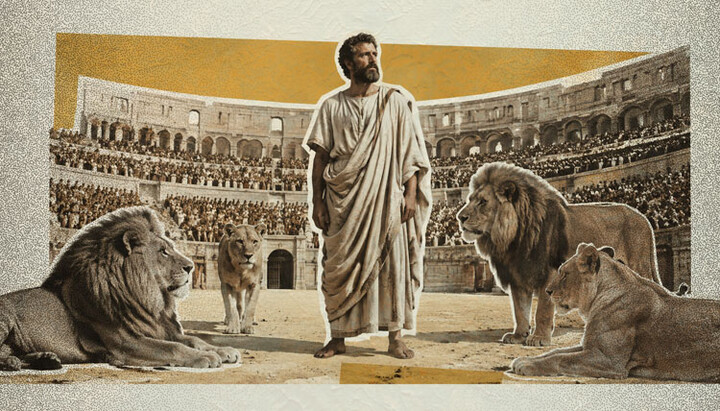
A persecuted Christian of antiquity. Photo: UOJ
On the tenth Sunday after the feast of Holy Pentecost, one of the most paradoxical texts of the New Testament is read at the Divine Liturgy. It is a passage from the First Epistle of the holy Apostle Paul to the Corinthians (4:9–16).
The Corinthian community was extraordinarily gifted. Charismatic gifts were flourishing among them: prophecy, glossolalia, and healings. The Corinthians were people of Hellenistic culture – they valued sophisticated philosophy, refined rhetoric, and outward eloquence. Yet behind this brilliance lay a profound spiritual pathology. Having received the gifts of the Holy Spirit, the Corinthian Christians came to believe that they had already attained the Kingdom of God, been deified, and become a spiritual elite.
They fell into the state which the patristic tradition calls prelest, or spiritual delusion born of pride. They began dividing the Church into factions ("I am of Paul," "I am of Apollos," "I am of Cephas"), being carried away by the human wisdom of their preachers. Moreover, they began to look down upon Paul himself – a man outwardly unimpressive, inarticulate, constantly persecuted and destitute.
"Yes, Paul brought us the foundations of the faith," the Corinthians reasoned, "but he is too simple, too archaic. We have gone further; we already reign in Christ."
And so, the Apostle Paul responds to this false triumphalism with a spiritual irony that speaks to each of us whenever we begin to consider ourselves “spiritually advanced”: "For I think that God has displayed us, the apostles, last, as men condemned to death; for we have been made a spectacle to the world, both to angels and to men" (4:9).
The bloody arena of Corinthian pride
In the Synodal translation, the word “spectacle” is understood today as referring to disgrace or shame. Yet in the Slavonic – and, more importantly, in the Greek original – the word used here is “theater.”
Paul employs a terrifying, bloody metaphor that would have been familiar to anyone living in the Roman Empire. He invokes the image of an amphitheater.
In the first half of the day, gladiator fights took place in the arenas of Roman circuses. These were professional spectacles: the fighters had a chance to survive, to win, and to earn glory.
But at the very end of the day, as the spectacle drew to a close, those known as bestiarii or noxii were led into the arena – criminals condemned to death, stripped of armor and weapons. They were handed over to wild beasts to be torn apart for the amusement of a jaded crowd. They had not the slightest chance. They were doomed. Paul says, "God has led us, the apostles, out as the very last of these condemned to death."
Let us reflect deeply on this most profound paradox. Every religion in the world, including distorted forms of Christianity, seeks triumph, victory, visible prosperity, power, and authority. People want their faith to make them strong in the eyes of those around them. Paul, however, asserts the opposite: true apostleship, true discipleship to Christ, means taking the position of one condemned to death in the arena of history. This is the great problem of theodicy (the justification of God in the face of the existence of evil and the suffering of the righteous).
Why does God permit His best disciples to be persecuted, humiliated, and broken? Paul's answer is this: because the existence of a Christian is set beyond the bounds of this world.
The world that lies in evil is incapable of digesting the Gospel, and therefore the true presence of God in history always appears as weakness, defeat, and a “theater of death.” The world judges us, the Angels look upon us, and our task is not to triumph in an earthly sense, but to remain faithful to Christ amid this cosmic amphitheater.
The refuse of the ancient pagan world
The apostle then unfolds a series of merciless antinomies, contrasting the illusions of the Corinthians with the harsh reality of cross-bearing: "We are fools for Christ's sake, but you are wise in Christ; we are weak, but you are strong; you are distinguished, but we are dishonored" (4:10). In these words there is the most subtle, holy irony. Paul seems to say, “How wonderfully you have arranged things for yourselves! You have managed to combine Christ with comfort, the reputation of wise men, and the respect of society. Meanwhile, we – the very ones who brought you this faith – remain fools.”
At its very foundation, Christianity is irrational according to the logic of “this age.” From this seed there would later grow the phenomenon of foolishness for Christ’s sake.
What is holy foolishness? It is the voluntary renunciation of human reason and reputation for the sake of exposing the lie of this world.
The wisdom of this age always seeks compromise, benefit, and self-preservation. The wisdom of the Cross is the willingness to surrender everything, trusting in God precisely where, from the standpoint of human reason, total ruin sets in. If our faith does not seem at least a little "foolish" to the world, if it fits perfectly into the agenda of secular society, then somewhere we have lost the Crucified Christ and replaced Him with a convenient ideological surrogate.
Paul then deepens the picture to its utmost, using words that in respectable ancient society were generally avoided even in speech: "Even to the present hour we both hunger and thirst, and we are poorly clothed, and beaten, and homeless. And we labor, working with our own hands. Being reviled, we bless; being persecuted, we endure; being defamed, we entreat. We have been made as the filth of the world, the offscouring of all things until now" (4:11–13).
In the original Greek text, two terms appear here: περικαθάρματα (perikatharmata) and περίψημα (peripsema). Peripsema is the dirt scraped from the soles of sandals, or the rinsings from dirty dishes poured into the gutter. Perikatarmata is an even deeper and more terrible word.
In pagan Greece, this term referred to "human refuse" (the destitute, criminals, and the gravely ill), whom the civic authorities maintained at public expense for one purpose: if a plague, famine, or epidemic struck the city, these people would be sacrificed to the pagan gods in an attempt to purge the city of defilement. They were the expiatory refuse.
Paul takes this marginal, degrading concept and applies it to himself and the apostles: "The world looks upon us as garbage, as refuse destined for disposal, through the elimination of which it attempts to restore its own peace of mind and stability."
The true Church will never be "comfortable" for the system of this world. When the Church is faithful to its Lord, it inevitably becomes an object of hatred both for totalitarian systems and for secular, consumerist society.
It is portrayed as “backward,” “superfluous,” “the refuse of history.” And the tragedy of the Corinthians – and of many of us – is that we are terrified of being seen in this way. We want to be respectable, approved of, and influential. But Paul reminds us that the way of Christ is the way of the One who was crucified outside the city gates, rejected by both the religious and political elites.
Spiritual fathers vs teachers
Having seemingly taken his rebuke to the utmost, Paul might have been expected to reject the Corinthians and write them off completely. But it is precisely here that a remarkable reversal takes place. The apostle’s tone changes instantly. From a stern rebuker, he becomes a loving, wounded parent: "I do not write these things to shame you, but as my beloved children I warn you. For though you might have ten thousand instructors in Christ, yet you do not have many fathers; for in Christ Jesus I have begotten you through the gospel. Therefore I urge you, imitate me, just as I also imitate Christ" (4:14–16).
Here Paul introduces a crucial distinction for Orthodox ecclesiology and ascetic theology: between an instructor and a father. In Greek daily life, a "pedagogue" was a slave to whom the master entrusted the task of escorting a child to school, supervising his manners, disciplining him for misconduct, and checking memorized rules. The pedagogue was not a kinsman; he did not love the child with a parent's love. He simply performed an external, practical function of supervision and discipline.
Paul says, "In Corinth you may have thousands of such lecturers, bloggers, preachers, and teachers who give you dry rules, teach you fine speeches, and work for their own authority. But they do not die for you. You have few fathers. But I gave birth to you through the pangs of the Cross."
Spiritual fatherhood is not administrative authority and not the right to command another's conscience. It is the capacity to take upon oneself the sins, infirmities, foolishness, and pride of one's children, to descend into the arena of the amphitheater for their sake, and to be consumed there so that they might live.
It is precisely for this reason that Paul has the right to speak the bold words: "Imitate me, just as I also imitate Christ." This is not pride. He calls them to imitate not his talents or intellect, but his readiness to be crucified for the sake of Christ and his neighbor.
A mirror for the modern community
The apostolic reading of the 10th Sunday after Pentecost is a mirror held up to the face of the contemporary church community. It confronts each of us with a series of brutally honest questions that cannot be evaded through outward piety.
Are we not attempting to build within our own hearts or our parish life a Christianity that guarantees us the status of "the wise, the strong, and the glorious"? Christianity as a club for psychological comfort, as a way of making ourselves feel “better than those sinners around us,” as an ethnographic or aesthetic shield against a frightening reality? If so, Paul reminds us: such Christianity is an illusion. It crumbles at the very first serious historical trial.
Can we remain faithful to Christ and His Church when the world around us begins to regard us as “refuse” and perikatharmata? When faithfulness to canonical truth, the purity of the Gospel, and the commandments of Christ requires us to renounce the applause of this world, political advantage, or public approval?
Our age is an age of an abundance of "instructors." The internet, social media, and books offer us thousands of teachers ready to explain "how to live rightly," how to pray, how to fast, and whom to condemn. But the world is suffocating from the absence of fathers – those who are able not to judge, not to lecture from the pulpit, but to have compassion, to weep with those who weep, to cover sins with love, and to give birth to souls for eternity through their own pastoral sacrifice.
Saint John Chrysostom, commenting on this passage, marveled at the courage of Paul, who was not afraid to lay bare his own infirmities in order to save his disciples from ruinous pride. The Apostle Paul returns us to the harsh reality: the power of God is made perfect in weakness. To be "fools for Christ's sake" in a foolish world is the only way to preserve true, Divine reason. To be "last" in the earthly hierarchy is the only path to becoming first in the Kingdom where the Crucified and Risen King of Glory reigns.
Read also
The help God never asked for
Uzzah wanted only to keep the Ark of the Covenant from falling into the dust. Why did this well-intentioned act cost him his life, and who was really responsible for his death?
Freedom begins when there's nothing left to take
Fear of persecutors takes root in our attachment to possessions. We turn to St. Basil the Great to understand why the prefect's threats held no power over him.
The bride in the window frame
The author of the earliest account of St. Thecla’s life was defrocked. Yet it was his book that preserved the only ancient description of the Apostle Paul’s appearance.
Drinking priest, or the flip side of parish life
In his epistle, the Apostle Jude describes a scene familiar to anyone who has seen a church meal turn into a drinking party.
A lesson from a speechless donkey
The famous seer struck his donkey three times for refusing to go forward. All the while, she was saving his life – and seeing what he could not.
The time when the soul ripens
Modern society has turned youth into a cult and old age into a period of merely “living out one’s days.” The Christian perspective reveals the profound spiritual meaning of our later years.