Three previously unknown copies of Ostroh Bible discovered on Mount Athos
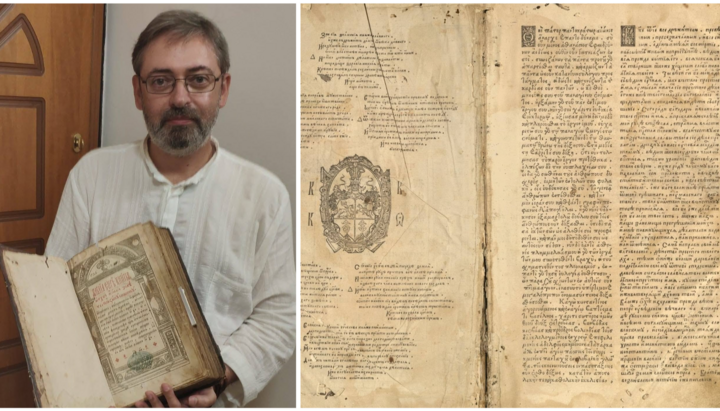
Three copies of the Ostroh Bible discovered on Mount Athos. Collage: UOJ
In August 2026, researchers on Mount Athos discovered three previously unknown copies of the 1581 Ostroh Bible. The scholars found the unique 16th-century books while working in monastic repositories normally closed to outsiders.
Before this discovery, scholars knew of approximately 350 surviving copies worldwide of the first complete printed edition of the Holy Scriptures in Church Slavonic, comprising 1,256 pages.
The research expedition and examination of the volumes were led by Serhiy Shumylo, director of the International Institute of the Athonite Legacy, PhD in History and Doctor of Theology. The Ukrainian scholar received support and assistance from German colleagues at the Leibniz Institute for the History and Culture of Eastern Europe (GWZO) and the Gerda Henkel Foundation.
Researchers studied the provenance of each of the three newly discovered volumes in detail. Judging by marginalia – notes written in the margins – in other Ostroh books from the same collection, one copy of the Bible belonged to St John Vyshensky, a religious polemicist and writer. At the turn of the 16th and 17th centuries, he lived as a recluse in a cave on Mount Athos, from where he sent his epistles. This theory is supported by a dedicatory inscription to John Vyshensky from Vasyl Surazky, a member of the Ostroh scholarly circle, found in another Ostroh edition dating from 1595.
The second copy of the Bible belonged to disciples of St Paisius Velichkovsky. The book was kept at Neamț Monastery in Romania, which he headed, and was later taken by monks to the Holy Mountain.
The third volume of the Ostroh Bible belonged to Hieromonk Kallist Menovsky, locum tenens of the Chernihiv archiepiscopal see. In 1754, Vasyl Luhovyi, a Cossack of the Poltava Regiment, donated the book to the Ukrainian Cossack skete of Chornyi Vyr on Mount Athos. The skete was founded by Hieroschemamonk Gregory (Holub), a former bunchuk comrade of the Nizhyn Cossack Regiment. In the 18th century, the monastery was inhabited primarily by Zaporizhian Cossacks, earning it the name “Spiritual Zaporizhzhia.” Petro Kalnyshevsky, the last Kosh Otaman of the Zaporizhian Sich, was a patron and benefactor of the skete.
In total, Shumylo identified 32 early Cyrillic printed books from the 16th and 17th centuries published in the Kyiv Metropolia, as well as 143 Ukrainian editions from the 18th century, in the monastery collection. Almost all of them had belonged to the library of the Chornyi Vyr Cossack skete. Some of the books reached Mount Athos directly from Ostroh through Prince Vasyl-Kostiantyn Ostrozky (1526–1608). The year 2026 marks the 500th anniversary of the birth of the prince and patron of learning and the 450th anniversary of his founding of the Ostroh Academy.
“All these early printed books that we discovered on Mount Athos constitute a unique literary, spiritual, and cultural heritage that has survived in a foreign land, far from Ukrainian soil,” Serhiy Shumylo said. “In the 16th–18th centuries, the Kyiv Church and Kyivan Christianity exerted a powerful spiritual and cultural influence on other peoples and other Local Churches, including at such an ancient global center of Eastern Christian monasticism as the Holy Mountain of Athos.”
Earlier, the UOJ reported that a fifth-century Gospel manuscript had been sold at auction for €1.5 million.
Read also
Dumenko: Negotiating with UOC on its terms would mean surrender for OCU
The OCU head expressed confidence that his organization would emerge victorious on Ukraine’s “religious front.”
OCU rep claims UOC parishes in Germany may threaten its national security
OCU cleric Petro Bokanov believes expansion of UOC structures in Germany is a threat to German national security.
UOC priests consecrate cardiology center wards in Uzhhorod
Priests of the Mukachevo Eparchy served a moleben for the health of doctors and patients of the cardiology center in Uzhhorod.
Metropolitan Onuphry explains how to live so as not to grieve Mother of God
The Primate of the UOC said in a sermon on the Protection feast at the Intercession Monastery that one must live by God's commandments even when they are inconvenient for the modern world.
Drone damages UOC church in Cherevkivka, Donetsk region
The Church of St. Seraphim of Sarov in the Sloviansk Deanery was damaged by a drone .
UOC-KP opens "metochion" in Georgia
"Patriarch" Nikodim of the UOC-KP reported the creation of a "metochion" in Georgia to strengthen spiritual ties outside Ukraine.