The triumph of love over law
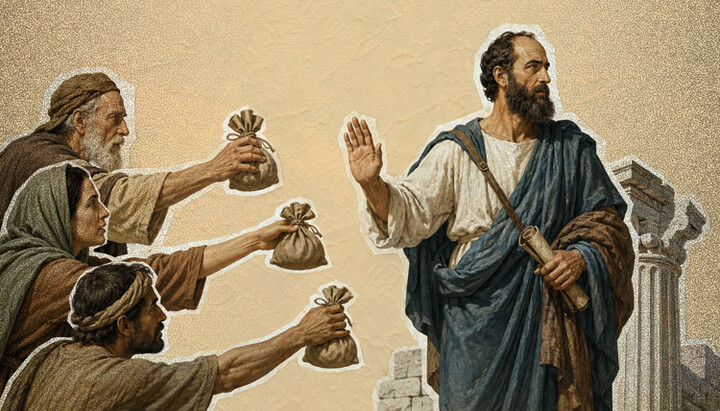
The Apostle seeking no material gain. Photo: UOJ
The Apostolic reading of the 11th Sunday after Pentecost is a passage from the First Epistle to the Corinthians of the Holy Apostle Paul (1 Cor. 9:2–12). At first glance, this text seems purely practical, even mundane: the Apostle reasons about the preacher's right to material support from the community. However, in the context of the patristic tradition and in comparison with the parallel Gospel reading (The Parable of the Unmerciful Debtor, Matt. 18:23–35), this passage reveals the deepest layers of ecclesiology, asceticism, and Christian metaphysics.
To understand the Apostle Paul, we need to transport ourselves to Corinth in the mid-50s of the first century. Corinth was a bustling port metropolis, cosmopolitan, proud of its Hellenic wisdom, and prone to divisions. The local Christian community, scarcely established, had already split into factions. It was at this point that the so-called “false apostles” (or “Judaizers”) appeared in Corinth and began to undermine Paul’s authority. Their arguments were historically compelling for the early Christians.
Paul was not one of the Twelve. He did not walk with Christ through Galilee, sit with Him at the Last Supper, or gather in the Upper Room in Zion on the day of Pentecost. He worked with his hands. In the ancient world, among both Jews and Greeks, a teacher of high standing was supported by the community. The fact that Paul made tents (Acts 18:3) to support himself was presented by the false teachers as evidence that he was unsure of his own status: “See, he himself knows that he is a ‘second-rate’ apostle, since he is reluctant to take money from you.” Paul is forced to defend himself. Yet he does so in a paradoxical way – he proves that he has every right to receive support in order to show why he voluntarily renounced those rights.
The seal of true faith
Paul shifts the conversation from the plane of personal grievances to the plane of the nature of the Church and apostolic ministry.. "If for others I am not an apostle, yet at least I am to you; for you are the seal of my apostleship in the Lord" (1 Cor. 9:2). In the ancient world, a seal certified the authenticity of a document or a right of ownership.
For Paul, the authenticity of his ordination and calling by Christ is proven not by a "mandate" from the Jerusalem pillars of the Church, but by the transformed lives of the Corinthians themselves.
The Church is not a bureaucratic institution but a living organism. If the community has passed from pagan debauchery to holiness "in the Lord," then the Spirit that acted through Paul was genuine.
Paul uses three everyday images (a soldier, a vinedresser, a shepherd) and one sacred one, referring to the Torah: "You shall not muzzle an ox while it treads out the grain" (Deut. 25:4). Paul's theology here is Christocentric: the material world is not separated from the spiritual. If God cares for oxen, then surely the Creator provides for a synergy within the community: the faithful nourish the preacher with earthly things, and he nourishes them with heavenly ones.
A step beyond the law
The center of the entire passage is verse 12: "Nevertheless we have not used this right, but endure all things lest we hinder the gospel of Christ." Here Paul formulates a theology of kenosis (self-emptying) in pastoral ministry. Imitating Christ, Who, being God, "emptied Himself by His own will" (Phil. 2:7), Paul voluntarily renounces a lawful right for the sake of a higher goal – his neighbors' salvation. His poverty is not weakness but a sovereign manifestation of Christian freedom.
From the standpoint of religious philosophy, this text of Paul is a profound treatise on overcoming juridism for the sake of love.
Within the framework of Roman and Jewish law, the category of right is sacred. If you have a right, you are obliged – or at least logically expected – to exercise it. Paul breaks this logic. He constructs an impeccable system of proofs that he has the right to support. And as soon as the wall of his juridical righteousness is built, he takes a step back: "I have the right, but I will not use it."
This is a pure transition from the category of justice (law) to the category of grace (love). In the philosophy of law, this is called a voluntary limitation of sovereignty for the good of the Other.
The trap of merciless justice
For the Greek philosopher, freedom is independence from external circumstances (the autonomy of the Stoics). For Paul, freedom is the capacity to become a slave for the sake of the Gospel. He is free from the opinion of his critics and the money of Corinth, but he binds himself to them through love.
In the liturgical tradition of the Orthodox Church, the readings of the New Testament are never chosen at random. There is a profound harmony of meaning between this Sunday’s Epistle (1 Cor. 9) and Gospel (The Parable of the Unmerciful Debtor, Matt.18).
In the Gospel, a servant, having received an enormous forgiveness from the King, goes to his fellow servant and harshly demands his lawful right (repay the 100 denarii!). He acts entirely according to the law; justice is on his side. But this "dry justice" destroys him, turning him into a "wicked servant," because it ignored the ocean of God's mercy.
In the Epistle, the holy Apostle Paul demonstrates a diametrically opposite type of behavior. He knows that he has the right. But, remembering how much he himself has been forgiven by Christ (for he was a persecutor of the Church!), he refuses to burden the Corinthians with his rights.
The path to true freedom
To insist on one’s legal rights when one can yield for the sake of love and peace is the way of the unmerciful debtor. To renounce one’s rights and bear the burden oneself, so as not to place an obstacle in the way of another’s faith, is the apostolic way.
For the faithful of the Church in today’s world, this passage sounds a call to inner freedom: external circumstances, courts, or human condemnation cannot annul the "seal of apostleship" – the living faith and capacity to forgive that are at work in people’s hearts, despite all the storms of history.
Read also
Honest atheism vs. spiritual hypocrisy
The 70th anniversary of Albert Camus’s Nobel Prize recalls an uncompromising challenge to Christianity. An honest unbeliever brings theology back to the mystery of the Cross.
The valley of trouble and the gateway of hope
One soldier buried an expensive cloak and some gold beneath his tent. Because of this, all Israel lost a battle. Why did one man’s sin bring disaster upon an entire nation?
From love spells to bishop's throne
Antioch’s most powerful sorcerer sent demons against a devout young Christian woman three times – and failed every time. In the end, a demon himself revealed the truth that led to his conversion.
The Weeping Queen of Blachernae
On the night of the Feast of the Protection, only two people witnessed the miracle in the Church of Blachernae. Everyone else prayed and saw nothing. Yet they, too, received grace.
Deadly spiral of human hatred
The tragedy of Lebanon's civil war lays bare how dehumanization and fear can turn human beings into monsters.
Woe to expectant mothers – or to those of little faith?
God commanded one prophet not to have children, yet told his people in exile to bear sons and daughters. What does this apparent contradiction tell us today?