The monastic pawnshop without profit
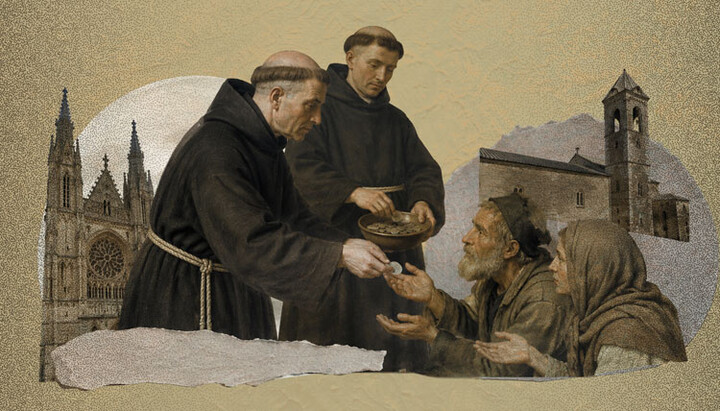
A mutual-aid fund devised by the Franciscans. Photo: UOJ
Imagine a winter evening in an Italian town in the mid-15th century. A craftsman carries his last warm coat to a moneylender – the only thing keeping his family from the cold. In return, he receives a handful of coins, enough to buy bread until spring.
But that bread will eventually cost him thirty, perhaps even fifty percent a year in interest.
By today’s standards, such rates would immediately be called predatory. In the 15th century, they were commonplace. A failed harvest, an illness, any unexpected disaster – and a man could lose his tools, his clothes, his home. After that came debtor’s prison or complete dependence on the person to whom, on paper, he now owed everything.
A lawyer who knew the system from within
In 1462, an institution unlike anything else of its time opened in Perugia. It accepted ordinary possessions as collateral – dishes, work tools, old clothes – and lent money against them.
But instead of charging thirty or fifty percent, it charged around five.
Just enough to cover rent for the premises and the wages of a clerk and doorkeeper.
Behind the idea stood two Franciscan friars – Barnaba da Terni and Fortunato Coppoli. Coppoli, however, was no ordinary monk. Before taking monastic vows, he had been a respected jurist. He understood the laws and mechanisms of moneylending so thoroughly that he was able to build a system that bypassed them almost flawlessly.
The new institution was called the Monte di Pietà – the “Mount of Piety.” Here, “mount” had nothing to do with geography: in medieval Italy, the word referred to a public fund, capital pooled by a community. In essence, it was a municipal mutual-aid fund.
Its lending rules were simple and strict at the same time. A borrower brought in an item and received a modest loan against it. If he repaid the debt, he got the item back. If he did not, the item was sold at auction – but if the sale brought in more than the amount owed, the difference was returned to the borrower. The lenders kept nothing beyond what was due.
By the middle of the 16th century, around two hundred such funds were operating across Italy.
Accused of sin
It might seem like the perfect solution: help the poor, make no profit, live according to the Gospel.
Instead, it triggered a theological controversy that lasted half a century.
Dominican theologians looked at the five-percent charge and saw exactly what the Church had condemned for centuries – interest on a loan.
The Old Testament explicitly forbids usury. The Gospel calls on Christians to lend without expecting anything in return. For strict Dominican theologians, any interest at all, however small, remained interest – and therefore sinful.
The Franciscans answered differently. This was not profit from capital, they argued, but reimbursement for the cost of maintaining the charitable institution itself.
There is a difference between profiting from another person’s need and simply avoiding bankruptcy while helping someone in need.
At times, the dispute became so heated that poor borrowers seeking help had to be turned away – and sent straight back to the very moneylenders charging thirty percent.
For half a century, the two theological schools could not agree. Yet while learned men argued fiercely, the funds continued operating, and poor people continued bringing their last frying pans and cloaks to the friars as collateral.
Rome settles the dispute
Rome itself eventually brought the controversy to an end.
On May 4, 1515, during the tenth session of the Fifth Lateran Council, Pope Leo X issued the bull Inter multiplices. It declared that charitable loan funds charging a moderate amount solely to cover the wages and expenses of their staff “contain no kind of evil, provide no occasion for sin, and are in no way to be condemned.”
More than that, such lending was deemed “worthy of praise and approval” and fundamentally different from usury.
The wording left little room for further dispute. The Church officially recognized that lending money to help a poor person, without seeking personal gain, was not a violation of the commandment but a way of fulfilling it.
So who won?
The pope’s Solomonic decision can be viewed as a victory for one theological camp over another.
But the real question was never which group of monks had won a scholastic argument.
The real question was what would happen to the craftsman standing on a winter evening with his last coat under his arm, forced to choose between a loan from a greedy moneylender and certain hunger.
The founders of the Monti di Pietà did not invent a new economic theory. They did something far more difficult – they found a way to help people without turning that help either into charity that humiliated their dignity or into a new form of exploitation disguised by pious language.
The borrower was not asking for alms. He left collateral and received money on equal terms – except those terms did not ruin him.
And perhaps this is where the Christian answer to the perennial question of whether money is good or harmful can be found.
There is no need to reject the market economy as such – even monks understood perfectly well that cashiers had to be paid and premises had to be rented.
What matters far more is that the system should serve not profit, but the human being for whom it was created.
Read also
Facade of bones and facade of light
Antoni Gaudí spent forty-three years building a church in Barcelona, knowing that this construction was for the ages.
Trial of a dead pope
Once in Rome, the body of a deceased pope was seated on the throne and put on trial. The accusation relied on a church canon that had once saved his see.
Monastery built in defiance of king
When Orthodox believers in Minsk were left with just one church, townspeople decided to build another – and even a royal decree did not stop them.
Young Mother and Sleeping Christ
Michelangelo carved a Virgin Mary who looks younger than her Son – and signed his name in marble for the only time in his life. Neither of these peculiarities was accidental.
Orthodox books from a Uniate printing press
In the 18th century, Uniate monks at Pochaiv printed books used in prayer by Orthodox Christians and Old Believers alike.
The story of the honey brotherhood
The Mogilev Brotherhood began with members pooling money to brew honey drinks for feast days – and eventually grew to have its own printing press.