Fight for knowledge under Vatican protection
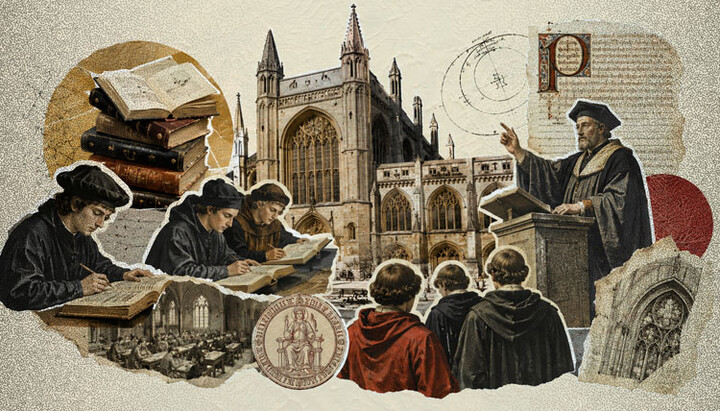
The birth of academic scholarship. Photo: UOJ
The word “university” almost never meant what we understand it to mean today. It was simply a corporation, guild, or association of people in the same profession. The term was used for guilds of blacksmiths, associations of merchants, and urban communities.
When a “guild of masters and scholars” formed around the school at Notre-Dame Cathedral in Paris in the early 12th century, it was seen as an ordinary professional association – nothing more. Only later, as such guilds multiplied, did they begin to bring together teachers from all fields of study.
Protecting the wandering scholars
No sooner had the guild emerged than it needed protection – not from enemies of learning, but from debt collectors. By the mid-12th century, students from across Europe were flocking to Bologna to study Roman law. As foreigners without civic rights, they were subject to the so-called right of reprisal. If someone from a student’s homeland owed money to a local merchant, any citizen of the same country who happened to be nearby could be forced to pay the debt. Simply being born in the same duchy as the debtor could be enough.
In 1155, Emperor Frederick Barbarossa, while receiving a delegation of Bolognese masters, issued a special decree. It guaranteed traveling students personal safety, freedom of movement, and the right to be tried only by their own teachers or by a bishop, bypassing the local courts.
Thus, for the first time, scholars received formal imperial protection on a par with the clergy and nobility.
This was not yet the celebrated tradition of university autonomy as we know it, but the first precedent for academic freedom had been established.
The philosopher put on trial twice
At the same time, the foundations of scholarly methodology were beginning to take shape. Around 1121, the Parisian master Peter Abelard compiled a book titled Yes and No. It consisted of 158 theological questions, for each of which the author assembled seemingly contradictory quotations from the Bible and the Church Fathers.
Church authorities reacted sharply to the new work. The Council of Soissons in 1121 condemned Abelard’s early theses, and in 1140, at Sens – not without the “help” of Bernard of Clairvaux – he was once again declared a heretic and sent into exile.
The analytical method itself, however, did not die. On the contrary, it became embedded in the foundations of the curriculum.
The pattern of “question – objections – answer – replies to objections” became a standard method of university instruction and, a century later, formed the basis of Thomas Aquinas’ *Summa Theologiae*. The paradox is striking: the Church condemned the man while at the same time adopting his scholarly tools. From then on, truth in the universities was not simply to be accepted on faith – it was to be worked out, step by step.
The strike the pope settled
University freedom faced its real test in a street confrontation. In February 1229, students in Paris got into a fight with a tavern keeper over an unpaid bill. The clash escalated into a street riot, and guards acting on the orders of Regent Blanche of Castile dispersed the crowd by force. There were casualties: several students were killed, along with some bystanders.
The masters responded with the only weapon available to their guild: they shut down teaching altogether and left the city – some for Oxford, others for Toulouse or Angers. The Sorbonne stood empty for two years.
The city paid dearly for this, since students’ spending supported much of the Latin Quarter. The dispute dragged on until 1231, when Pope Gregory IX issued the bull *Parens scientiarum*, later known as the Magna Carta of the University of Paris. It removed the university from the authority of both the city courts and the local bishop, placing it directly under papal jurisdiction, and formally recognized the masters’ right to suspend classes again if their rights were violated.
Freedom bought at a high price
Academic freedom won its right to exist through a century-long struggle by the university guild for the right to argue and, when necessary, to go on strike and walk away. Barbarossa gave traveling scholars protection from foreign courts. Abelard gave them a method in which answers emerged from the clash of competing views. And the ability of students and professors to leave their alma mater at any moment turned freedom of speech from a lofty declaration into a hard demand that governments and bishops had to reckon with.
The Church that gave birth to the academic guild was not always pleased with what eventually grew out of it.
Yet it was nevertheless church authority, through a papal bull, that protected scholars from the arbitrary actions of the royal guard. The paradox shows how a social institution created by the Church gradually came into its own and learned to defend its rights – even in conflicts with those who had brought it into being.
Read also
Orthodox Books from a Uniate Printing Press
In the 18th century, Uniate monks of Pochaiv printed books that Orthodox believers and Old Believers used for prayer.
The story of the honey brotherhood
The Mogilev Brotherhood began with members pooling money to brew honey drinks for feast days – and eventually grew to have its own printing press.
Golgotha in the midst of a pogrom
In the autumn of 1938, the Jewish artist Marc Chagall painted the crucified Christ. Synagogues burn and refugees flee around the cross, while the Crucified One Himself is wrapped in a prayer shawl.
Stories of the Early Church. Level of governance: patriarch
How did several episcopal sees rise above the rest, why did the Church’s administrative map come to mirror that of the empire, and is the patriarchate a sacred form of Church governance?
A Chronicle without an author
We are accustomed to calling The Tale of Bygone Years the work of St. Nestor. Yet another monk left his signature on it, while the chronicle itself passed from one generation of scribes to the next.
How a wedding stopped a war
The young princess of Slutsk was married off to keep two powerful noble families from drowning the city in blood. Soon afterward, a Uniate metropolitan complained that Orthodoxy had been reborn in Slutsk.