The crowd in the stands was the first social network
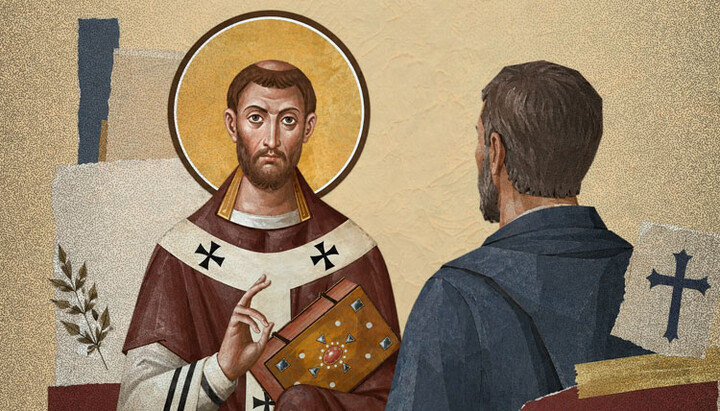
A conversation about curiosity. Photo: UOJ
By the end of the fourth century, Blessed Augustine was already a bishop. Yet in his cell he was simply a man with a pen in his hand, working on the tenth book of his Confessions and examining his own weaknesses with the same merciless honesty with which he had once dissected the heresies of others. I knock cautiously and enter to speak with the hierarch about something important.
“Your Grace, forgive the intrusion. We have developed a habit that is hard to justify. We spend hours scrolling through news feeds. We know there will be nothing but negativity – and still we keep scrolling, as if our finger reaches for the screen on its own. Is this weakness of will, or something worse?”
The Bishop of Hippo puts down his pen and answers warmly:
“You did right to come to me. I am writing about that very impulse at this moment – only it goes by a different name. The Apostle John calls it the lust of the eyes. I call it curiosity. And it is not harmless. There is a thirst for knowledge that seeks what is beautiful in everything. But there is another kind that seeks precisely the opposite – out of boredom, not because it is useful. What pleasure is there in looking at a mangled body, a sight that makes you shudder? And yet people come running to see it, only to grieve and turn pale.”
A lizard on the wall and a dog in the field
“Forgive me for being so direct, Your Grace, but it is easy to give advice from the outside. You did not have smartphones and social media constantly distracting you from useful things.”
He smiles.
“I did not need a news feed. I can be sitting at home while a lizard on the wall catches flies, or a spider traps them in its web – and it can hold my attention for a long time, even though the creature is insignificant and has nothing to do with me. Or I may be riding along, absorbed in serious thoughts, when suddenly a dog starts chasing a hare across a field – and my thought follows my eyes and is no longer with me, but caught up in the chase. My body stays on the road, but my mind turns aside.”
“So the problem is not what form the temptation takes, but the very fact of being distracted?”
“Exactly. What distracts me is not the scale of the event, but the process itself: something moves, something is new, and the soul, forgetting its purpose, rushes after it like the dog after that hare.”
The friend who tried to close his eyes
Blessed Augustine falls silent for a moment, then begins another story.
“Let me tell you about a friend of mine. His name was Alypius, and he hated the bloody spectacles of the arena. One day his friends dragged him to the games by force. He told them, ‘Even if you drag my body here and sit me down in this place, you cannot force me to give either my mind or my eyes to the spectacle.’ And he closed his eyes.”
“A perfectly sensible defense.”
“So he thought. But he had closed his eyes, not his ears. When one of the fighters fell and the crowd roared, curiosity overpowered his resolve. He opened his eyes – just for a moment, simply to find out what had happened. And what he saw wounded his soul more deeply than the sword wounded the body of the man dying in the arena.
“He became drunk on the sight of blood as though on wine. He no longer looked away and began to delight in the very spectacle he had once avoided. He left the arena no longer the man who had entered it. He had become one of the crowd – and later he himself brought new spectators to the games.”
“That is what frightens me most, Your Grace. Not the first click on a link to some horrifying story. It is what happens afterward: you get used to it – and soon you are forwarding it yourself, adding your own ten words of outrage, and without noticing it you become part of the very information noise that horrified you at first.”
“You have grasped the most important point. It is not the spectacle itself that destroys a person. What destroys him is the transformation of the spectator into a participant in that spectacle – when he no longer notices the change taking place within himself.”
What are we really looking for?
“So what are we supposed to do? Stop looking at the world around us altogether? Close our eyes like Alypius?”
“He closed his eyes – and it did not help, because his ears were still open and his heart was still unguarded. The issue is not our eyes, and it is not the news. The issue is the question we should ask ourselves before reaching for the next story:
“Am I seeking knowledge out of love for the person I am reading about, for the sake of prayer, or for something I may actually be able to do? Or am I merely seeking the prideful satisfaction of knowing that once again I was among the first to find something out? The first nourishes the soul. The second leaves it hungry, no matter how much cheap feed you keep trying to give it.”
The saint picks up his pen again, but before returning to his writing, he looks up at me.
“I did not write this book so that readers would marvel at the weaknesses of an old bishop. I wrote it so that everyone who recognizes his own weakness in the lizard on my wall might ask himself the same question I have been asking myself for forty years: Where is my heart looking right now while my eyes are busy consuming information? Ask yourself that question this evening before you pick up your smartphone.”
Read also
Drinking priest, or the flip side of parish life
In his epistle, the Apostle Jude describes a scene familiar to anyone who has seen a church meal turn into a drinking party.
A lesson from a speechless donkey
The famous seer struck his donkey three times for refusing to go forward. All the while, she was saving his life – and seeing what he could not.
The time when the soul ripens
Modern society has turned youth into a cult and old age into a period of merely “living out one’s days.” The Christian perspective reveals the profound spiritual meaning of our later years.
Faith is not a checker piece in a spectator sport
Arguments about faith on social media increasingly resemble no-holds-barred fights. We turn to a saint who, sixteen centuries ago, knew how to speak to those interested only in turning theology into a combat arena.
The metropolitan who fought with a pen
St. Cyprian of Kyiv was robbed, expelled, and barred from his see. He answered with letters, books, and canons – and before his death, forgave everyone.
Loneliness under one roof
Spouses can share a home for years, raise children, and faithfully attend church – yet remain strangers to each other.