In Jerusalem, scholars discover new evidence of Christ's burial
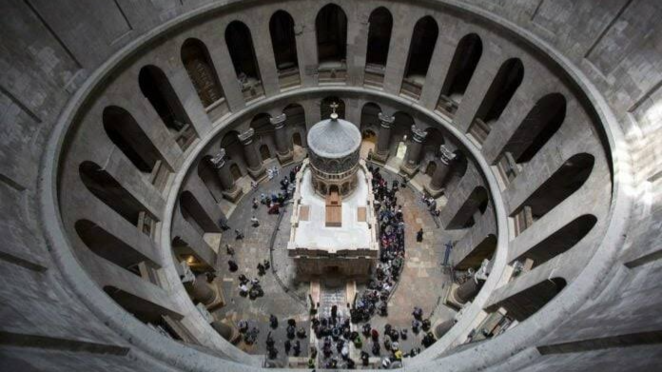
The Aedicule at the center of the Church of the Holy Sepulchre. Photo: Greek City Times
In Jerusalem, beneath the Church of the Holy Sepulchre, Italian archaeologists have uncovered an ancient landscape featuring a garden and tombs. The new findings bear striking similarities to the descriptions in the Gospel texts concerning the place of the Saviour's burial, reports Romfea.
A team of researchers led by Professor Francesca Romana Stasolla of the Sapienza University of Rome has published the results of their study. The specialists have been conducting archaeological work since 2022 as part of the restoration of the church floor. As a result, the scholars uncovered beneath the paving stones an abandoned stone quarry, areas of cultivated land, tombs hewn into the rock, and an ancient garden.
The archaeological data fully corresponds to the testimony of the Evangelist John the Theologian regarding the presence of a garden and a new tomb near Golgotha. The researchers also found traces of the cultivation of olive trees and grapevines dating to around 33 AD, the time of the Crucifixion and Resurrection of Jesus Christ.
"The Gospel mentions a green area between Golgotha and the tomb, and we have identified these cultivated fields," said Stasolla. The tombs themselves are also of particular significance. They are hewn directly into the rock, which proves that this area was indeed used as a burial site.
The depth of the ancient quarry reaches six metres in some places, and people later filled it with soil for agricultural use. During the earthly life of the Saviour, this territory lay outside the city walls of Jerusalem, which confirms the words of the Epistle to the Hebrews concerning the Lord's suffering "outside the gate."
The researchers examined in detail one of the burial chambers, which in the second century was blocked by a Roman structure built during the reign of Emperor Hadrian. Two hundred years later, the builders of Emperor Constantine the Great demolished the pagan structure, reopened the tomb, and isolated it from the other caves to create a site of Christian pilgrimage.
As the UOJ reported, archaeologists hope to find the Ark of the Covenant in Jerusalem.
Read also
Council of Churches urges Zelensky to establish military chaplain day
UCCRO said establishing Military Chaplain Day would help develop chaplaincy services in the Ukrainian Armed Forces.
Priest at Lavra prayer vigil explains why saints feared nothing
During a prayer vigil outside the Kyiv-Pechersk Lavra on the feast day of St. John the Theologian, Fr. Georgiy reminded the faithful that love casts out fear.
UOC hierarch takes part in consecration of Serbian monastery in Germany
Bishop Veniamin of Boyarka took part in the consecration of the restored monastery of the Serbian Orthodox Church in Hildesheim.
International conference on theology and Church history held in Kharkiv
On October 9, the V International Conference on Theology and Church History, attended by guests from Europe, was held at the Kharkiv Theological Seminary of the UOC.
UOC Boryspil Eparchy priest's brother killed in war
In the village of Perevolochna, Chernihiv region, a funeral service was held for the soldier Roman Povkh, the brother of the rector of a UOC church in the village of Sadove.
TRC detains rector of UOC church in Mali Puzyrky village
A priest of the Khmelnytskyi Eparchy with a heart condition was forced to undergo a medical commission and taken away to an unknown destination.