"The Starry Night": A prayer from a hospital ward
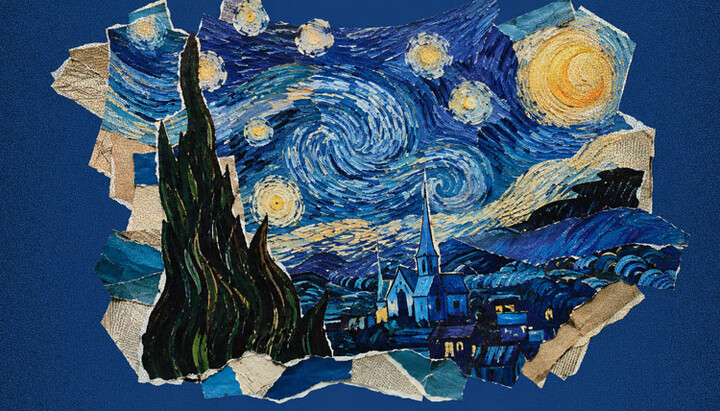
The Starry Night, Vincent van Gogh, 1889. Photo: UOJ
For decades, the pictorial subject of Vincent van Gogh's Starry Night has appeared on notebook covers, tableware, and various posters. The painting's wide reproduction has gradually obscured its deeper meaning. Indeed, what unfolds before us here is, in fact, the artist’s most honest sermon and confession of a wounded soul.
The morning Venus in the barred bedroom window
In May 1889, Vincent van Gogh voluntarily entered the Saint-Paul-de-Mausole hospital. This decision was preceded by a severe nervous breakdown, which ended in self-harm. Doctors still debate the precise diagnosis. Studies mention epilepsy, hereditary metabolic disorders, and severe addiction.
The patient was allocated two rooms in the hospital building. On the second floor was a bedroom with a barred east-facing window. On the ground floor was a studio where the windows had no bars. It was from the bedroom, in early June, that the artist first glimpsed the pre-dawn landscape that would form the basis of the future painting.
In a letter to his brother Theo, he noted: "This morning I saw the countryside from my window a long time before sunrise, with nothing but the morning star, which looked very big." In those days, the outline of Venus was visible above the horizon.
Van Gogh worked on the painting during the day, in the studio. The composition was assembled gradually, from memory. The painter combined his nocturnal impression, recent landscapes made from life, and a pencil sketch of the Saint-Rémy panorama made during a walk.
A сomposite image and nostalgia for the past
The dark silhouette of the cypress tree, visible on the left side of the composition, is taken from reality. A month before working on The Starry Night, Van Gogh had already painted a similar tree in a wheat field. The bright celestial body closer to the center does indeed correspond in size to the morning Venus.
The village at the foot of the hills is fictional. This settlement is considered a generalized image in which the real features of Saint-Rémy are intertwined with the artist's imagination.
The shape of the moon also differs from the astronomical reality. During the June nights above Saint-Rémy, the moon was almost full and gibbous. Van Gogh, however, painted a thin and delicate crescent. The artist sought to depict each element of the painting according to his own imagination.
A Dutch bell tower in a Provençal landscape
The most expressive part of the composition is the silhouette of the local church. The parish church of Saint-Rémy has a flat dome. In the painting, the dome is absent altogether. In its place rises a sharp, elongated spire. Experts from the Museum of Modern Art in New York assert that such bell towers are characteristic of Holland, the painter's homeland.
Other researchers believe that a deep longing for the northern lands would manifest in Van Gogh only later. They argue that the Saint-Rémy church did in fact have a spire and that the master invented nothing.
Be that as it may, the artist's choice resonates with his past. Vincent's father, Pastor Theodorus van Gogh, served in the Dutch Reformed Church. Vincent himself studied theology in Amsterdam, after which he went to preach among the miners of the Belgian Borinage. But the mission's leadership considered his behavior excessively fervent and inconsistent. Van Gogh was dismissed.
This rejection led him to seek other paths of service. At the age of thirty, he took up brushes.
His spiritual searching never disappeared. Van Gogh had previously written to Theo: "I have a terrible need – shall I say the word – of religion, and so I go out at night to paint the stars." Death appeared to him as a journey to distant celestial bodies, like a train ride.
Having completed The Starry Night, the artist maintained that his new works featuring stars and olive trees were "not a return to romantic or religious ideas." The experience of rejection by the Church made him cautious about any outward expressions of spirituality.
A vertical line amid the nocturnal storm
But the painting’s compositional structure suggests otherwise. The celestial ocean in the painting is seized by a powerful swirling motion. The stars burn at the centers of luminous vortices, the clouds spiral in whorls, and the distant hills resemble waves on the sea. The natural world depicted in the painting lives by the law of a cosmic storm. At the foot of the hills, houses with sleeping inhabitants lie still, unaware of the storm. The temple’s stark vertical spire and the cypress reaching upward symbolize eternal life, untouched by the storms of earthly existence.
The author's inner world during the periods between episodes of illness remains hidden from us. Vincent himself denied any theological subtext in the subject of his painting. Yet the clear vertical lines amid universal chaos speak for themselves.
The steadfastness of faith is often manifested in patience and silent standing. In hours of doubt and trial, our faith resembles this steadfast bell tower from Van Gogh's painting. The words of the Psalmist come to mind: "The heavens declare the glory of God; and the firmament sheweth his handywork" (Ps. 19:1). This canvas became a painted sermon on the courage of an artist who did not yield to temptations and struggled against them to the end.
Read also
Young Mother and Sleeping Christ
Michelangelo carved a Virgin Mary who looks younger than her Son – and signed his name in marble for the only time in his life. Neither of these peculiarities was accidental.
Orthodox books from a Uniate printing press
In the 18th century, Uniate monks at Pochaiv printed books used in prayer by Orthodox Christians and Old Believers alike.
The story of the honey brotherhood
The Mogilev Brotherhood began with members pooling money to brew honey drinks for feast days – and eventually grew to have its own printing press.
Golgotha in the midst of a pogrom
In the autumn of 1938, the Jewish artist Marc Chagall painted the crucified Christ. Synagogues burn and refugees flee around the cross, while the Crucified One Himself is wrapped in a prayer shawl.
Stories of the Early Church. Level of governance: patriarch
How did several episcopal sees rise above the rest, why did the Church’s administrative map come to mirror that of the empire, and is the patriarchate a sacred form of Church governance?
A Chronicle without an author
We are accustomed to calling The Tale of Bygone Years the work of St. Nestor. Yet another monk left his signature on it, while the chronicle itself passed from one generation of scribes to the next.